







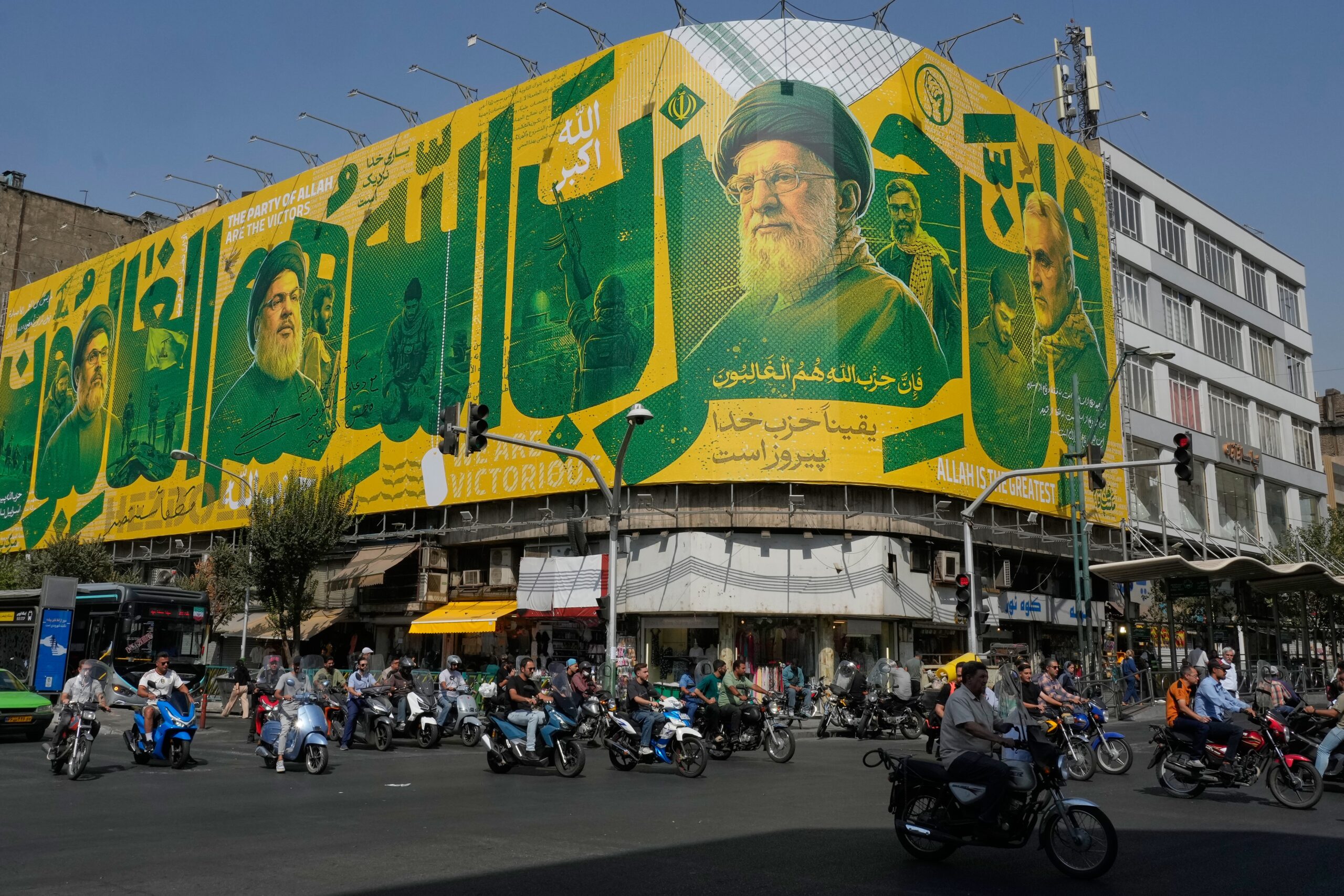

The war of words between the Trump administration and Iran is heating up as both sides appear to be engaged in a waiting game, trying to hold out until after the November 3 U.S. mid-term elections. Even so, both sides are preparing for an escalation in the fighting as President Trump has signaled attacks on Iran will resume after Nov. 3.
The elections will determine if President Trump’s Republican Party will maintain control over both houses of Congress, or if Democrats will grab one or both, either of which will present serious obstacles to the Trump agenda.
A Sept. 21 Reuters/Ipsos poll showed President Trump’s national approval rating at 32%, the lowest of his political career, and a 13-point drop to 73% among Republicans.
Israeli Prime Minister Benjamin Netanyahu also faces an election to determine if he will hold his seat as prime minister. Mr. Netanyahu—widely reported to have enticed Mr. Trump to join him in an unprovoked attack on Iran on Feb. 28—has been an absent party in the war since around late April after the initial attack, leaving the American military to pursue the war alone.
Mr. Netanyahu is currently the defendant in a corruption case involving bribery, fraud and breach of trust. If he loses his seat, much of his immediate attention will be drawn to defending himself and avoiding possible jail time. He has denied any wrongdoing.
The International Criminal Court has also charged him as a war criminal.
Dear U.S. citizens
Gen. Hossein Mohebbi of Iran’s Revolutionary Guard, in what was called a “letter to the American people,” addressed the upcoming U.S. elections directly. Iran has previously written letters to the American public, hoping to deliver a clear message on their positions.
Gen. Mohebbi told The Associated Press and Reuters the American people should take to the streets and protest the Trump administration’s war-mongering policies.
He said the U.S. uses Iran’s nuclear program as an excuse to “plunder” Iran’s wealth and turn the country back into a colony. The letter says Iran’s nuclear program is to advance technologies for its citizenry, not for a nuclear weapon, the main argument Mr. Trump uses for the war.
Iran and the U.S. defended their positions in the war as presidents of both spoke before the 81st General Assembly of the United Nations gathered Sept. 22-26 in New York.
Regarding the November election, President Trump said, “They’re (Iran) waiting to see how I do in the midterm election. What they don’t realize is I’m not running. … The Republican Party is running and I’ll be helping them.”
“I give absolutely no credence and will not give credence to the election when it comes to Iran. It doesn’t even enter my mind,” he said, in a speech critics say initially sounded like a “state of the union,” reflecting national accomplishments of the administration. The Associated Press fact check also noted Mr. Trump made “myriad false and misleading claims.”
Mr. Trump invited the world leaders to join him in enforcing an economic “D-Day” his administration announced in August to increase economic pressure on Iran to reopen the Strait of Hormuz.
Iran’s currency, the rial, reportedly has continued to fall to historic lows as the U.S. continues a naval blockade targeting Iranian oil exports while imposing additional sanctions aimed at restricting Tehran’s access to money and military supplies.
The U.S. president touted his Gaza peace plan and ceasefire negotiated between Hamas and Israeli forces (IDF), even though the IDF continues to fire missiles into Gaza, killing civilians. His Board of Peace recently announced a $2.45 billion plan to rebuild Gaza.
In response to U.S. attacks, Iran has inflicted severe damage to vital U.S. military bases and equipment throughout the Middle East.
Might makes right?
Mr. Trump has boasted of using military might to invade Venezuela, kidnap its president and first lady, and take control of that nation’s oil reserves. “Last month, we signed the largest oil deal in history, covering 65 billion barrels of oil, which will benefit both Venezuela and the United States,” he said.
He described the U.S. military as a force that will assert American power “where necessary in our region and around the world to create a safer future for us all,” a statement critics say should make nations nervous.
The UN was created after World War II as a forum for countries to discuss issues and avoid conflict, explained Dr. Wilmer Leon, a Morgan State University political science professor.
“We have a sitting American president coming to the UN talking about military force and using veiled threats of using nuclear weapons to annihilate a member state,” he said. “That demonstrates he doesn’t understand his audience or that he really has no interest in diplomacy.”
Regarding the upcoming elections, Dr. Leon said President Trump would be ill-advised to resume the fighting. “It would mean American body bags arriving at Dover Air Force Base before the election. That’s a very bad idea.”
The day after President Trump addressed the UN Assembly, President Masoud Pezeshkian of Iran said he adjusted his prepared speech because “yesterday, the United States president described us as terrorists. We have been the victims of terrorism.”
He said their Supreme Leader Ayatollah Ali Khamenei was assassinated by the U.S. and Israel “without any legal framework or reason.” Innocent children “whom, in truth committed no crimes, no sins” were killed at a school and at a sports facility by American bombs. (See related story on page 14)
“We have only defended ourselves. We are not terrorists. Our innocent people have been the targets of cowardly attacks and aggressions imposed upon our country,” he argued.
In Gaza, some 70,000 civilians have been killed “then they label us as terrorist. Are we the sources of instability? We only seek to live independently.”
“For the last two centuries Iran has not attacked any country or territory, but we have always defended ourselves,” President Pezeshkian said.
Iran recently offered a shorter version of a plan—the 14-point Memorandum of Understanding (MoU) signed by both presidents in June—that called for a seven-day cessation of hostilities and planned phased reopening of the Strait of Hormuz. Mr. Trump rejected the new plan outright, but Iran said it was reviewing the U.S. counterproposal at Final Call press time.
Iran’s latest proposal includes lifting the U.S. naval blockade and sanctions relief.
Meanwhile, Iran has rejected attempts to associate it with two incidents labeled “terror attacks.” Five “masked” men were arrested near England’s Royal Air Force Base, which is used by the U.S. to launch attacks on Iran. They were released on bail Sept. 28 without charge. Tehran has also rejected any association with an attempt to crash a passenger jet filled with Israeli citizens.
The copilot in a Sept. 31 FlyDubai flight from Dubai to Israel reportedly stabbed the pilot in an alleged attempt to take control of the plane and crash it. The plane landed safely in Saudi Arabia and at Final Call presstime, the identity of the copilot or motive was not known.
Some critics and podcasters have labeled the events as “false flag” operations to justify an attack on Tehran.
