











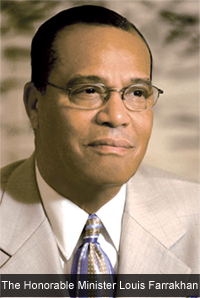
[Editor’s note: The following article is the first installment of excerpts from the address entitled “My Prayer, Sacrifice, Life and Death is All for Allah, The Lord of The Worlds, Part 1,” delivered by the Honorable Minister Louis Farrakhan on Sunday, October 27, 1991, at Mosque Maryam in Chicago, Illinois. To order this message in its entirety, please visit, store.finalcall.com or call 1.866.602.1230, ext. 200.]
In The Name of Allah, The Beneficent, The Merciful.
In The Name of Allah, The Beneficent, The Merciful. The One God to Whom all praise is due, The Lord of The Worlds. The Finder and the Life-Giver to us, the sleeping mentally dead nation in the wilderness of North America. We thank Allah for His coming in the Person of Master Fard Muhammad to Whom praise is due forever. And we could never thank Him enough for raising up in our midst the divine leader, teacher and guide, His messenger to us, The Messiah, The Exalted Christ, the Most Honorable Elijah Muhammad.
I greet all of you, my dear brothers and sisters, with the greeting words of peace: As-Salaam Alaikum.
We thank Allah for each and every one of you who are present here this afternoon. While I was out of the country last week, this thought came to me concerning today’s lecture. Those of us who are here, by the help of Allah, may, after the end of this lecture, consider yourselves fortunate.
Accept the nature in which Allah created you (a righteous Muslim)
The Honorable Elijah Muhammad taught us that all of us, by nature, are Muslim. No matter what you call yourselves, God has declared you to be the righteous. We respect the names that you call yourselves, but The Best Knower has declared that you all are Muslims.
Now, before you reject that beautiful title, or name, let us understand what The Best Knower has said about that name. It is an Arabic word; therefore, we are not Arabic speaking people, so we are not expected to understand it readily. But the word “Muslim” means “one who submits his will or her will entirely to do the will of God.”
This is not a faith that you accept, it is really the nature in which God has created you that our 400 years of servitude under White people has taken us away from. So, we are not asking Black people to be “converted” to Islam, we are only asking you to accept what is yours and be yourself.
What is yourself? A righteous Muslim. Those two words seem to be a double positive. If you are a Muslim in submission to the will of God, you are already righteous. So why did the Honorable Elijah Muhammad have to say that we are righteous Muslims?
[In English Lesson No. C1, the question is asked,] “Are there any Muslims other than righteous?” [to which the answer is given]: “I beg your pardon. I have never heard of one.”
Well, you know that if we are by nature Muslims, we are by circumstance other than our own selves. We are not righteous in our thinking, we are not righteous in our actions, even though we are righteous by nature.
But Master Fard Muhammad said, “I beg your pardon. I have never heard of one.” Somebody has begged our pardon. Even though we are born of the righteous, and are by nature righteous, we are, by circumstance, wicked; And if God does not pardon us, or have mercy upon us, then we would be destroyed along with our wicked oppressor. But God has pardoned our iniquities.
So, when you come to the Teachings of the Honorable Elijah Muhammad, it doesn’t matter what you did yesterday, your sin is forgiven. A merciful God has intervened on our behalf and forgives whatever we have done of evil under the influence of our oppressor.
The Oath (Prayer) that we, as righteous Muslims, are required to make bond
The subject matter that I was given deals with a part of a prayer that each Muslim recites, at least each follower of the Honorable Elijah Muhammad recites, and this becomes an oath that we take. As members of the F.O.I. and members of the M.G.T. Class, we take this as an oath, but it is a part of our prayer, and it is recited like this:
“My prayer, my sacrifice, my life and my death are all for Allah, The Lord of The Worlds.” That is a powerful expression, “My prayer, my sacrifice, my life and my death are all for Allah, The Lord of The Worlds.” Then we say: “No associate has He, and this am I commanded and I am of those who submit.”
When a person makes that kind of oath, there is a lot required of that person.
Let’s pay attention to the words again: “My prayer, my sacrifice, my life and my death are all for Allah, The Lord of The Worlds.” Now, to our visiting brothers and sisters, you may call God by a different name.
Some say “God,” some say “Jehovah,” some say “Shiloh,” some say, “God Almighty,” some say “Christ,” but whatever name you call Him by, all of the best names belong to Him.
But when you add all of those names together, we say the proper name of God is “Allah,” which means The One True God, The Originator of the heavens and the earth and all things in existence; The Creator. “My prayer, my sacrifice, my life and my death is all for Allah.”
Now tell me: What is an oath? If we are taking this as an oath, what is an “oath”? According to the dictionary, an “oath” is “a solemn appeal to God to witness one’s determination to speak the truth”; “a statement or a promise strengthened by such an appeal.”
When you go to court, you have to swear to tell the truth. When you take an oath of initiation into any organization or group that gives oaths, that should be a solemn appeal to witness our own determination that what we are saying, it is the truth, and we’ll do everything within our power to live up to the oath that we are taking.
“My prayer, my sacrifice, my life and my death is all for Allah, The Lord of The Worlds.” I can’t take an oath for my brother. I can’t take an oath for my mother. I can’t take an oath for my friend. An oath is something that each individual must make for his- or herself. “A solemn appeal to God to witness our determination to speak the truth.”
Allah knows whether we are liars or whether we are truthful. All of us have made pledges and broken most of them. Some of us have taken oaths and broken those. Some of us have taken vows to God and broken those. So if we break an oath or a vow, or a pledge to God, then nobody else has a chance.
But we as Muslims are taught in our Lessons: “Have not you learned that your word shall be Bond regardless of whom or what?” And our answer is: “Yes. My word is Bond and Bond is life, and I will give my life before my word shall fail.”
God, and His integrity, is wrapped up in His word! When God says a thing, you can bank on it! You can believe in it, you can trust in it, you can stand upon it, because God does not lie! Whatever God says, He already has the power to do it. And when He says it, it’s already a thing accomplished; all we have to do is be there if we are in the time of its fulfillment.
But consider this: Since we use the possessive pronoun in front of “prayer,” “sacrifice,” “life” and “death,” why should we use the possessive pronoun “my”? What do you really possess?
Think about it. What you are, or we are, you (we) had nothing to do with it. You don’t own the flesh that has made up your body. You don’t own the bones nor the blood. Do you? It’s not yours. The scriptures of the Bible teach, “It is a sure thing, you bring nothing into the world, therefore you can take nothing out.”
So, what did you own coming in here? Nothing! Nothing. The flesh that is on our bodies, it must return where? To the earth. The bone returns to the earth. The air that we breathe returns to the atmosphere. Come on! So what do you own? Nothing!
But yet, God gives us the privilege to say, “My prayer, my sacrifice, my life and my death.” Since we don’t own anything then my life is not really mine. Death is ordained. I didn’t bring myself into the world, nor can I take anything out. Then why should the term “my” be used?
In law they say, “possession is nine-tenths of the law,” meaning that the fact that someone possesses something carries a weight of 90 percent; that they are the legal owner of it. Possession doesn’t necessarily mean that it belongs to you, but it means that you have control over it.
Here, now, this is your life, this is your body: How much control do you exercise over what God has given you? When we first come into the world, our parents exercise control over this [our body]. They have a right to exercise control over it.
But the duty of the parent and the duty of the teacher is to steward that life in such a way that at a certain point that child will be mature enough to gain control over themselves.
So, this [body] that God has given you, He has given you a responsibility to control it; to become the manager of your flesh, the manager of your mind, the manager of your will, the manager of your talents, the manager of your gifts and the manager of your destiny.
Each of us, whether we believe it or not, has a great measure of control over our prayer, our sacrifice, our life, and we have a measure of control even of our death. We actually can determine not necessarily the time, unless you are suicidal. You actually can determine the spirit of your death; the way you expire. You can actually determine it.
I don’t mean whether you will die by gunshot or die by hanging; no, no, I don’t mean that. But I mean you can determine the state that you will be in at death. Mm! That’s powerful, to have that kind of control that you can determine the state that you will be in when death comes.
‘My Prayer’: The reaffirmation of our desires
“My prayer, my sacrifice, my life and my death is all for Allah, The Lord of The Worlds.” Now let’s deal with this word “prayer.” Many of us don’t think we “pray,” but there’s not a day that goes by that you don’t say a prayer—you don’t even recognize that it is a prayer!
According to a dictionary, they say that “prayer” is “a devout petition to and a spiritual communion with God or an object of worship.” Stop right there. It could be a connection to God, but it could be a connection to anything that you worship as a partner or associate with God. Also, “prayer” is “an entreaty, a supplication, thanksgiving, adoration, or even confession.”
Now look, I want you to bear with me … And I pray that Allah will bless every word that I speak in His Name, that it may mean something to you and me, and that we will be edified by what we hear and go away better than when we came in.
The Qur’an teaches us that Allah created us “complete, yet incomplete.” Anytime you are “incomplete,” you are imperfect. God created us in need, so anytime you are created in need, then there must be a supplier of what you need.
When a baby cries because it needs changing, or it’s hungry, the baby doesn’t know how to say, “O Allah!” But when the baby cries, that is its sincere supplication to somebody that can satisfy their need.
They didn’t put their hands up in a certain way, fold them in a certain way, go through certain rak’as, or positions of prayer. Their position is laying on their back, crying to the top of their voice. That is a prayer!
And when you hear the baby cry, then out of compassion that God has put in you, you answer that baby. If it’s a change of a diaper, if it is food, if it is something that is irritating the child, you try to remove it to give comfort to that child.
The child may not know how to say, “Thanks ma,” but it shows you, in its development, a “coo,” and it learns to smile, and to say to you in its way, “Thank you.”
Gratitude is absolutely a requirement of God, that when you are given something you have to say, “Thank You.” When you receive something that you could not give yourself, God requires of you and me to be grateful.
Each of us receives something every day that we could not give ourselves, “but little it is,” The Qur’an says, “that we give thanks. Surely man is ungrateful.”
Since we are created in need, then every day we are asking somebody for something. We are human beings that are creatures of desire. Don’t you want something? Everybody in here wants something, don’t you? You do, don’t you? Sure, you do! I do.
Then if you want something, then you have to find the supplier of what you want. If you wake up this morning and you want some drugs, and you don’t have none in your possession, what do you gotta do? I’m putting it on, you know, in simple terms, brother. You’ve gotta go look for the supplier. Is that right?
Now the supplier may have what you want, and you have what he wants. He wants from you some money, and then he wants to make you addicted so that every day you’ll look for him. He doesn’t have to come looking for you, you will find him wherever he is when you need a fix. Then he becomes your supplier of your need.
Prayer is the reaffirmation of desire. We hang on to what we want in life by reaffirming or reidentifying our desire until we reach our goal. But if impatience comes and we don’t reach the goal as quickly as we desire, and we become irritated, which may threaten to cause us to turn away from our goal.
Then who do you go to, to reaffirm your desire so that you can endure the struggle to reach your goal? You go to The God, Who is The Author of desire. And when you go to Him, He gives you strength to endure another day as you move towards your goal.
‘My Prayer’: The way we express gratitude to The Supplier of our needs
The Honorable Elijah Muhammad gave us a prayer to say, and he said we should say it seven times a day. And at the end of that prayer, it reads: “O Allah! Suffice Thou me with what is lawful. Keep me away from what is prohibited. And with Thy grace, make me free from want of what is beside Thee.”
The beauty of that prayer is that a Muslim does not want to be dependent on any supplier that is another creature. The Muslim wants to depend on The Creator. The Muslim will thank God for one of the creatures through whom his wants or needs are supplied,
But he is never blinded by the intermediary; he always is grateful to The Source. A Muslim doesn’t want anything outside of what pleases God. That’s what makes a Muslim so special.
What do you want? If what you want is in the purview of what God’s will is, then you are on a right course. But when you desire things outside of God’s will, then you cannot expect His help in getting your desire.
Every day we seek something that we need. Some of us need a job. When you need a job, what do you do? You get up, you go downtown, or you go somewhere, you knock on a door, you fill out an application and you hope that that person will give you a job. You went to the middleman. You didn’t reach The Source.
Look. Brother, have you watched children when they want something? They [say,] “Gimme!” When you go downtown and you see a beggar, or a blind person with a cup, they’re shaking the cup, but it’s like in this (hands cupped) position.
Every time you ask, that’s a prayer. Who are you praying to? Do you follow what I’m saying? If you ask Brother Farrakhan for something, and I am able to give it to you, you should say, “thank you.” But Who should you thank first and foremost? Allah (God)! In fact, before you even come to Brother Farrakhan, or anybody, you should go first to God. I’ll tell you why in a minute.
Every time we look to somebody to help us meet our needs or our wants, that person is being placed by us in a position of power over granting what we desire. We are constantly seeking someone to aid us in the various relationships, a husband to a wife and a wife to a husband.
A parent to a child, a child to a parent, a teacher to a student, a student to a teacher, an employer to an employee, and vice versa. We find ourselves always looking to someone to help us.
But we must be careful when we look to somebody to help us, because then when they give us help we are now putting them in a position of power over us by supplying our need. Are they worthy of that?! …
When we give the power of our being over to those who facilitate our desire, not recognizing that they are not The Source of this, then we have a tendency to set up other gods beside Allah.
And this is hateful in the sight of Allah, that we would take someone of the creatures that supplies our need and then give the power of our being over to somebody who is, in another sense, as much in need as we are!
When you and I give the power of our being over to somebody else because they gave us something that we needed, we have set up another god beside God. Then in this, we have become polytheists—and God is ever against polytheism.
And so many of us who declare The One God are polytheistic. So many who declare Jesus are polytheistic. You talk Jesus, but you bow down to white folks! You talk God, but as soon as you have a need and somebody supplies that need, you start falling down, worshiping.
We worship our preachers. We worship our teachers. We worship our leaders. Wrong! Every teacher, every preacher, every leader, every messenger, every prophet of God is nothing more than a servant of God!
Why worship the servant when you can worship The God Who gave you the servant?! This is why we are always disappointed when our leaders die and leave us in the lurch. “O leader! Where are you?” “Well, I didn’t tell you to worship me from the beginning.”
If he’s any kind of leader, he will not allow you to worship him. If he’s any kind of teacher, he will move you beyond himself! If he is a prophet of God, he is not there to represent himself, he is there to represent The God.
Then look at the mistakes that the worshipers have made. The Jews sometimes talk more of Moses than of Jehovah. The Christians talk more of Jesus than they do of The Father. And Muslims, I must say, you talk more of Prophet Muhammad, peace be upon him, than you do of Allah.
And when the prophet’s name is mentioned, there is a clamor in the mosque. When Allah’s name is mentioned, quiet. When Jesus’ name is mentioned there is a clamor in the church! When The Father’s name is mentioned, it’s quiet. You worship what God has given but not The God Who is The Giver of the gift!
Allah says He is The Granter of Security. He said He is The Life-Giver. He is The Beneficent. He is The Merciful. He is The Forgiving. He is The Lord of Grace. He is The Controller and Manager of All Affairs. He is The Author of All in Existence.
And He is The Nurturer of All Things, making them attain stage after stage until they reach perfection. God uses His creation to satisfy our wants and needs, but we should never give the honor to the creature before we give it to The Creator.
To be continued.
