









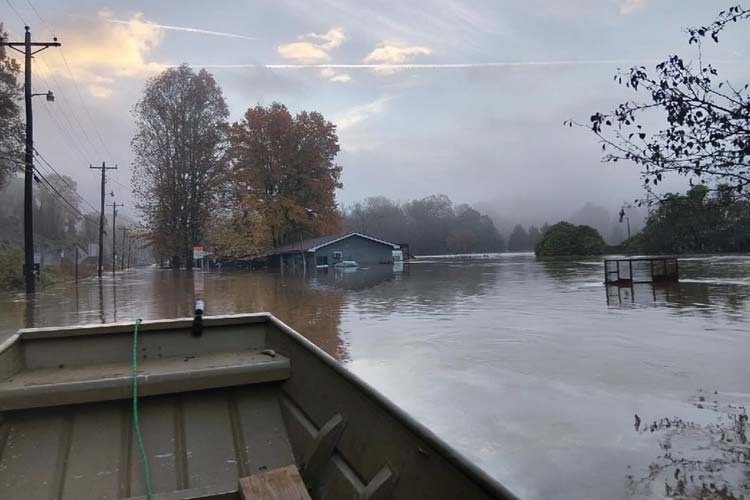

Flooding recently impacted parts of Georgia and Tennessee, causing road closures and other problems. On Nov. 4, 8 to 10 inches of rain fell on the mountains where Georgia and Tennessee meet. By early Nov. 5, water from the Toccoa River had poured into McCaysville, Ga., and Copperhill, Tenn., two small towns on the state line.

The river rose higher than ever re-corded there, to just over 18 feet. Water stood 6 to 7 feet deep downtown and rose over the roofs of some homes, according to McCaysville Police Chief Michael Earley. Crews made more than 140 rescues by boat and helicopter, Georgia and Tennessee officials said.
However, when the water receded, the trouble stayed.
McCaysville’s water plant stopped working. Families were told to boil their water before drinking it. Copperhill asked people to conserve water while the state worked to restore drinking water. Both towns closed to visitors and set a nighttime curfew. Schools closed. The Copperhill post office shut down.
At least six buildings caught fire during the storm. Officials believe lightning started them.
Georgia Gov. Brian Kemp declared an emergency in four counties, and Polk County, Tenn., declared one, too.
The Toccoa becomes the Ocoee River in Tennessee, the same river that hosted whitewater races in the 1996 Atlanta Olympics. Near Copperhill and Ducktown, Tenn., the river runs through an old copper-mining area that operated from the 1840s until 1987.
The mines left so much damage that the EPA lists the area as a Superfund site, a polluted place under federal cleanup. Tennessee says routine testing has found no current water problems from the old mines for people using the river. No agency has yet said whether this record flood stirred up old pollution.
New Mexico has also been impacted by flooding. In September, a flash flood near Newcomb, N.M., killed two adults and a child, Navajo police said.
Then, starting Oct. 22, storms pushed the San Juan River to historic levels. At Shiprock, N.M., it rose above 23 feet. Major flooding there starts at 20.5 feet. Upstream in Farmington, it reached about 14.5 feet, where major flooding starts at 12 feet.
Law enforcement officers made hundreds of water rescues between Farmington and Bloomfield, the office of New Mexico Gov. Michelle Lujan Grisham said. On Nov. 1 and 2, another storm flooded the region again.
What the water left behind
Untreated wastewater got into the San Juan River when floodwater reached Bloomfield’s treatment plant, Gov. Lujan Grisham’s office said. Downstream in Montezuma Creek, Utah, the Navajo Tribal Utility Authority said its wastewater ponds broke open. It told people to stay out of the river and asked people on that system to use less water.
Evacuated neighborhoods in San Juan County, N.M., stayed closed for days. Officials pointed out damaged buildings, dirty water, downed power lines and possible gas leaks.
In Utah, the flood washed out a bridge on Highway 163 near Bluff . In Colorado, the supports under a bridge on U.S. 160 collapsed, and the bridge must be rebuilt. A natural gas pipeline was damaged, and cell phone service went out for a time, Colorado’s governor said.
New Mexico’s governor says recovery could cost $200 million to $300 million. The federal emergency declaration does not pay for clearing mud and wreckage, her office noted. San Juan County expects that work alone to cost $230 million to $240 million.
In California, no storm came ashore. However, extra-high tides, called king tides, rode in on warm ocean water and flooded streets in Newport Beach and Huntington Beach.
On Oct. 27, Los Angeles Harbor saw its highest water level since records began in 1923, the National Weather Service said. Forecasters said the tides ran up to 1.7 feet higher than pre-dicted.
In Huntington Beach, seawater damaged about 114 homes and buildings, the city said. Six homes were yellowtagged, which limits who can go inside for safety reasons.
The city warns that tides in late November could be even higher.
Flooding also affected parts of Florida after heavy rain, forcing the move of 21 midterm polling locations.
AccuWeather preliminarily estimated total damage and economic loss from the devastating rainfall in Florida at $3 billion to $5 billion. Rainfall totals of 28.93 inches in Malabar and 28.13 inches in Palm Bay were recorded.
AccuWeather also reported that public schools closed in Brevard, DeSoto, Indian River and St. Lucie counties, according to the Florida Department of Education.
“For some Palm Bay residents, the flooding brought another hardship: water shutoffs. A water-main break along Port Malabar Boulevard NE forced the city to temporarily interrupt service to affected customers … . Officials said 4 feet of water prevented crews from accessing the repair site,” the weather service reported.
‘Watch the weather!’
The Most Honorable Elijah Muhammad, Eternal Leader of the Nation of Islam, warned that Allah (God) would punish America with the forces of nature for its evildoings and wickedness.
In His book, “The Fall of America,” in Chapter 35, titled “America Surrounded with The Judgment of Allah,” the Most Honorable Elijah Muhammad wrote: “The four great judgments that Almighty [God] Allah is bringing upon America are rain, hail, snow and earthquakes.”
His National Representative, the Honorable Minister Louis Farrakhan, has warned America many times to ‘watch the weather.’ In his Oct. 14, 2012, address “Guidance for Our President and Our Nation,” Minister Farrakhan cautioned, “I said again, ‘Watch the weather!’—because God doesn’t fight with your cheap ‘weapons’!”
Student Minister Abdul Haleem Muhammad, the Nation of Islam’s Southwest Regional Student Minister and an urban planner, spoke with The Final Call on Nov. 6, days after the Nov. 3 election. “The weather is a sign that, in spite of the political victories that we seem to enjoy, God is sending us a signal that He’s still displeased with this nation,” he said.
He pointed to the Holy Qur’an, the Islamic book of scripture, Surah (Chapter 2, Ayat verse 153), which states, “O you who believe, seek assistance through patience and prayer. Surely Allah is with the patient.”
“Ofttimes we’re not patient with Allah, and we have to learn how to balance our spiritual and temporal desires,” he said. America, he said, is facing “afflictions in the form of His judgment raining down on America.”
Minister Farrakhan, like his teacher, has continued to be a warner to America and the nations of the Earth. “America is surrounded with the Judgment of God.
Climate control is very important in the context of war, but there’s no space on this earth that has received as much calamity from weather as the United States of America. Water glaciers are melting. Some of these glaciers are the size of some small states.
When you see a water glacier, what you see on top is nothing compared to what is on the bottom. So, when the top falls off , the bottom rises. And when the top begins to melt, the water rises,” Minister Farrakhan said in his July 2019 message, “The Man Jesus and How Not To Fall Into Idolatry.”
“So, the Honorable Elijah Muhammad said the Holy Qur’an bears witness that Allah would curtail this place on both sides. He said he wouldn’t buy anything on either coast, because the coasts are going to be flooded.
You heard it first here. Now watch the news bear witness that a Messenger of God, a man taught by God, is telling you things that are and things to come,” said Minister Farrakhan.
