







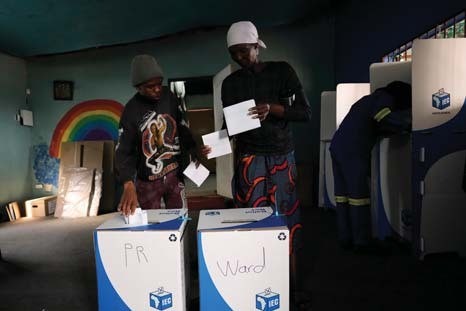

While United States midterm election results turned many city and state governments from red (Republican) to blue (Democrat), South Africa’s municipal elections held Nov. 4 were seen as a gauge of public mood ahead of the 2029 national polls.

According to reporting by the Associated Press, South Africa voted in local elections that are “expected to be a tough test for the African National Congress (ANC) party, which led the country out of White minority rule but has seen a consistent decline in support over the last decade.”
The UK-based The Guardian noted that the ANC is on course for a bruising result in South Africa’s local elections as voters go to the polls amid deep discontent over water outages, power cuts and crumbling infrastructure.
The ANC remains South Africa’s largest and most influential party, but polls increasingly show its rating in decline. According to The Guardian, the ANC’s popularity was “down from 45.6 percent at the last municipal elections in 2021 and 40.2 percent in the 2024 national elections.”
Redge Nkosi is based in Pretoria and is the founder and executive director of First Source Money and Public Banking of South Africa. In an interview with this writer, he explained that “The South African elections are a testament of local elections and who is going to take charge.”
“The dynamics won’t change collectively with the African, or what you call the Black vote. Many people are disillusioned with the ANC, but they are not fundamentally going to accept the Europeans to rule over South Africa,” said Nkosi, a former member of the Nelson Mandela administration.
He added, “At the local elections, that’s one thing, but at the national elections, there is no European party, including the Democratic Alliance (DA), able to claim the African vote.
“People are not enchanted with the service delivery. One of the reasons is because the ANC decided to work with the International Monetary Fund and World Bank with their budget systems.”
Many critics, including left-wing factions, trade unions, and civil society groups, argue that the ANC’s early decisions adopted neo-liberal economic frameworks influenced by global financial institutions, while others contend that local governance failures, corruption, and structural apartheid legacies are the primary drivers of poor service delivery.
During closed-door negotiations between 1990 and 1993, ANC economists compromised on economic sovereignty to secure a peaceful political handover. The consequence was that while Mandela may have won political freedom, corporate and macroeconomic control remained largely in the hands of the pre-existing White economic elite and international financial hubs.
The ANC Department of Economic Policy received foundational training at the Wall Street investment firm Goldman Sachs. During training from the investment firm, the ANC transitioned from its original liberation ideals (such as the wealth-redistribution goals of the 1955 Freedom Charter) toward Westernaligned, neoliberal economic frameworks.
Turning to the U.S., Nkosi referred to President Donald Trump’s recent communique to South African President Cyril Ramaphosa. According to Newsday, the communique, issued on November 2, said that the U.S. removed South Africa from the African Growth and Opportunity Act (AGOA).
“This means that South Africa will lose its duty-free access to the United States in many key sectors, including agriculture and vehicle manufacturing,” reported Newsday. ca.za, a South African general news publication and digital platform.
U.S. Ambassador Jamieson Greer, a key member of the cabinet leading U.S. trade policy, tariffnegotiations, and international trade enforcement, issued the statement following President Trump’s notices to Congress and the South African government.
President Trump’s communique to President Ramaphosa did not explain why South Africa is being removed from its duty-free status.
South Africa’s local elections include more than 600 political parties, and in some areas for the first time ever, we will see 60 candidates competing for one seat. Those extremely high contestant rates re-flect a governance crisis.
Corruption and poor service delivery in municipalities have led community leaders to say they will establish their own political parties or stand as independent candidates, pledging to be different from the current ruling party.
According to The Guardian, “South Africa’s electoral commission will have a week to announce the final results of Nov. 4 vote’s, which chooses councilors and parties, with mayors not directly elected.
Parties will then have two weeks from the announcement to form councils and elect mayors.” The ANC’s continued standing, influence, and power hang in the balance.
Follow Jehron Muhammad
@Africawatchfcn on X
