











NEW YORK—A food fight has erupted in New York as the National Supermarket Association and independent grocery store owners launch a federal lawsuit against New York City Mayor Zohran Mamdani in response to his plan to introduce city-run grocery stores.
The federal lawsuit, filed on Sept. 8 in the U.S. District Court for the Southern District of New York, alleges that the administration’s planned discounted grocery stores constitute illegal predatory pricing and antitrust violations.
Since launching his 2024 mayoral campaign, Mr. Mamdani has centered his platform on restoring affordability across New York, which is currently ranked among the top 10 most expensive states in the nation.
Since winning office, the mayor has embedded an ambitious “Affordability Agenda,” designed to lower daily expenses for working-class New Yorkers burdened by the surging cost of living, into the administration’s policies.
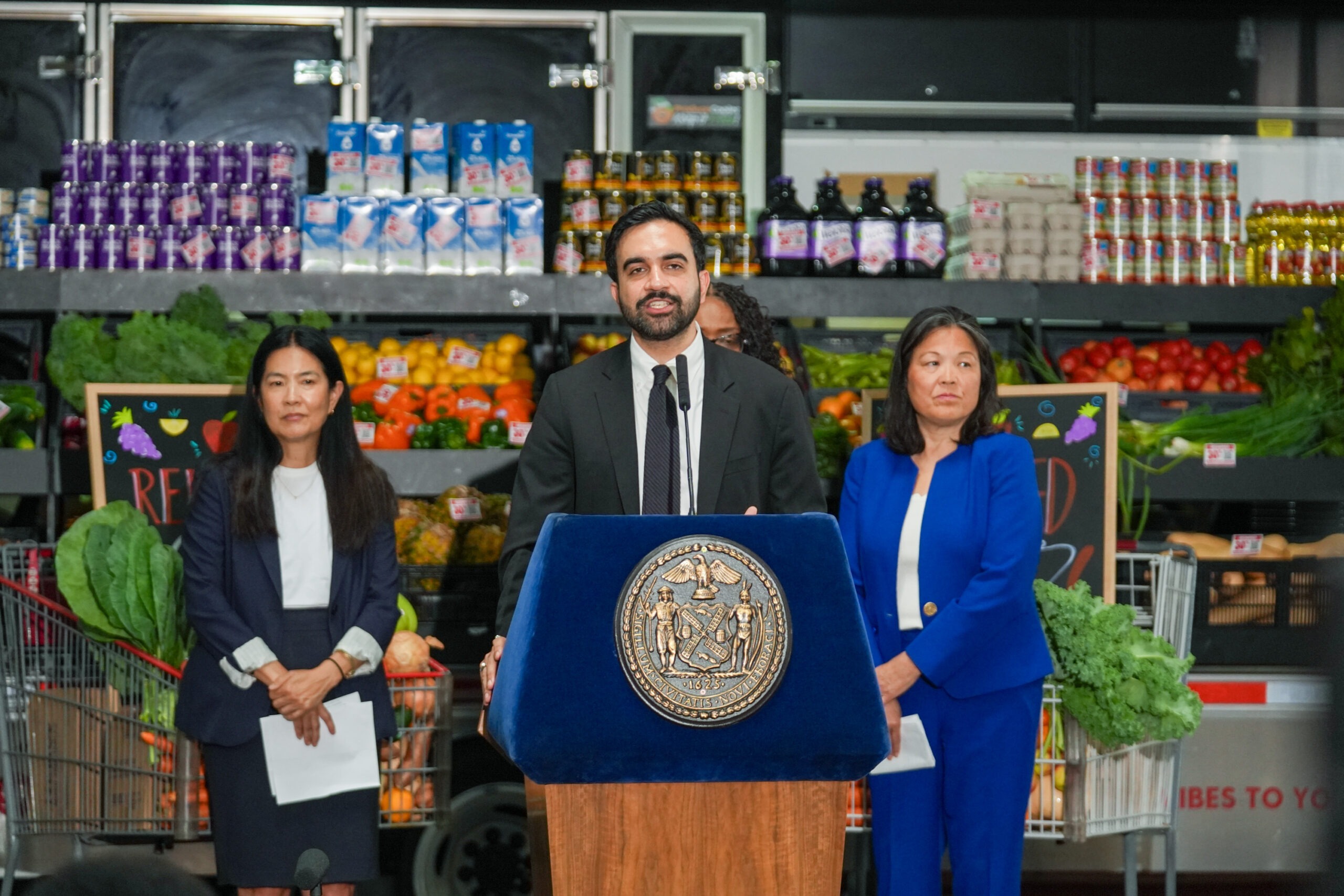
As one of the latest expansions of the administration’s broader agenda, Mayor Mamdani announced that his office, along with other New York officials and the NYC Economic Development Corporation (NYCEDC), are proposing a new grocery store initiative, the “N.Y.C. Groceries: Recipe for Affordability.”
The proposal aims to use $70 million in public capital funds to build one municipally owned store on city-owned property in each of the five boroughs: Manhattan, Brooklyn, Queens, the Bronx, and Staten Island.
The stores would offer a 30% discount on essential goods like meats, dairy products, fruits and vegetables. The goal is to combat the average rise in grocery prices in New York since 2020.
While the mayor, who was sworn in Jan. 1 of this year, says this initiative will lower the cost of living for New Yorkers, attorneys and supporters of the lawsuit against him claim the plan would leave private grocery store owners with a larger bill to pay in an already financially taxing industry.
The city’s grocery stores would not pay rent or property taxes and would receive substantial municipal financial support. This would allow them to lower prices without adding financial strain. Local grocers, which must pay for everything from rent to electricity bills to full price on staple goods, simply cannot afford to lower their prices.
The lawsuit claims that the mayor’s proposed city-run grocery stores’ low prices would create unfair competition for small local markets.
Mark Jaffe, is President and CEO of the Greater New York Chamber of Commerce. He told The Final Call that the greater concern is that if local marketers go out of business because they can’t compete with the government’s low grocery prices, city-run stores would then begin to hike prices. This could create a monopoly in the New York food industry, supporters of the lawsuit argue.
The National Supermarket Association’s federal lawsuit comes just weeks after the Multicultural Business Coalition filed two state lawsuits to block the establishment of Mayor Mamdani’s plan.
The Multicultural Business Coalition’s first lawsuit argues that the plan violates the civil rights of local business owners. The second challenges the city’s authority to launch the plan without conducting proper economic reviews or assessments.
Still, despite the pending lawsuits, critics say they are looking for tangible collaboration with the mayor’s office.
“We could avoid all of these lawsuits if the mayor would just sit down with us and say, “How can we best help business in New York? That’s really what it comes down to. But to date, the mayor’s office has not wanted to sit down and do that,” Don Rogeriers, strategic advisor to the Greater New York Chamber of Commerce, told The Final Call.
“When you really look at it from a New York economic perspective and how that impacts the businesses in New York, it’s simply not fair to use taxpayer-funded money to compete with businesses who are struggling,” he added.
Mayor Mamdani, meanwhile, maintains his confidence in establishing the city-owned stores. During a city press conference on Aug. 24, he said in part, “I continue to be fully confident in both the legality and the importance of our initiative to deliver five city-run grocery stores, one in each borough, to the people of our city.”
“We are talking about a reflection of a cost of living crisis that has seen grocery prices increase by about 30% over the last few years, and we’re also talking about delivering five city-run grocery stores in a city of 8.5 million people that has more than a thousand grocery stores,” he added.
“And we’ve seen, in fact, with Essex Street Market in Manhattan, as well as, more Street Market in Brooklyn, a model where the city has subsidized groceries and it has not had a negative effect on bodegas around them or on grocery stores around them,” said Mayor Mamdani.
The first city-run grocery store is slated to open by 2027 in Hunts Point, a historic food desert, replacing the former Spofford Juvenile Detention Facility on 20,000 square feet of municipal land in the Bronx.
