









Officials still mum on why restoring power was delayed
GARY, Ind.—For the first five days after the Aug. 11 derecho that caused widespread damages and power outages in Northwest Indiana, every household Sister Alva Muhammad checked on was still in the dark. Then one person’s lights came on. The next day, another household was restored.
Members of the Nation of Islam Gary, Indiana, study group celebrated each small victory while continuing to check on those still without power. It was a quiet, block-by-block rhythm of watching out for one another that would define Gary’s recovery long before utility crews finished their work.
“We took care of one another,” she said. “And that, to me, was the most beautiful thing that I saw in all of the weeks without power.”
That instinct—neighbors organizing for neighbors, before government aid arrived and long after headlines moved on—is the story Gary is telling about itself now.
Weeks after one of the most violent storms in Northwest Indiana history, with utility poles broken and hundreds of thousands of customers plunged into darkness, what residents describe isn’t chaos.
It’s a city that fed itself, checked on its elders, cleared its own streets, and found out exactly who its neighbors were. And it’s a city now asking, with that same unity behind it, why the outage lasted as long as it did.
What people needed, and what people gave
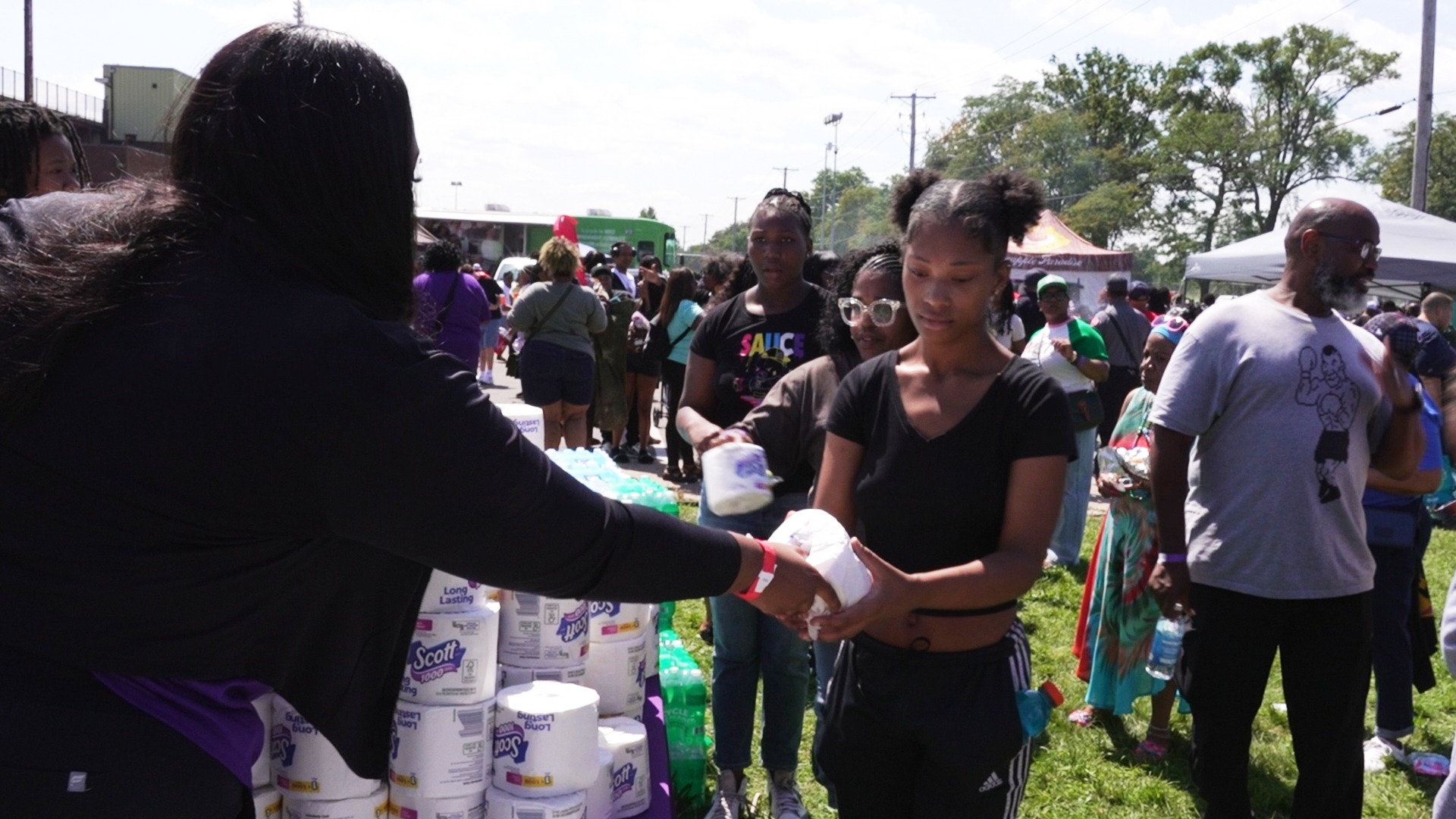
The first days after the storm brought the obvious emergencies: food, water, gasoline, baby formula, phone charging. Then the outage aged and the needs changed, turning toward refrigerated medicine, oxygen tanks needing refills, seniors without transportation to pharmacies that still had power. Gary eventually supplied oxygen to more than 75 residents from the city and surrounding communities.
KC Thompson, known as DJ KCeaser, who lost power for 14 days like much of the city, spent that time in the streets. His social media became an informal dispatch center: “Gary, what do you or someone you may know need today?”
He’d post, and residents would ask openly for rides, food, supplies, wellness checks, or simply somebody to talk to. Weeks later, he was still coordinating: volunteers with chainsaws, school-supply deliveries, relief crews working block-by-block to clear trees that had been lying in yards since the storm.
“This storm has brought us out,” he said. “It takes a village and it was deeper than a child. We all children.”
What struck him most was watching people who had lived beside each other for 20 or 30 years without speaking, suddenly learn who among them was a plumber, an electrician, or simply someone willing to help.
Houston rapper and activist Trae Tha Truth, who brought tractor-trailer loads of supplies to Gary and worked alongside local crews cutting downed trees, put it plainly: “Everybody needs to play their part.”
Refusing the rumors
Part of what Sister Alva Muhammad did during the outage was less visible but just as important: she policed the truth. Using what cell service she could find, she distributed only information she could personally verify, by phone, by seeing it herself, or from a source she trusted directly.
“I did not want to spread rumors because there was already plenty of that going around,” she said.
That mattered, because rumors were circulating that Gary was descending into lawlessness. She said that wasn’t what she saw. “There was no rioting in Gary. There was no chaos in Gary. There was no widespread looting in Gary. There was no crime spree in Gary,” she said.
Instead: neighbors setting up grills and feeding strangers, businesses without electricity still finding ways to provide food, residents carrying water into neighborhoods where wells had stopped working because their pumps needed power to run.
In a disaster, misinformation can spread as fast as the emergency itself. Gary’s response was to counter it, house-by-house, with verified fact and shared labor.
A church built for exactly this moment
One institution had prepared for this kind of failure years in advance. Progressive Community Church installed solar panels roughly a decade ago and, more recently with help from the American Red Cross, added battery backup capability. So, when much of Gary went dark, the church didn’t, and it became an anchor almost immediately.
Calls came quickly. The Red Cross wanted to set up there. City representatives asked to use the site. Fire personnel needed operational space. “We heard y’all got power,” Pastor Curtis Whittaker remembered people telling them.
Ms. Freida Graves, a lifelong Gary resident and director of Food as Medicine for Faith CDC, said the church was able to provide food, electricity and charging while other facilities in the city struggled to offer the same.
Pastor Whittaker said the experience has only sharpened his sense of what Gary’s institutions owe each other going forward: resilience hubs, churches, schools, community centers, equipped with solar generation, battery storage, refrigeration for food and medicine, and charging stations, so that “when the grid goes down, our communities don’t have to go down with it.”
The church is now advocating for a community-scale solar farm and microgrid near its property, an effort Pastor Whittaker estimates at roughly $10 million, a bet that the next crisis should find Gary readier than this one did.
The unity is turning into a demand
That same solidarity that fed neighbors and cleared streets hasn’t dissolved now that the lights are back. It has shifted into a shared, pointed question: why did this take so long, and could it have been prevented?
At the center of that question sits a number nobody in authority has yet been willing, or able, to provide: how much of Northern Indiana Public Service Company (NIPSCO) documented tree-trimming shortfall was sitting in Gary when the storm hit.
State records establish the shortfall clearly at the system level. NIPSCO told the Indiana Utility Regulatory Commission (IURC), it planned to trim vegetation along more than 1,263 miles of power lines during the prior year, but completed only about 954, a gap of roughly 309 miles.
Or about a quarter of the plan, left undone heading into storm season. NIPSCO says its vegetation-management spending has more than doubled since 2016 and that the company is targeting a seven-year trimming cycle budgeted at roughly $27 million to $29 million a year.
What none of that discloses is where those 309 uncompleted miles were. NIPSCO’s service territory spans Northwest and North Central Indiana; the 1,263-mile plan and the 954-mile completion figure are both territory-wide totals, not a city-by-city accounting.
No public filing, company statement or regulatory record reviewed by The Final Call breaks the shortfall down by circuit, county or municipality. That means the claim animating much of Gary’s grievance, that its trees, specifically, were the ones left untrimmed, has not actually been confirmed or denied by anyone with the data to do it.
That silence is now part of the story. Gary absorbed the largest outage event in NIPSCO’s history: about 375,000 customers knocked out, with the city among the hardest and longest hit. If Gary’s circuits carried a disproportionate share of the system-wide shortfall, that would be a serious finding.
If Gary’s trimming was actually current and the outage was purely a function of storm severity, that would matter too. Right now, the record supports neither conclusion, only the fact that the question hasn’t been answered.
Rev. Whittaker’s Change.org petition, “Tell NIPSCO to Slash Residents’ Bills After Two Weeks Without Power,” had gathered 950 signatures toward its goal of 1,000 as of the latest count.
It calls for automatic outage credits, reimbursement for spoiled food and medication, extended protection from disconnections, and fewer regulatory barriers for churches and nonprofits seeking solar and battery systems.
But beneath its specific asks is a simpler demand: an answer. Not a territory-wide average, not a spending total, but a circuit-by-circuit accounting of what NIPSCO actually did, or didn’t do, to the trees hanging over Gary’s power lines before Aug. 11.
The Final Call contacted NIPSCO with a series of questions for a response and received the following email response from the company on Sept. 11, stating, “We decline to comment.”
The case for asking
For some, the circumstantial case for asking or demanding accountability from utility providers is challenging. Eyewitness accounts from residents like Sister Alva Muhammad describe years of visibly overgrown vegetation near lines in her neighborhood, a concern she’d carried since moving to Gary in 2015.
Weeks after the storm, volunteer chainsaw crews were still clearing trees block by block, a pace and volume that residents and city officials have pointed to as evidence of years of deferred maintenance, not just a single catastrophic storm.
A proposed class-action lawsuit specifically alleges that NIPSCO failed to adequately maintain vegetation and inspect poles and lines before the storm; the company disputes the claims, which have not been proven in court.
Indiana Gov. Mike Braun cited the same territory-wide vegetation numbers when he directed the Indiana Office of Utility Consumer Counselor (OUCC) to petition the IURC for a formal investigation.
Saying NIPSCO “is a monopoly utility that Hoosiers pay every month with the expectation that it will use its considerable resources to maintain its system, prepare for severe weather and restore service as quickly as possible.”
The OUCC’s petition asks regulators to examine NIPSCO’s vegetation management, right-of-way maintenance and whether ratepayer-funded reliability investments were used as promised.
The kind of inquiry that could, if pursued rigorously, finally produce a circuit-level answer for Gary specifically. NIPSCO customers paid more than $81 million for vegetation management from 2023 through 2025, according to figures cited by the OUCC.
The vegetation question sits inside a larger one about what five years of promised grid modernization actually bought Gary. In 2021, NIPSCO won IURC approval for a $1.635 billion transmission, distribution and grid-improvement plan covering 2021 through 2026, pitched partly as a way to reduce outages and speed restoration.
Consumer advocates objected at the time, arguing the plan represented roughly a 70% increase in average annual spending over the prior plan for diminishing returns. In rebuttal testimony, NIPSCO’s own witness, Charles Vamos, acknowledged that core reliability measures.
How often outages occur and how long they last, had not recently improved, and that less than 8% of NIPSCO’s assets had even been touched by the prior investment cycle. He said the company had “room to improve.” Five years and $1.6 billion later, Gary became the test case.
NIPSCO maintains that storm severity, not any gap in preparation, explains the length of the outage. The company points out that the 99-mph gust recorded at Gary’s airport falls within Category 2 hurricane-equivalent wind range, a severity level neighboring Illinois utilities did not face from the same system.
“This was the worst damage we have ever seen,” NIPSCO President Vince Parisi said when the company announced 99% restoration on Aug. 25. The storm’s severity is independently confirmed by the National Weather Service.
But severity and preparation are not mutually exclusive questions, and NIPSCO’s own comparison to Illinois cuts both ways: if wind alone explained the outage’s length, it raises the question of why NIPSCO’s Indiana infrastructure fared so much worse than infrastructure just across the state line facing a related, if smaller, event.
Lessons for the next storm
Sister Alva Muhammad has spent more than 20 years studying disaster preparedness, guided by the Teachings of the Most Honorable Elijah Muhammad and His National Representative, the Honorable Minister Louis Farrakhan.
This guidance includes in part, storing food, learning preservation methods, securing the home, having necessities ready before an emergency arrives. That preparation helped her family withstand 14 days without electricity. But she said the derecho taught her something more humbling.
“I think this storm taught us that none of us is as prepared as we think we are,” she said.
“What if this happened in winter?” she asked, a question that turns the community’s improvised, ad hoc response into something residents are trying to formalize before they need it again.
Her answer keeps returning to a directive she describes as familiar to students of the Honorable Minister Louis Farrakhan: make our communities a decent and safe place to live. “Part of that starts with making our homes a decent and safe place to live,” she said, “so that if we can’t leave our homes, then we’ll be safe.”
Restoring more than power
The lights are mostly back on in Gary now. But residents who spent two weeks depending on each other rather than the grid aren’t describing the recovery as something that simply happened to them. Pastor Whittaker draws a sharp line between the two.
“Charity responds to the storm,” he said. “Justice changes things before the next storm.”
Then, simpler still: “We don’t just want restoration. We want transformation.”
The power company restored the electricity. In the weeks it took to do that, Gary’s residents were already restoring something else: proof, delivered street-by-street, that a city can hold itself together while it waits for everyone else to catch up. What’s left now is the question that same unity is refusing to let go of, whether the wait was as unavoidable as the storm itself.
