



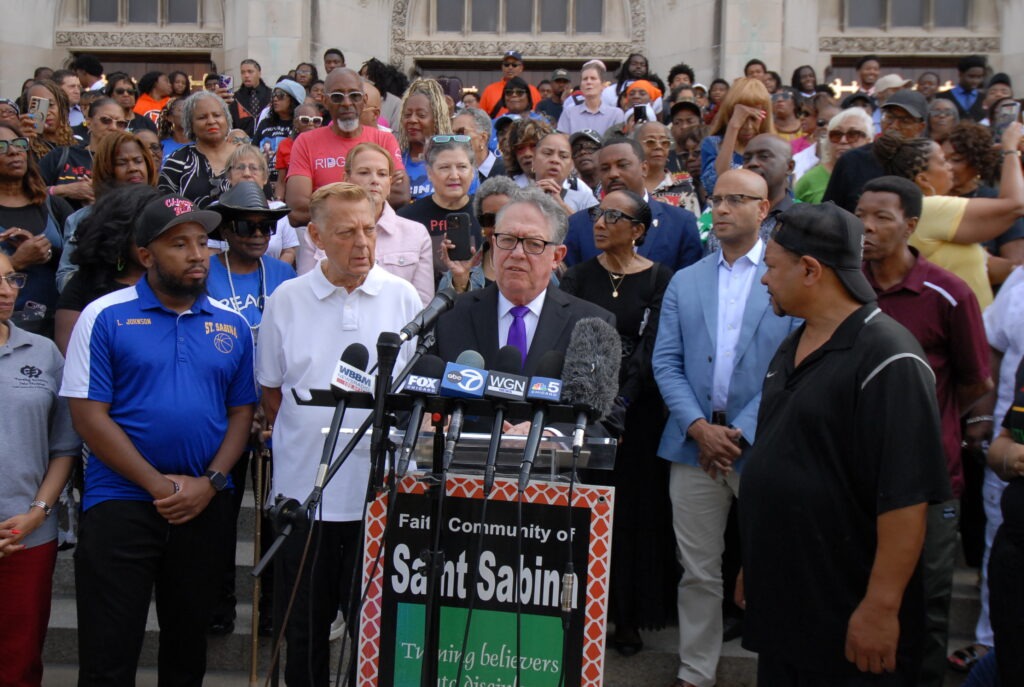
CHICAGO—A bank of television cameras and microphones facing the stone steps of the Faith Community of St. Sabina Aug. 26 witnessed a loud chorus of supporters shouting: “Father Mike! Father Mike! Father Mike!”
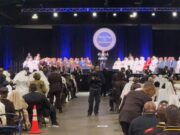
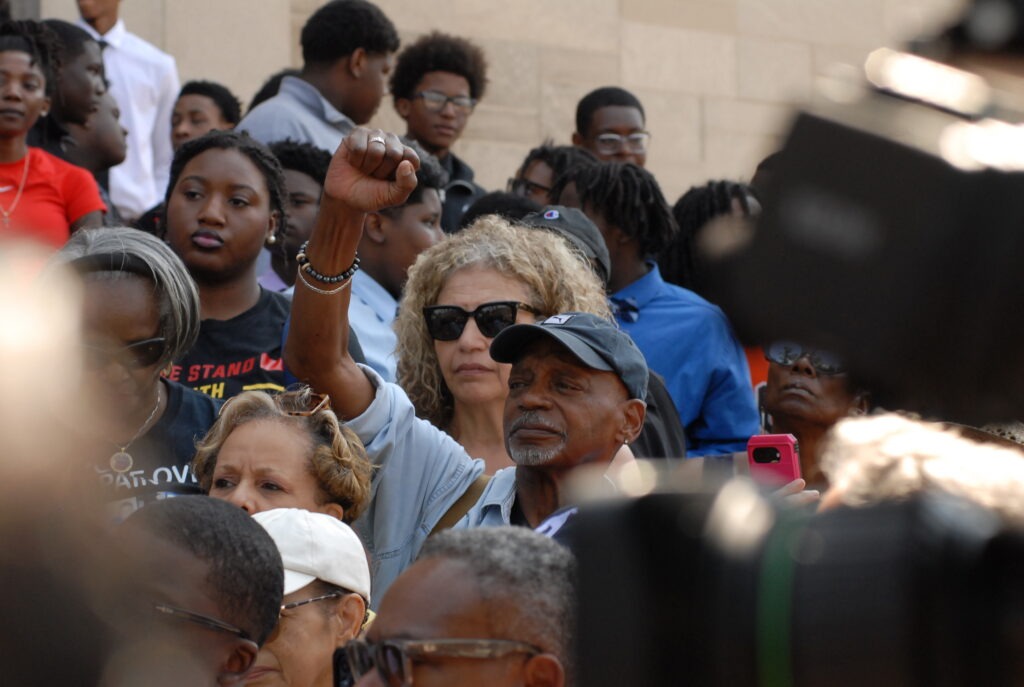
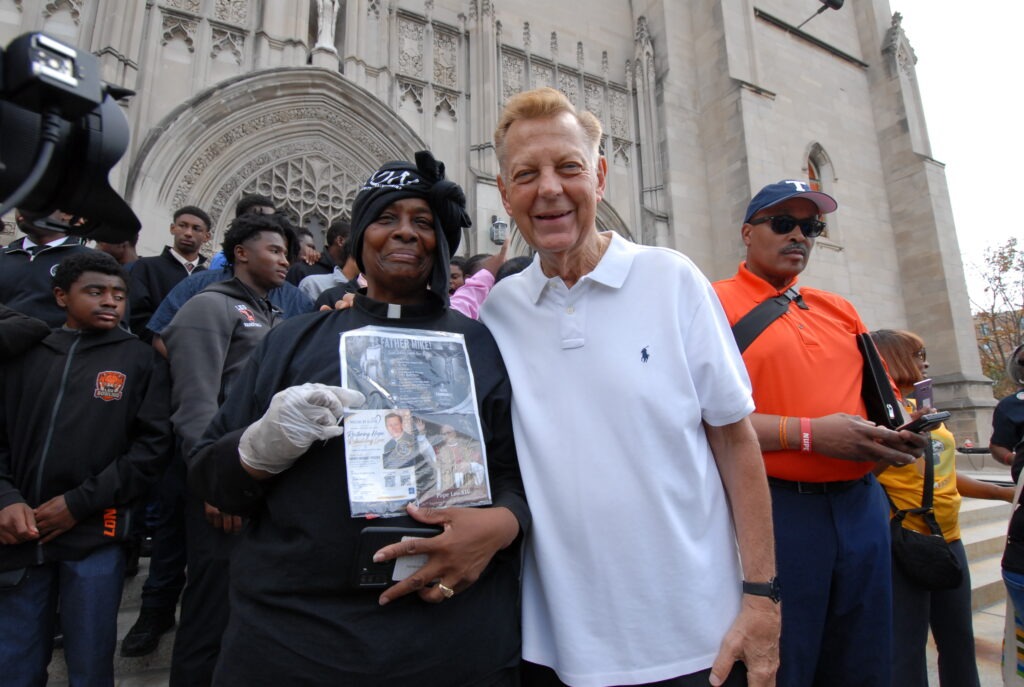
More than 100 parishioners, students, clergy, current and former elected officials and community supporters filled the broad steps of the historic Black Catholic parish Aug. 26 as Rev. Michael Pfleger walked to a clear lectern set outside the church he has served for more than half a century.
Some raised cellphones to record the moment. Others leaned forward around news crews. Smiles moved through the crowd as the longtime pastor, dressed simply in a white polo shirt, stood again before his church family.
Two days earlier, Cardinal Blase J. Cupich, archbishop of Chicago, had reinstated Father Pfleger effective immediately after the Archdiocese of Chicago’s Independent Review Board concluded there was “no reason to believe” he was guilty of an allegation of sexual abuse dating to the 1990s.
The decision ended a painful removal from ministry that kept Father Pfleger away from St. Sabina for about seven weeks while he was simultaneously undergoing radiation treatment for prostate cancer.
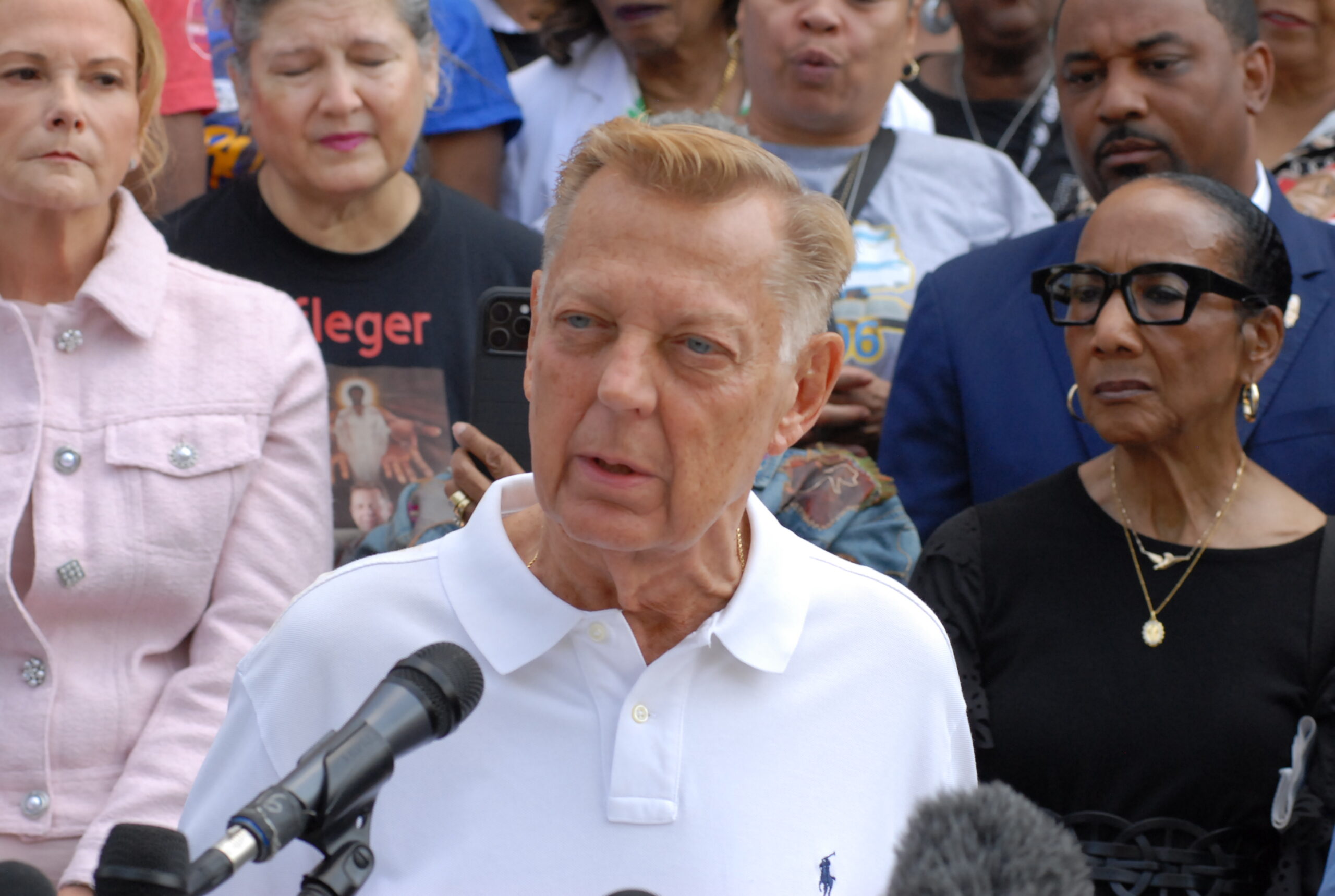
The gathering was part homecoming, part press conference and part call to action. Father Pfleger thanked those who carried him through what he described as public humiliation and private anguish, then turned his attention to an Archdiocesan process he called broken and unjust. “An accusation should begin an investigation and not end a reputation,” he told the crowd.
The scene was markedly different from the weeks of uncertainty that preceded it. Father Pfleger said he had missed block parties, a church picnic, food and book bag giveaways, Friday night peace walks and six Sundays of worship.
The separation also disrupted a parish whose ministry reaches far beyond Sunday Mass, including a food pantry Father Pfleger said serves about 250 people a day, youth programs and community anti-violence work.
Protection needed on all levels
Photos: Haroon Rajaee
On the steps, parishioners stood shoulder to shoulder with young men from Leo High School. Local television microphones crowded the lectern. Attorney James Figliulo, Father Pfleger’s high school classmate and legal counsel, addressed the news media first as supporters filled nearly every visible space behind him.
Atty. Figliulo said the church must protect children while also protecting priests from unjust allegations. The problem, he argued, is a system that can act quickly to remove a priest but slowly to resolve a claim.
“We all need a process because we all want to protect children from sex abuse,” he said. “But we also want to protect priests who are unfairly accused.” He said the allegation against Father Pfleger should have been resolved much sooner and pledged that lawyers, community leaders and faith leaders would continue pressing the Archdiocese for reform.
“We can still protect children and provide a fair process for the priests,” Atty. Figliulo said. “There are a hundred ways to do it, and we’re going to work together to get it done. We’re not letting it go.”
Dr. Shaka Rawls, president and principal of Leo High School, brought students to witness what he considered a living lesson in perseverance and justice. “There’s no better educational opportunity than for our young Black and Brown men on the South Side of Chicago to watch somebody deal with false accusations,”
Dr. Rawls said to The Final Call. “There is no better educational process than seeing this man fight this firsthand and actually being vindicated. This is school today.”
Illinois Sen. Willie Preston, whose district includes St. Sabina, said concern for children and fairness to the accused are not competing values.
“The worst thing we can do for real victims is allow someone falsely accused to be essentially convicted in the court of public opinion,” Sen. Preston told The Final Call. He described Father Pfleger as a friend personally and professionally and said there had been no substantiated evidence that would cause him to abandon that friendship.
When Father Pfleger finally stepped to the microphones, those behind him quieted. He began not with anger, but gratitude. “First, I am thankful to God for His faithfulness and His strength,” he said. “I have had to deal with cancer and public humiliation simultaneously, and the emotional trauma did not help the radiation treatment. I learned quickly that I could not handle either without Him.”
He thanked Atty. Figliulo and his law firm, Smith, Gambrell & Russell; researcher and adviser Andrew Stroth; his canon lawyer, Msgr. Patrick Lagges; judges and attorneys who offered support; ministers across faith traditions; St. Sabina’s staff and leadership; his family; and the close circle of friends who gave him room “to vent, cry and express my heart.”
He also thanked the parishioners who prayed, called, texted and publicly demanded his return. “You are proof that we are building a church of leaders,” Father Pfleger said. “I am honored and humbled to be your pastor.”
For St. Sabina, the removal was not an abstract administrative action. Father Pfleger told The Final Call about an eighth-grade boy in the parish’s altar service ministry who cried, lost sleep and repeatedly asked whether his pastor would ever return. Father Pfleger called the child and assured him that he was all right, that he loved him and that he would be back.
“He just cried on the phone,” Father Pfleger recalled. “This young child has to go through this kind of trauma. It’s cruelty.”
The pain extended across a congregation already confronting violence, hunger, racism and the other pressures bearing down on Black and Latino communities, he said. A faith community should be a place where people are strengthened for those battles, not another institution they must fight.
The allegation came to the Archdiocese through an attorney representing a woman who said Father Pfleger abused her when she attended St. Sabina school between 1993 and 1995. Father Pfleger denied the accusation. In a July 11 announcement, he said he had been ordered to leave the parish and cease ministry while the matter was investigated.
In his Aug. 24 letter to St. Sabina parishioners, Cardinal Cupich said the Independent Review Board, assisted by the Office of Child Protection and outside investigators, had thoroughly reviewed the allegation. He defended the importance of an independent and disciplined inquiry, even when it is public and requires substantial time.
“As to this case, the Review Board has concluded there is no reason to believe Father Pfleger is guilty of this allegation,” Cardinal Cupich wrote. “After careful consideration I have accepted their conclusion and have reinstated Father Pfleger to ministry at St. Sabina, effective immediately.”
The cardinal also acknowledged that Father Pfleger’s absence had caused “real and painful” suffering.
Father Pfleger said the call he had waited weeks to receive came shortly after 7 p.m. Aug. 24. His attorney first told him the Cardinal would be calling. About 30 minutes later, Cardinal Cupich informed him of the review board’s finding and his immediate reinstatement.
“It was like an exhale,” Father Pfleger told The Final Call. “The hurt, the pain, the questions, the doubt—all that you go through—now that chapter closes.”
Word spread quickly. Parishioners came to the church, where they embraced, prayed together in the sanctuary and began celebrating the return of their pastor. Father Pfleger later shared a social media post recalling Michael Jordan’s famous 1995 announcement: “I’m back.” He said his nephew suggested the comparison and that the message represented a comeback rooted in faith, perseverance and strength.
But relief did not erase the ordeal. The night before the press conference, Father Pfleger granted The Final Call an exclusive, hour-long interview, offering an in-depth account of his removal, reinstatement and concerns about the Archdiocese’s review process.
Father Pfleger said the transcript of the accusation referred to buildings and tunnels that did not exist. He said attorneys and investigators examined the locations and timeline and concluded that the alleged encounter could not have occurred as described.
Father Pfleger also said he was ordered to leave his home and removed from ministry before the accuser had been interviewed. He then had to retain and pay for his own attorneys to defend himself against an allegation that had already become public.
Reflecting on a previous accusation that was determined to be unfounded, Father Pfleger said his removal received front-page coverage, while news of his reinstatement appeared on “page 21 or 22” in some publications. “The bad always seems to outshout the good,” Father Pfleger told The Final Call.
Father Pfleger said an accusation, once broadcast nationally, can follow the accused for life even when the claim is later rejected. He criticized a process that identifies the priest publicly while shielding the accuser and acts before preliminary credibility checks have been completed.
“You are guilty until proven innocent, and your name is slandered and trashed across local and national news networks,” he said. “Let me be clear: I believe every accusation should be taken seriously. But this policy allows no room for the accused to be taken seriously or receive justice.”
Father Pfleger said he and a group of lawyers and judges plan to propose changes that would preserve protection for children while adding an initial assessment of credibility, urgency and present risk before a priest is publicly removed. He also questioned why allegations that may involve criminal conduct are not handled first by agencies such as law enforcement or child protection authorities.
The balance is essential, he said, because the Catholic Church’s historic failure to protect children cannot be corrected by abandoning fairness to the accused.
“Caring for both doesn’t mean you’re not caring for one,” he told The Final Call. “You can be just and fair to both.”
Perseverance amid pain
The investigation unfolded as Father Pfleger faced another threat to his life. After nearly three years of monitoring and tests, his prostate-specific antigen level rose to 14.5, he said. Doctors warned that the cancer was near the bone and required prompt treatment. After consultations at Northwestern Medicine and the University of Chicago, he chose radiation rather than surgery.
For four weeks, five days a week, he underwent treatment at the University of Chicago. His PSA level later dropped to 2.16, he said, and doctors told him he was cancer-free. He continues medication and monitoring and is scheduled for another PSA test in September.
The physical side effects were difficult, but the public accusation intensified the mental and emotional strain, he said. Radiation staff repeatedly warned that tension, stress and anxiety could interfere with treatment.
“I’m going through a national accusation. What do you think I’m going to have?” he recalled telling them.
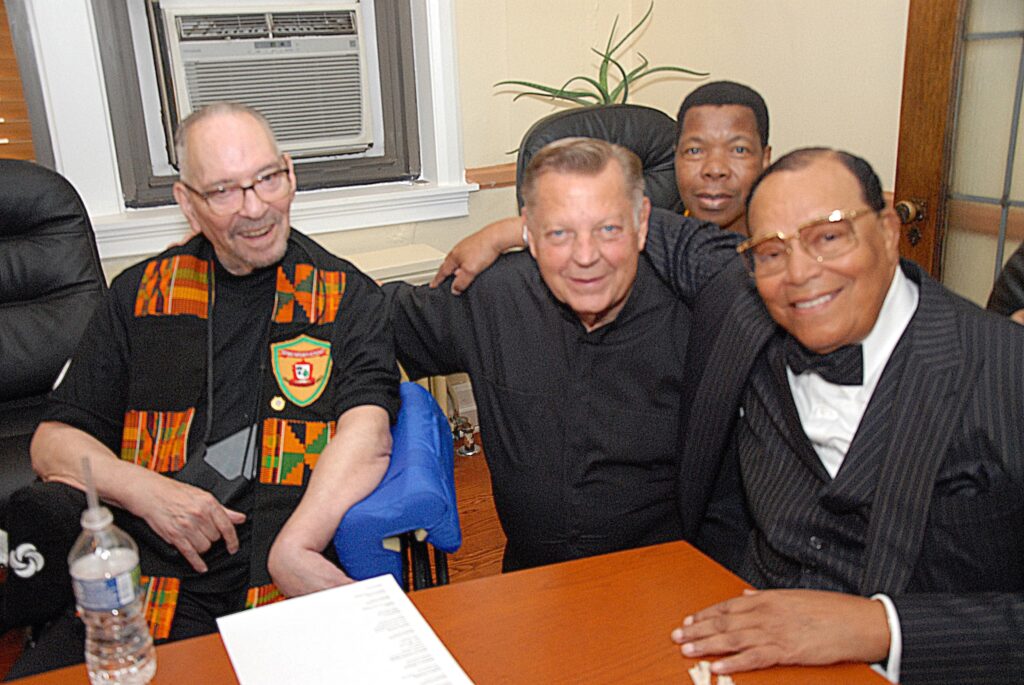
During the press conference, Father Pfleger said the overlapping trials forced him to depend more deeply on God. He revisited speeches and sermons by leaders whose lives taught him how prophetic voices endure persecution, including the Honorable Minister Louis Farrakhan, Rev. Jeremiah Wright, Dr. Martin Luther King Jr., Malcolm X and Medgar Evers.
He told The Final Call that the bond between St. Sabina and the Nation of Islam had been a source of strength throughout his ordeal. At the root of the Torah, Holy Qur’an and Bible are shared principles of “love, respect, justice and caring for the poor,” Father Pfleger said. He expressed deep gratitude for the support of the Nation of Islam and his decades-long friendship with Minister Farrakhan.
“I am so grateful to be able to call the Minister my brother and my friend, and the Nation my family,” he said. “That is a gift for which I am very grateful.”
That interfaith solidarity is part of Father Pfleger’s larger history as a White Catholic priest leading a predominantly Black parish and confronting racism, gun violence, liquor and tobacco advertising, poverty and police misconduct. He arrived at St. Sabina in 1975 and became pastor in 1981. Over the decades, the parish developed a national profile for blending worship with social action.
Father Pfleger said his public positions have brought hate mail, lost financial support, threats against his life and repeated demands that he become less controversial. He sees those demands as incompatible with the faith commitment he made May 14, 1975, to proclaim the Gospel of Jesus Christ.
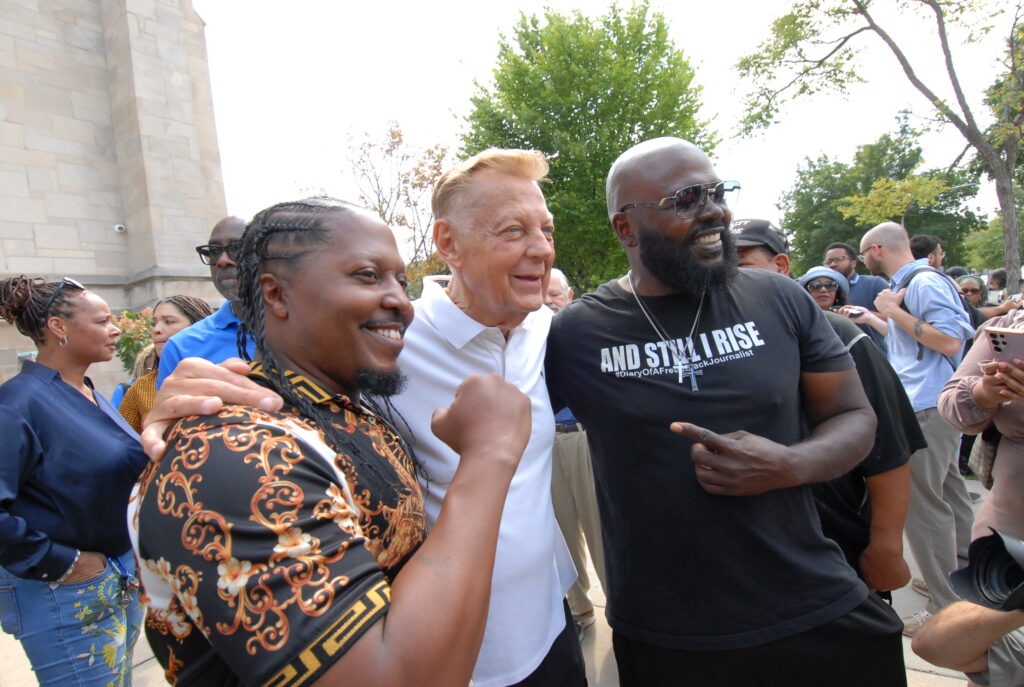
On the church steps, the homecoming reached its defining moment as Father Pfleger shifted from what had happened to what would happen next. He invoked Dr. King’s warning about becoming silent on things that matter and the late Jesuit priest and anti-war activist Rev. Daniel Berrigan’s admonition that anyone following Jesus “better look good on wood.”
Then he named the causes that would continue to command his voice: the suffering in Gaza, the treatment and deportation of immigrants, attacks on voting rights, war abroad, racism, White supremacy and a national “war on the poor.” Supporters nodded and called out their agreement.
“I have not come through arrests, name-calling, accusations, suspensions, lawsuits or threats on my life to remain silent,” Father Pfleger declared.
The crowd erupted as he delivered his answer to those he believes hoped the ordeal would diminish him.
“There have been many people throughout this who have tried to bury me,” he said. “They should know you have simply caused me to grow deeper roots and grow taller to bear new fruit.”
He paused before the final line, with St. Sabina behind him and his church family surrounding him.
“No, I am not going to remain silent, nor be silenced,” Father Pfleger said. “In fact, I intend to turn up the volume.”
