












The former head of Israeli military intelligence published a white paper Oct. 12 outlining the Israeli operational policy toward Palestinians since the Oct. 7, 2023, attack by Hamas on Israeli concertgoers that resulted in approximately 1,200 Israeli deaths and 251 taken hostage.
Tamir Hayman, Tel Aviv University’s executive director of the Institute for National Security Studies (INSS) think tank, writes that a public conversation must take place regarding Israel’s “national identity.”
He lists 10 “theoretical and deliberately exaggerated” interpretations of “new” principles for discussion, including the primacy of Jewish identity over democracy, settlement and civilians as central to security, and prioritizing an independent industrial defense capability, among others.
Although the principles are the de facto, unstated position of the government in light of Oct. 7, the paper suggests clarity on the principles will inform deci-sion-making and dictate Israel’s approach to security.
To preserve security, Israel must be in a constant “state of war” that cannot “be
replaced by a state of peace,” he writes. The intensity of the war may vary with circumstances, but “its constant presence is an asset to national security.”
“Any arrangement with Arab actors is temporary and deceptive,” writes Mr. Hayman, a retired general. Therefore, “any agreements are merely technical and temporary.”
Being self-reliant and not dependent on powers like the United States is necessary because “excessive adherence to restrictions imposed on Israel by a U.S. administration is dangerous.”
He describes the U.S. as a “declining power” that ultimately will “abandon Israel” and subject the colonial state to a “progressive American value system” incompatible with Israel’s Jewish character.
“Severing ties with the United States is therefore not only inevitable, but essential to Israel’s independence and the resilience of its Jewish national identity,” he writes.
The author suggests preemptive strikes—similar to the U.S.-Israel Feb. 28 unprovoked attack on Iran—should be a strategic norm rather than a rarity.
Establishing “forward defense” zones where Israel occupies parts of another nation—as in Southern Lebanon—provides a base to destabilize that nation and allows Israel to move conflict into “enemy territory.”
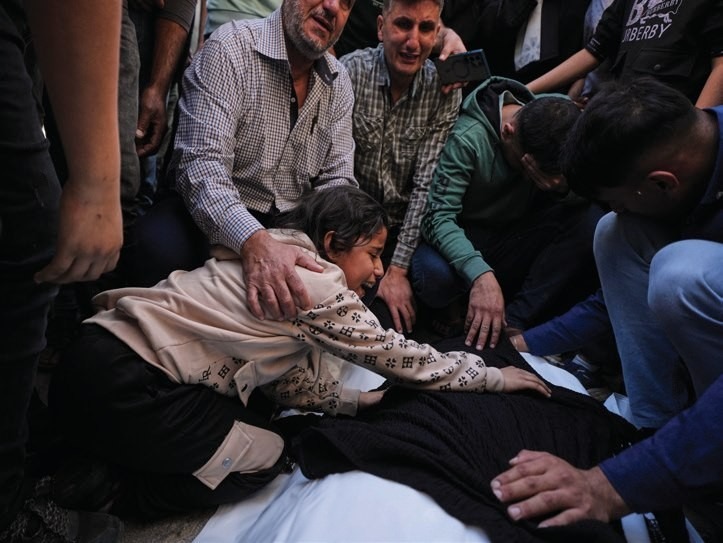
Dima Yassin mourns over the body of her mother, Dina Yassin, during the funeral of her parents, who were killed in an Israeli army strike on an apartment in Gaza City, Oct. 20.
The paper suggests that a state of Palestine exists as a Western narrative rooted in “post-colonial guilt” and the conflict should instead be viewed as a “permanent Israeli-Arab” conflict.
The ebb and flow of the Palestinian resistance against Israel constitutes the Arab attempt to fight and destroy the State of Israel, he suggests. However, any Arab inhabitant of the “Land of Israel” who chooses to remain in the Jewish state will be granted residency rights and local self-governance, the document says.
The general acknowledges the history of Israeli aggression prior to statehood in which Israelis established settlements in areas occupied by Palestinians or legally purchased land and organized voluntary paramilitary organizations, or “underground militias.”
“Defense is established by creating communities and outposts in all areas of friction with the Arab population, in Judea and Samaria [occupied West Bank area], and in security zones in Syria, Lebanon, and the Gaza Strip,” the document says.
Traditionally, the Declaration of Independence defined Israel as a Jewish state committed to the principles of liberal democracy, General Hayman writes. He calls into question the survivability or the legitimacy of Israel remaining a “civic and democratic” state versus “making religious sources” the framework for setting security priorities. Can a policy seeking to curtail the civil rights of Israel’s Arab citizens still align with Israel’s definition as a “Jewish and Democratic” state, he asks?
This all bears witness to what the Honorable Minister Louis Farrakhan said in his February 25, 2024, Saviours’ Day address, where he warned of Israel’s intentions.
“The first Nakba or ‘catastrophe’ on the Palestinians was done in 1948 when Israel became a state. And they exiled 700,000 Palestinians and made them like vagabonds in the Earth. But Netanyahu had in mind that he was going to use the pain of their loss to destroy the whole Palestinian community not only in Gaza but the West Bank, (and) East Jerusalem. It was a genocidal attack that he knew would preserve his place as a ‘great Jewish leader,’” Minister Farrakhan said.
“People do strange things when their hatred is so great of the people that they are killing; that their intention was to cleanse Gaza of every Palestinian that lived there and cleanse the West Bank and East Jerusalem so that Israel would not be bothered with Palestinians anymore,” he continued.
“Now some of you, my Black brothers and sisters, you are not concerned about the Middle East; you’re concerned about the refugees that are coming into the major cities that you feel may take your place. But to charge Israel with genocide and have the proof of their charge: South Africa stood up and took Israel to the International Court of Justice at The Hague,” Minister Farrakhan said.
—James G. Muhammad, Contributing Editor
