








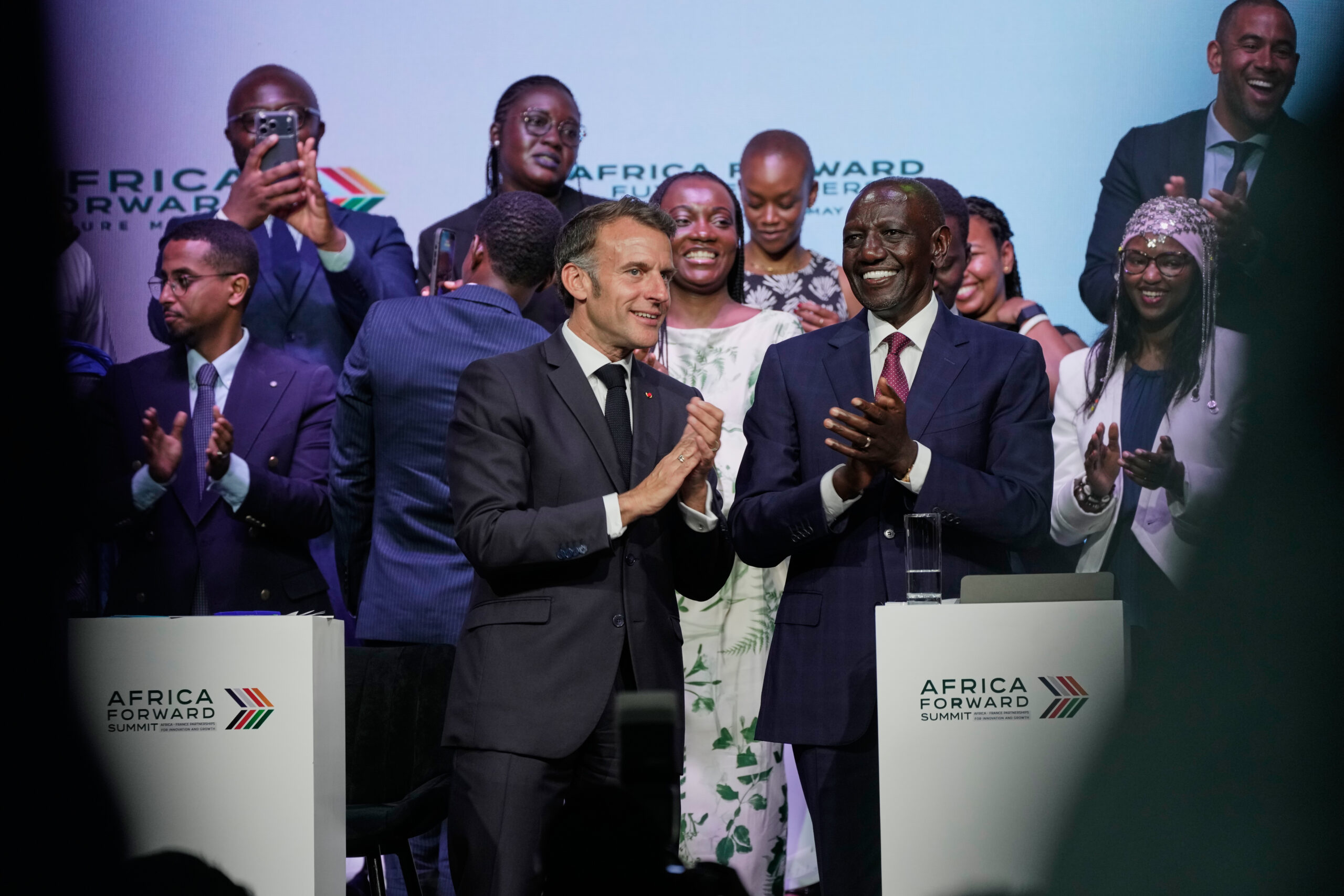

Earlier this year, the country of Kenya hosted the France-Africa Summit themed, “Africa Forward Summit: Africa-France Partnerships for Innovation and Growth.” French President Emmanuel Macron and Kenyan President William Ruto co-chaired the mid-May proceedings.

The choice of capital city Nairobi was not incidental.
This marked the first time a France-Africa summit was co-hosted and held in an Anglophone (English-speaking) African nation rather than a traditionally Francophone (French-speaking) country on the continent. The summit came amid France’s diminishing ties with its former African colonies but as Kenya is seeking increased trade.
In advance of the summit, Macron told Paris-based magazine “The Africa Report” that colonialism could no longer be blamed for all of Africa’s challenges. “We must not exonerate from all responsibility the seven decades that followed independence,” he said. He called on African leaders to improve governance.
This condescending remark was not the only controversial thing the French president stated.
According to Ghana’s online news portal, Modernghana.com, Macron made another declaration that sparked debate. “Standing alongside Kenyan President William Ruto at a press conference on the eve of the Africa Forward Summit, French President Emmanuel Macron looked into the lenses of the world’s media and made a declaration that would ignite a continent,” reported Modernghana.com.
According to the outlet, Macron claimed, “We are the true Pan-Africanists.” The French president, with his country’s history of colonialism and the post-colonial blemish of Africa’s last colonial currency, the CFA Franc, added, “We believe that Africa is a continent, and that this continent has an enormous amount to build.”
Within hours, his comments went viral. “For millions of Africans who know their history who know what France spent three centuries doing on the African continent the claim was not simply debatable. It was breathtaking in its audacity.
And what followed both in the streets of Nairobi and on social media platforms across Africa and its diaspora was one of the most pointed, passionate, and historically grounded conversations about France’s relationship with Africa that the continent has had in a generation,” noted Modernghana.com.
Togolese human rights activist Farida Bemba Nabourema responded in a scathing open letter to Macron titled, “You Are Not A Panafricanist and Can Never Be!”
In it, she took Macron to task recounting France’s colonialist past. She recounted France’s horrific history that began on the continent of Africa. “Pan-Africanism was not born in Paris. It was not theorized in the corridors of sciences or the salons of the Fifth Republic.
It was born in the holds of slave ships, in the plantation fields of Saint-Domingue in the exile of men and women whom your republic and its predecessors hunted, poisoned, shot, disappeared and buried in unmarked graves precisely because they had the temerity to believe that African and African-descended people deserved to govern themselves,” she wrote.
“Pan-Africanism is, at its most fundamental, the political philosophy that said no to everything France spent three centuries saying yes to: slavery, colonialism and neocolonialism.
It is the intellectual and organizational tradition built in direct and irreconcilable opposition to the project your nation prosecuted across this continent with a consistency and a brutality that your current rhetorical repositioning cannot retroactively launder.”
Nabourema’s response was not the first time Macron has been confronted with response by Africans on France’s colonial history and its impact.
In October of 2021 Macron hosted a summit in Montpellier, France. No heads of state were invited, but reportedly thousands of young Africans, including artists, athletes, and businesspeople attended. According to Theelephant.com, an online outlet that provides analysis on the continent, the purpose of the 2021 gathering was, “To demonstrate a ‘new’ France-Africa relationship, built on listening to youth.”
At the summit Kenyan radio personality and social activist Adelle Onyango addressed the audience in which Macron was a part of. “We as Africans feel the pain of colonization every single day. The lack of a clear and strong acknowledgement of the continent’s pain on this destructive past results in skepticism.
What we end up with is skepticism of what exactly does France stand for. … In fact, the air of denial that France chooses to sit in is uncomfortable, not only for Africa but also for France, and it does no good for either one of us. How can you trust the source of your pain when the source doesn’t acknowledge it?” she said, reported Theelephant.com.
Macron’s real quest is in reinventing the colonial narrative. His goal is to stay connected by any means necessary, to a continent that is awakening to its history of being subjected to the Global North, including French imperialism.
Additionally, there are media reports that point out that France’s new African initiative, may have more to do with its current economic situation. France may not currently be collapsing economically, but as the world’s seventh largest economy, it faces a severe fiscal and political strain, driven by mounting public debt, high government spending, and a persistent budget deficit.
John Ryan is an economist and a Network Research Fellow at CESifo, Munich. He noted, in an article published on the website of the London School of Economics website (LSE), that France’s debt metrics are abysmal and he writes in part that France’s “External debt stands at approximately $7.7 trillion, equivalent to around 248 percent of GDP, while total debt across the economy is close to 319 percent of GDP.”
In Dr. Ndongo Sylla’s book, “Africa’s Last Colonial Currency: The CFA Franc Story,” co-authored by journalist Fanny Pigeaud, they argue that the CFA Franc continues to act as a neocolonial tool that extracts wealth from Africa’s Francophone countries.
They outline how this monetary arrangement hinders economic sovereignty, perpetuates underdevelopment, and subordinates African nation-states to European financial policies and French geopolitical interests.
The question Africa has to ask is: Does the continent with its significant mineral wealth want to continue to tie itself to a former colonial master during a time of its severe fiscal and political crises? Follow Jehron Muhammad @africawatchfcn on X
