











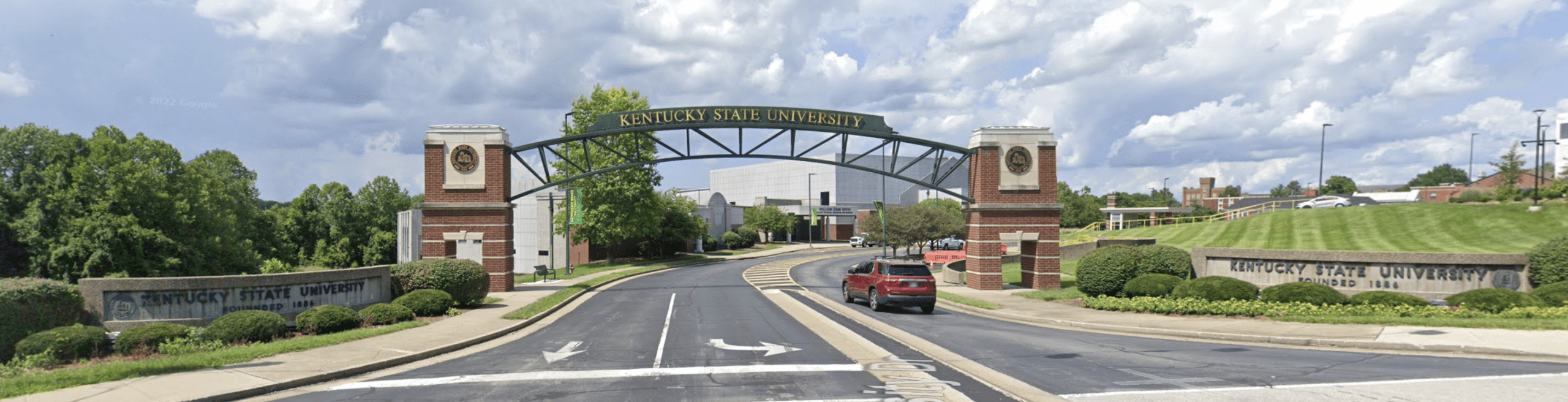

Two lawsuits are challenging a Kentucky bill that would transform Kentucky State University, an HBCU (Historically Black College/University), into a polytechnic institution.
KSU students, alumni and prospective students filed a federal lawsuit on May 11. An additional group of anonymous KSU students filed a state lawsuit on May 21.
Both lawsuits challenge Kentucky Senate Bill 185, which was signed into law on April 13. The bill places the university in a state of financial emergency for up to five years and restructures the university into a polytechnic institution focused on technical, workforce-oriented applied learning programs.
It also reduces academic program offerings to no more than 10 and allows for faculty terminations. In addition, the state would have increased control and oversight over KSU and would have authority over admission policies.
James Morris, of the Kentucky law firm Morris & Morris, P.S.C., serves as counsel for plaintiffs in both lawsuits. The federal lawsuit focuses on civil rights law and the issue of historic underfunding while the state lawsuit focuses on Kentucky’s constitution. Both ask the courts to halt enforcement of the bill as the lawsuits move forward.

“The state action is alleging a constitutional violation under Kentucky state law,” Atty. Morris said to The Final Call. “Our state constitution requires that in order for a legislature to pass a bill, it has to be read in both House and Senate three times.”
He alleged that SB 185 started as a four-line branch budget recommendation bill that was sent to the Senate floor three times, but on the third read, the committee substituted the previous branch budget text with a seven-page bill related to Kentucky State University.
“They never said ‘wait, guys, we just changed everything.’ They literally said, ‘We want to read for the third time. All right, reading for the third time, Senate Bill 185, an act related to branch budget recommendation.’ Then they said, ‘We’d like to do a committee substitute number one.
All right, committee substitute number one to branch budget recommendation. All in favor?’ They voted. It passed,” Atty. Morris said. “The substitute was the seven-page new text that never got read to anything because they’re using the old title.
Then, after the Senate passed the bill, they said I’d like to move to change the title to an act related to Kentucky State University and declaring an emergency.”
He pointed out several things wrong with the passage of the bill: one, by Kentucky law, “you can’t substitute a different bill and say, ‘oh, we read it three times’”; two, “you can’t have a statute that is related to a single individual or a single entity when a general statute would suffice,” and three, every bill that impacts a person’s retirement must have a financial report attached.
“The entire statute relates to Kentucky State University; not one reference to the other land grant, not one reference to the other universities. There wasn’t something that said if any university has the following problem, then we would declare a financial emergency. It’s literally written solely for the HBCU. Our constitution says that’s illegal under Kentucky law,” Atty. Morris said.
Supporters of the bill, including state lawmakers and some university officials, have presented it as a rescue plan for KSU that will stabilize the school financially.
Located in Frankfort, Ky., KSU is one of 19 HBCUs established as a land-grant institution under the Second Morrill Act of 1890, and it is Kentucky’s only public HBCU. Like most land-grant HBCUs, KSU has been a victim of severe underfunding by the state.
As early as 1981, Kentucky was found engaging in intentional segregation and discrimination by underfunding KSU, and the state entered agreements with the federal government to fix the issue, according to Atty. Morris. “They didn’t do that,” he said.
In September 2023, then U.S. Secretary of Education Miguel Cardona and then U.S. Secretary of Agriculture Thomas Vilsack sent letters to 16 governors highlighting the more than $12 billion disparity in funding between land-grant HBCUs and White land-grant institutions. Kentucky Governor Andy Beshear, a Democrat, received one of those letters.
Land-grant institutions were first established under the Morrill Act of 1862, but the first wave of institutions, including the University of Kentucky, did not allow Black students to enroll.
When states opened a second land-grant institution to serve Black students in 1890, they did so with the requirement to provide an equitable distribution of funds between their 1862 White institutions and 1890 Black institutions, according to the letter.
KSU, while “producing extraordinary graduates that contribute greatly” to Kentucky’s economy, “has not been able to advance in ways that are on par with [the] University of Kentucky, … in large part due to unbalanced funding,” the former secretaries wrote to Gov. Beshear.
If KSU received funding equal to the University of Kentucky from 1987 to 2020, the school would have had more than $172 million in additional funds. That $172 million could have supported infrastructure and student services and would have better positioned the university to compete for research grants, the former secretaries said.
The former U.S. secretaries also sent letters to the governors of Alabama, Arkansas, Florida, Georgia, Louisiana, Maryland, Mississippi, Missouri, North Carolina, Oklahoma, South Carolina, Tennessee, Texas, Virginia and West Virginia. Of the 18 states that have land-grant HBCUs, only Delaware and Ohio equitably funded their universities between 1987 and 2020, according to the federal review
In 2022, due to financial issues, the state of Kentucky loaned KSU $23 million with the expectation that the school would repay the loan.
“We’ll loan you $23 million but we want you to pay us back, and if you can’t pay us back, then there are consequences. Well, wait, why is this a loan? Here you are $200 million in the hole, and you couldn’t find a way to give Kentucky State University $23 million?” Atty. Morris questioned.
Despite the bill’s claims that KSU will still retain its status as an HBCU and as a land-grant institution, the lawsuits argue that the bill narrows KSU’s academic and historic missions.
The lawsuits also raise concern that the bill threatens traditional degree programs, gives the state excessive control over the university and could lead to reduced educational opportunities for students, along with faculty layoffs, staffing reductions and enrollment restrictions.
“They’re literally trying to avoid decades and decades of segregation and intentional discrimination by adopting a bill that would allow them to escape the responsibility for their neglect,” Atty. Morris said. Now, with the state’s plan to transform the university, students are leaving and scrambling to find a different school, leaving “nobody left” for the state to fund, he added.
“Right now, from what we understand, there’s less than 200 students now enrolling in the fall. That means that the system’s going to shut down. So, by the legislature doing what they did at the time they did in the spring and forcing it as an emergency bill, they’re basically going to choke out K-State and make it so that it self-implodes,” he said.
KSU enrolled more than 2,800 students in Fall 2025 but has not yet released enrollment statistics for Fall 2026.
The university’s board of regents approved a new academic plan on May 28 with the deadline to submit the plan to the Kentucky Council on Postsecondary Education by June 1.
Atty. Morris said while the new plan hasn’t been fully explained, the university has shut down its political science program and some of its music programs. Other programs, such as nursing, have been impacted, and still others, such as criminal justice, have not been listed at all.
“The board of regents has selected programs, but we have not gotten the final list. Some of the plaintiffs are directly impacted. Some of them already received letters saying their program is gone,” Atty. Morris said.
The first court date for the state lawsuit was June 1, with a full hearing scheduled for June 10.
Historically, HBCUs provided Black students an opportunity for higher learning at a time when they were locked out of White institutions due to discrimination and segregation. Today, they are still major drivers of economic success for Black people.
Though most HBCUs both public and private are underfunded compared to White institutions, Brookings Institution, a Washington, D.C.-based think tank, published an article on how HBCUs “do more with less.”
HBCUs serve only about 3% of college students in the U.S., but they produce nearly 16% of all Black U.S. graduates and are responsible for 18% of graduates in the fields of science, technology, engineering and mathematics, according to an article by Dr. Michael L. Lomax, president and chief executive officer of the United Negro College Fund,
On “Why HBCUs Still Matter.” In addition, he wrote that HBCUs generate $16.5 billion annually in economic impact and provide more than 136,000 jobs a year nationwide.
Dr. Denise A. Smith, former deputy director of higher education policy and senior fellow at The Century Foundation, a public policy think tank headquartered in New York City, has done extensive research into educational equity and government funding of HBCUs. She wrote an article in 2021 on funding disparities.
“No longer should we be focused on questions about” the relevance of HBCUs, “but rather we should be highlighting their significant contributions—and making substantial public investment so that HBCUs’ future can be actualized,” she wrote.
“The present moment is an opportunity for this country to atone for decades of discrimination and restore what is rightfully owed to the Black community and Black colleges.”
The Honorable Minister Louis Farrakhan, National Representative of the Most Honorable Elijah Muhammad, is a longtime advocate for the success of HBCUs. In a 2014 address to Morgan State University students, he warned that all HBCUs are “under attack,” because of their history of producing great leaders for Black people.
“Brothers and sisters, we have [99] Historically Black Colleges and Universities (HBCUs) that are just scraping by,” he said in another message titled, “Muhammad’s Economic Blueprint: Ending Poverty & Want,” which served as Part 31 of his 58-week lecture series, “The Time and What Must be Done.”
Minister Farrakhan noted that if Black people followed the economic program of the Most Honorable Elijah Muhammad, Eternal Leader of the Nation of Islam, and if 16 million Black wage earners contributed one nickel a day to a national Black treasury, the resulting $291 million from the first year could be used to match the endowment figures for 37 HBCUs.
This would make “these institutions free to determine one, the direction, two, curricula and three, staffs to provide our children with an education which will surpass any on our planet,” he said.
“The HBCUs must become a part of a system where they are functioning for a bigger purpose than just to confer degrees. We want our HBCUs to be ours, and they can never be that unless they are financially independent,” he added. “Do you know our schools [and the curricula] are controlled?
The Enemy does not want you to learn what will make you free from dependency on others! But with money in our pocket, we tell them, ‘No! This is the curriculum that has to be in here: The Curriculum that will make students that will build not only a nation but a world!’”
