










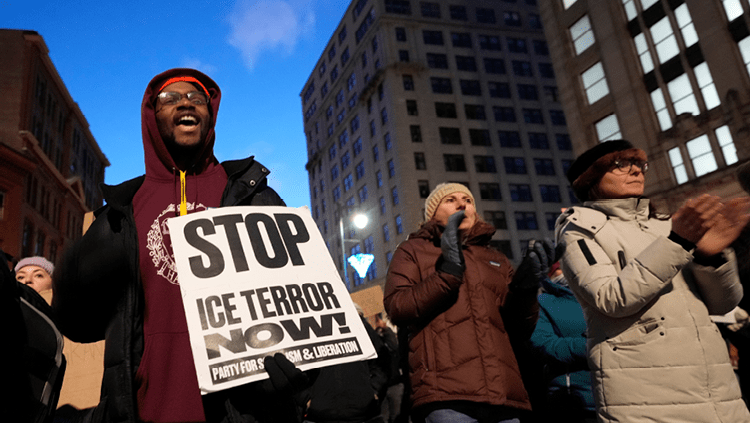

Public scrutiny and anger at federal immigration enforcement tactics in Minneapolis and other cities around the country is intensifying, as leaders, families, activists and politicians demand change and accountability.
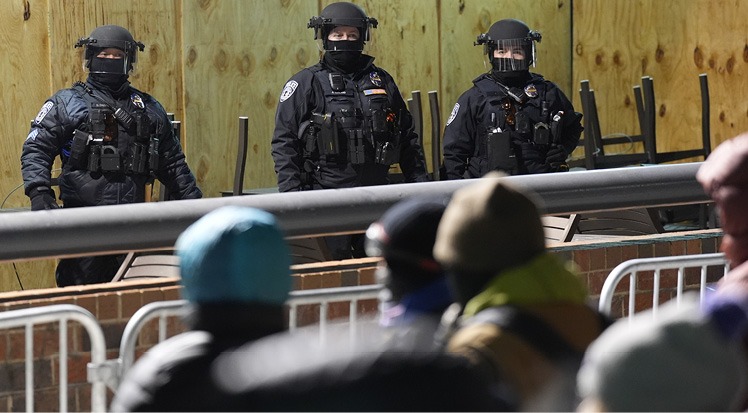
“It’s starting to feel like an occupation,” Trahern Crews, co-founder of Black Lives Matter Minnesota, said to The Final Call. With approximately 3,000 federal agents in the Twin Cities, Minneapolis has been gripped by large-scale protests, general strikes, two fatal shootings of civilians and continued Immigration and Customs Enforcement (ICE) raids and child detentions.
Thousands of Minneapolis residents braved below-zero temperatures to participate in a general strike and economic blackout on Jan. 23. Businesses, schools, and workplaces closed in solidarity with the strike.
Two Border Patrol agents fatally shot Alex Pretti, a 37-year-old intensive care unit nurse, the following day. His death, which occurred about two weeks after an ICE agent fatally shot Renee Good, caused another eruption of anger and dissatisfaction across the country, as thousands more joined a nationwide strike on Jan. 30, adhering to “no work,” “no school” and “no shopping.”
“There are absolutely no positives to ICE being here,” Jae Yates, an organizer with the Twin Cities Coalition for Justice, an anti-police brutality organization, said to The Final Call.
“These people are literally doing this job so that they can live out their racist fantasies of brutalizing Black and Brown communities, and when White people stand up alongside those communities, they become targets of that same violence.”
The two agents who fired their guns at Alex Pretti were placed on administrative leave. After the shooting, President Donald Trump said he would reduce immigration enforcement efforts in Minnesota.
The president sent White House border czar Tom Homan to Minneapolis to manage the ICE operation. During a news conference on Jan. 29, Mr. Homan said a “drawdown plan” is being developed based on local cooperation and the number of “targets” still to be found.
Mr. Yates voiced his disbelief in reduced efforts. “I don’t trust people who lie literally all the time. Trump is constantly lying about everything. And so that statement holds absolutely no water with me,” he said.
Minnesota officials have been calling for an end to ICE activity. Rep. Ilhan Omar (D-Minn.) has been vocal about her disapproval of ICE activity in the state.
During a town hall event on Jan. 27, a man sprayed the congresswoman with apple cider vinegar, temporarily disrupting her speech against the Trump administration’s immigration crackdown. The man was arrested and charged, but the incident further depicts a divided country.
Todd Gramenz, who operates Black Lives Matter St. Paul, said the continued ICE presence has caused people to feel uneasy and non-White-owned businesses to struggle.
“There’s less economic movement in our communities, which in turn leads to a downward spiral of youth having something to do,” he said to The Final Call.
Maine operation
The U.S. government launched a 10-day immigration enforcement operation in Maine from Jan. 20 to Jan. 29. Maine is a majority-White state with a very small immigrant population.
Immigrants make up 14% of the U.S. population, but only 4% of Maine’s residents are foreign-born, according to a report by the Migration Policy Institute, published in October 2025.
In 2023, half of the state’s immigrants were naturalized U.S. citizens, another 24% were legal permanent residents and 8% were temporary visa holders, the report said. Only 18% were unauthorized immigrants, with some having temporary status.
“To the federal government, I say this. If your plan is to come here to be provocative and to undermine the civil rights of Maine residents, do not be confused. Those tactics are not welcome here,” Maine Governor Janet Mills said in a video statement posted on X a week before the operation launched.
The picture in Maine cities Portland and Lewiston was similar to Minneapolis: people afraid to go outside, students not attending classes and businesses being disrupted.
By Jan. 26, more than 200 people were arrested, according to local media outlets in Maine.
The Department of Homeland Security claimed it was arresting “the worst of the worst,” but Lewiston Mayor Carl Sheline said that claim “just doesn’t add up.”
“From moms and dads to civil engineers to students to correction officer recruits, they are deporting our neighbors, family members, and employees.
And as we saw over the weekend—with now two U.S. citizens killed in Minneapolis by federal immigration agents—this nationwide immigration enforcement effort couldn’t be more off track,” he said in a Jan. 27 post on Instagram.
“ICE needs to leave Lewiston and our cities across the country. We cannot accept a system that treats our communities as battlegrounds and our citizens as collateral damage.”
The Maine-based Immigrant Legal Advocacy Project challenged the government’s claim in a Jan. 22 statement. “While ILAP does not have complete information on all people who have been arrested in the first days of the operation
We can confirm that many of the people arrested have no criminal record,” the statement said. “We can also confirm that many of the people who have been detained are asylum seekers, following a lawful process.”
Senator Susan Collins (R-Maine) announced that ICE would end its enhanced operations in the state on Jan. 29.
Raids, arrests and detentions
Across the country, federal law enforcement agents have been arresting and detaining people who have not been convicted of any crimes.
Recent analysis on immigration enforcement in the first nine months of President Trump’s second administration found that ICE arrests, including both street arrests and transfers from criminal custody to ICE immigration custody, quadrupled.
“For both types of arrests, ICE was much less likely to target people with criminal convictions. These changes led to over a sevenfold increase in arrests of people without criminal convictions,” the analysis, published Jan. 27 by researchers from the University of California Berkeley, said, adding that the quadrupling of arrests resulted in an even larger rise in deportations.
“Anytime we see crackdowns or law enforcement say, ‘Oh, we’re cleaning up the neighborhood, we’re going to take criminals to jail,’ a lot of what ends up happening is, a lot of people who are innocent or have nothing to do [with it] get caught in the mix,” Mr. Gramenz said.
In Iowa, a federal judge ruled that ICE illegally detained a man and attempted to cover its tracks. ICE agents arrested four people at a courthouse in Nebraska right before their scheduled hearings.
As part of their raids, an anonymous whistleblower revealed that ICE agents have the power to forcibly enter people’s homes without a judicial warrant, according to an internal ICE memorandum obtained by The Associated Press.
The memo, dated May 12, 2025, clashes with the Constitution’s Fourth Amendment, preventing “unreasonable searches and seizures.” It is being used to train new ICE officers, according to the whistleblower complaint.
One of the most vulnerable populations subject to ICE tactics, raids and detentions has been children.
A Black couple in Minneapolis was driving home with their six children when they got stuck between protesters and ICE agents. An agent released a tear gas canister under the family’s vehicle, causing the family to evacuate the vehicle.
Destiny Jackson, the mother of six, told news outlets that she had to give mouth-to-mouth CPR to her 6-month-old baby. The infant and two of her other children were treated at the hospital.
Liam Conejo Ramos had just gotten home from preschool in Minnesota when he was detained by ICE and taken to a detention facility in Dilley, Texas, with his father on Jan. 20. The image of the 5-year-old in his blue bunny hat and Spiderman backpack went viral.
He had been the fourth student detained by immigration officers in his school district in recent weeks, including two teenagers and one 10-year-old, according to The Associated Press.
“There are reports of whole classrooms worth of children simply not being able to show up to school, either because their parents are afraid to leave the house to take them or because their status is in question. A lot of these folks are literally asylum seekers who came here fleeing war and upheaval in their own countries,” Mr. Yates said.
“It’s been really devastating, honestly, to watch kids have to live in fear, and specifically to watch kids who are coming from such horrific conditions often caused by the U.S. to experience that brutality again in a place that they thought they were going to be safe in.”
Leecia Welch, chief legal counsel at Children’s Rights, an organization that investigates, exposes and combats children’s rights violations, reported to the AP accounts of children who were malnourished, extremely ill and suffering prolonged detention at the Dilley facility.
“The number of children had skyrocketed, and significant numbers of children had been detained for over 100 days,” she said. “Nearly every child we spoke to was sick.”
The Minnesota Public Radio news website reported other incidents of ICE agents shipping children to out-of-state detention facilities and detaining them. Reports of inhumane and deplorable conditions at ICE detention facilities around the country have also circulated.
ICE violations
Litigation trackers show numerous ongoing cases challenging ICE over racial profiling, detention facility conditions, family separation, detainer practices, access to facilities, the surge of federal agents in Minnesota and other states and the fatal shooting of Alex Pretti.
Minnesota’s chief federal judge found that ICE violated nearly 100 court orders stemming from its immigration crackdown in Minnesota and had disobeyed more judicial directives in January alone than “some federal agencies have violated in their entire existence,” according to The New York Times.
Black Lives Matter Minnesota held a “know your rights” training to educate community members interacting with ICE. “It’s very critical to know your rights,” Mr. Crews said. “Try not to go places by yourself. Go out in groups.”
Minneapolis residents have been keeping a close eye on ICE due to the surge. Mr. Yates argued that federal agents who have violated procedure, violated people’s due process rights or killed or harmed a citizen or immigrant should be arrested and prosecuted.
“We are at a point where our political leaders need to seriously consider abolishing this law enforcement organization,” he said.
