






On Jan. 3, the world woke up to news of the U.S. government’s bombing of Venezuela and to the kidnapping of Venezuelan president Nicolás Maduro and his wife, Cilia Flores. The actions immediately sparked international protests, from Latin America to Europe to the U.S.
In the Venezuelan capital city of Caracas, protesters, including the city’s mayor, Carmen Meléndez, demanded President Maduro’s return. “Maduro, hold on, the people are rising up!” the crowd chanted, according to Spectrum News. “We are here, Nicolás Maduro. If you can hear us, we are here,” the crowd said.
Chris Gilbert, professor of political studies at the Bolivarian University of Venezuela, described the demonstrations in Caracas as a show of public defiance and national unity in the face of foreign aggression, according to Tehran Times, the Islamic Republic of Iran’s English daily newspaper.
The publication reported a personal account from Christian Peach Ortiz, an Afro-Venezuelan who described the sound of explosions and the fear he and his family felt. He accused the U.S. of seeking to colonize Venezuela’s natural resources.
Demonstrators in several Latin American countries, including Cuba, Argentina and Mexico, also stood against the U.S. government’s actions. Protesters outside the U.S. embassy in Buenos Aires, Argentina’s capital, carried signs reading, “We condemn the U.S. bombing and the kidnapping of Maduro,” according to CBS.
In Cuba, President Miguel Díaz-Canel Bermúdez called the U.S. government’s attack “criminal” and joined protesters in Havana calling for the international community to condemn the U.S. Protesters outside the U.S. embassy in Mexico City denounced the U.S. government’s actions against Venezuela.
Venezuelans in Italy, Greece and Germany joined the international call in support of President Maduro and in condemnation of militarized U.S. actions.
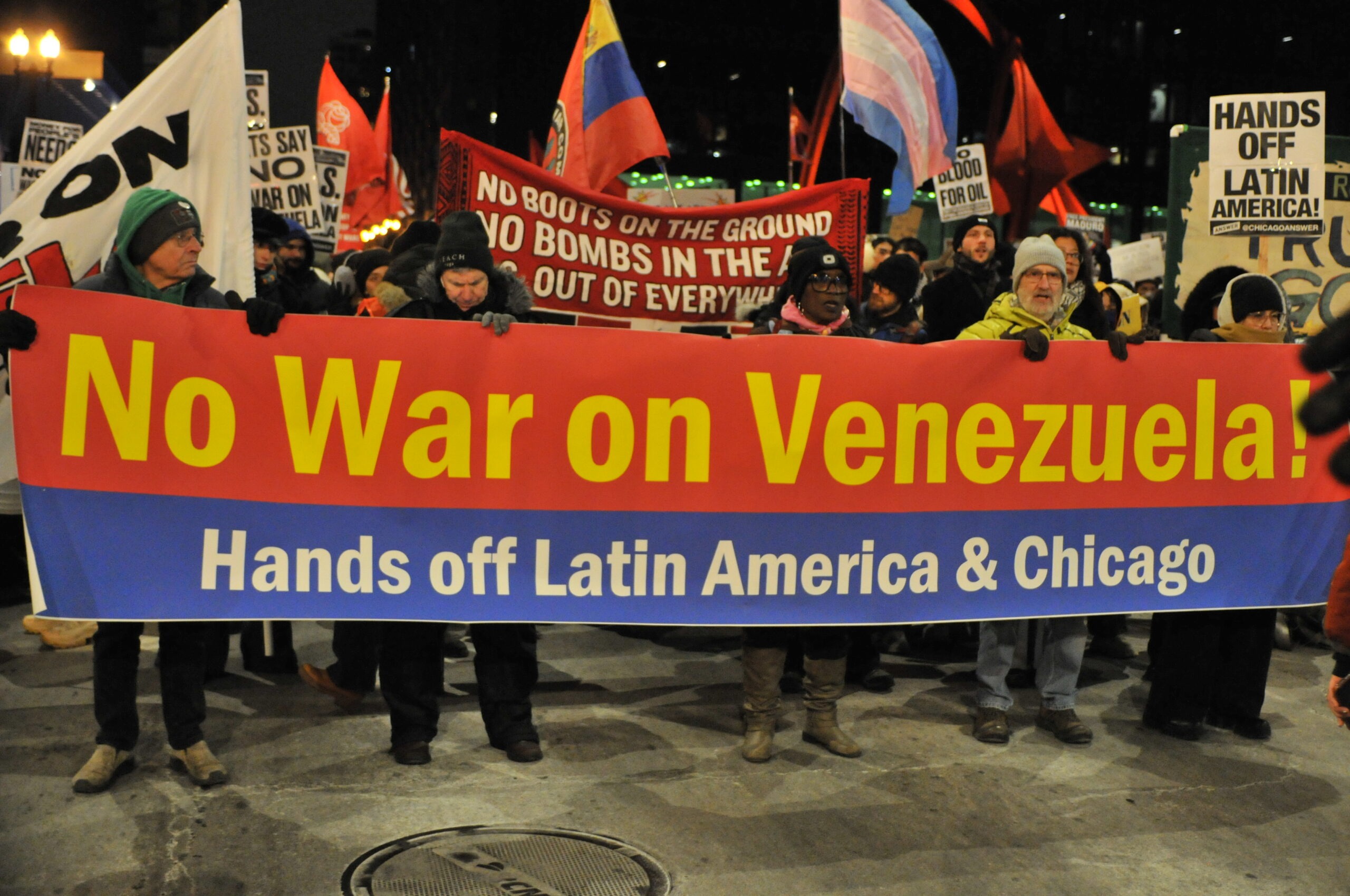
Protests swept across U.S. cities far and wide. Organized by the ANSWER (Act Now to Stop War and End Racism) Coalition, demonstrators took to the streets in more than 130 cities on Jan. 3 and Jan. 4.
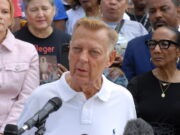
Hundreds of demonstrators gathered around the streets around the White House, their voices rising in a sharp rebuke of the U.S. military’s strikes. For those gathered, the conflict is not a distant foreign policy matter, but a direct assault on the principles of self-determination and international law.
The mood of many at the protest was one of profound disbelief. Many questioned the strategic and moral sanity of the administration’s current path. “They haven’t learned the lessons from Vietnam or Afghanistan or anything,” said Luci Murphy, a veteran D.C. activist and singer known for her decades of work in the struggle for human rights.
Speaking to The Final Call, Ms. Murphy did not mince words regarding the legality of the U.S. actions. “It’s a crime,” she said. “You know, it’s against all international law. How can this country remove the elected leader of another country?”
The skepticism expressed by Murphy and other demonstrators is mirrored in recent polling, which suggests that upwards of 70 percent of the American public remains opposed to military intervention in Venezuela. Many protesters held signs connecting the billions spent on overseas destruction to the lack of investment in struggling domestic communities.
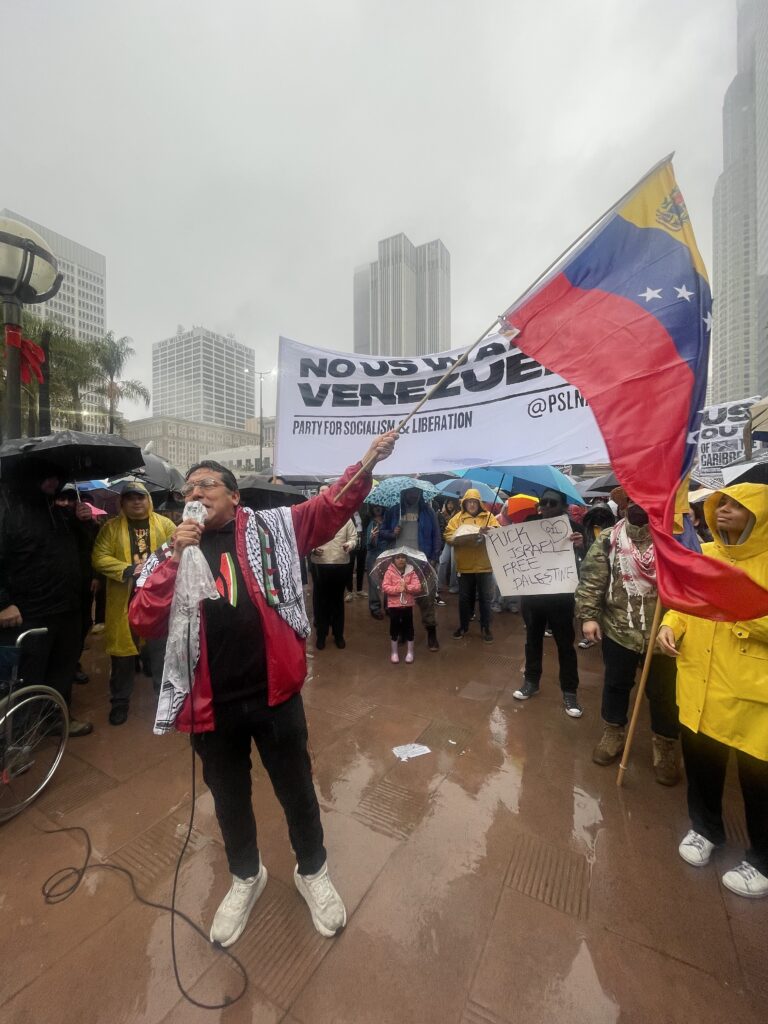
Approximately 200 demonstrators rallied in Los Angeles, downtown in Pershing Square, despite the pouring rain. Elizabeth Blainey, co-director, Union De Vecinos (Eastside Local of the L.A. Tenants Union), kicked off the remarks by commending those who gathered in the rain.
“This fight is about oil, but it is about more than that! It is about Venezuela building five million homes in the last 20 years. It is about free education, university education,” she stated.
“It is about free health care that has existed for the last 25 years. And the oil revenue funds that, and that is why Trump and his corporate friends want to take that down. But their (Venezuela’s) fight is our fight,” she said.
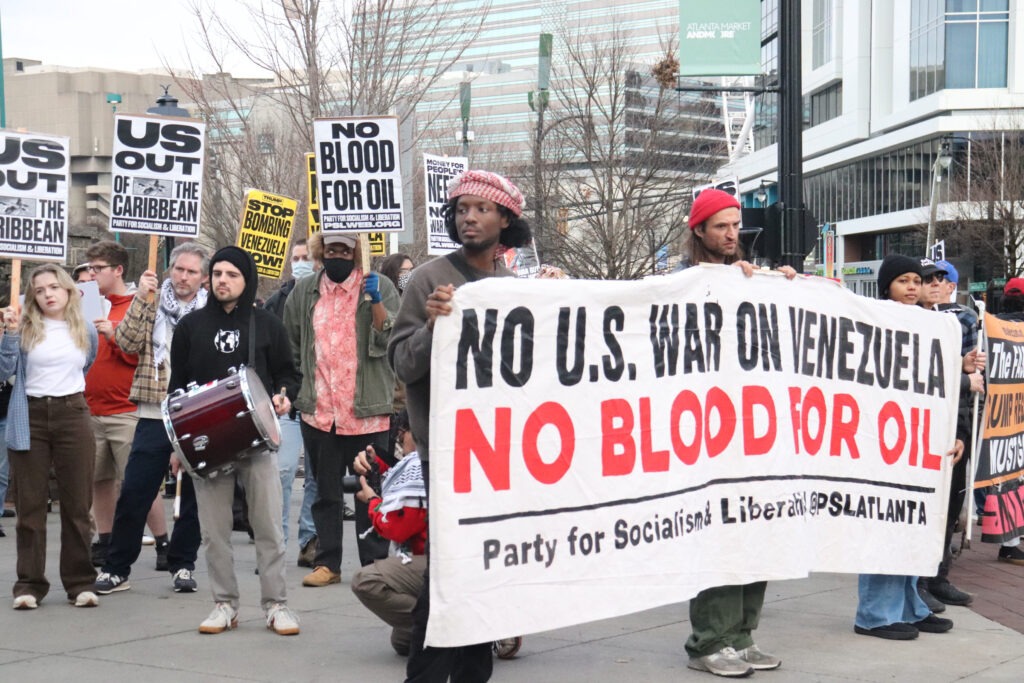
Protesters in Atlanta issued a strong condemnation of the U.S. government’s targeted actions and referred to the capture of President Maduro and his wife as an illegal kidnapping.
They made the U.S. government’s motives clear: the government’s actions are about the desire to control Venezuela’s large crude oil reserves, a motive the government itself is no longer hiding.
“It’s a huge, serious escalation. It’s basically an act of war. It’s a total violation of international law, even U.S. law. You cannot kidnap and try a foreign head of state,” Claudia Andrade, a member of the ANSWER Coalition, of Mexican descent, said to The Final Call.
“Their real objective is Venezuela’s oil. You can’t even get more clear than Trump himself saying, on today’s (Jan. 3) press conference, ‘Oh, we’re going to get that oil and we’re going to make so much money from it.’”
“These are very unhinged people, which means it could lead to very dangerous attacks against any other government that is independent of the U.S. So, Colombia, Brazil, Mexico; anyone who doesn’t toe the U.S. line could be open to a bombing campaign and direct U.S. intervention,” she added.
She and other program speakers highlighted the history of U.S. control and the U.S. government’s destabilization of foreign governments and unwanted interventions in countries across the world, including Syria, Cuba, Iraq, Libya, Iran, the Philippines, Honduras, Mexico, Brazil, Colombia, Afghanistan, Somalia, Korea and Vietnam.
They also linked the U.S. government’s actions in Venezuela to other current crises the U.S. is involved in, including the coordinated strikes in Nigeria and the genocidal war in Gaza.
“The Trump administration and the ruling class at large is using lies to justify their illegal acts,” Genny Kennedy, a member of the Party for Socialism and Liberation, who is of Nigerian descent, said to The Final Call.
“We also want to call attention to the fact that Venezuela has the largest oil reserves in the world and Nigeria is an OPEC country (Organization of the Petroleum Exporting Countries). It has a lot of oil as well.
These countries are resource-rich,” Ms. Kennedy added. “With Venezuela, they used to have their oil controlled by the United States, but no longer, and that level of wealth being lost by the United States has never been forgiven by the ruling class.”
Demonstrators in Atlanta also criticized the government for using taxpayers’ dollars to prioritize a potential war over the needs of the American people, such as food, housing, education, and health care.
Final Call National Correspondent Charlene Muhammad and Final Call Staff Writer Nisa Islam Muhammad contributed to this report.
