











A groundbreaking report by prominent global economists revealed that the current crisis of extreme inequality has deep-seated historical origins, tracing back to colonial times and the period of European expansion, which fundamentally questions the belief that wealth disparities are unavoidable or natural.
The report, commissioned by South Africa’s G20 Presidency and led by Nobel laureate Joseph E. Stiglitz, traces the origins of current global disparities to the centuries-old legacy of colonialism. The report, “G20 Extraordinary Committee of Independent Experts on Global Inequality,” was released in November.
The G20 (Group of Twenty) is an international forum that brings together the world’s major economies to discuss and coordinate global economic policies. The report is the first of its kind to be submitted to the G20.
South Africa’s President Cyril Ramaphosa is the current President of the G20 and holds the G20 presidency from December 1, 2024, to November 30, 2025.
According to the South African Government News Agency, “The Extraordinary Committee of Independent Experts on Global Inequality was established under South Africa’s G20 Presidency in 2025 to examine the structural causes of inequality and propose strategies to achieve a fairer global economy.”
According to the government news agency, President Ramaphosa hopes the findings will lead to solutions. “Now, with this report, we have clear actions that we can take as governments, as societies, and as the global community to reduce inequality. It is now up to us, the leaders of the G20 and the leaders of the world, to demonstrate the necessary will and commitment,” he said.
“It is an honor for us to present this report to President Ramaphosa (South Africa) and to the G20. The available evidence on inequality should concern leaders everywhere. The world understands that we have a climate emergency; it’s time we recognize that we face an inequality emergency, too.
It isn’t just unfair and undermining societal cohesion—it’s a problem for our economy and our politics, too. Our committee felt strongly that some of the worst effects of inequality are on democracy,” said Professor Stiglitz.
“The Committee’s work showed us that inequality is a crisis in need of concerted action. The necessary step to taking this action is for policymakers, political leaders, the private sector, journalists, and academia to have accurate and timely information and analysis of the inequality crisis. This is why our recommendation above all is for a new International Panel on Inequality,” he added.
Colonial foundations of modern inequality
The Honorable Minister Louis Farrakhan has spoken on inequalities and justice for decades. He has cautioned world leaders and the wealthy and powerful of the world about how they treat those in their country who are less fortunate.
In his illuminating book, “A Torchlight for America,” in the chapter, “Greed and Leadership’s State of Mind,” Minister Farrakhan writes, “The fundamental motivation in this society is greed and the preying upon the weak of the country and the weak of the world, versus sharing wealth in cooperation with the weak and the poor.
‘Greed’ is defined as a ‘selfish desire for possessions and wealth beyond reason.’ When greed is exercised in the society, it is reflected by division among the people.”
And while Minister Farrakhan was writing about the United States, the wisdom he shared is applicable to what is happening in the world regarding the rich and the poor.
“The whole society is modeled after division and that old mindset of ‘haves’ and ‘have-nots’; of ‘the lord’ and ‘the servant’; ‘the slave master’ and ‘the slave’; and ‘the male’ and ‘the female.’ These mindsets are reflected in the doctrines of White supremacy and Black inferiority; and are perpetuated by the root problems of greed and pervasive immorality.”
According to the report, the gap between wealthy countries of the “Global North” and the rest of the world started during the colonial era, when colonial economies were designed to acquire raw materials at the lowest cost. The wealthiest controlled the best land, and racial and sexual discrimination were used to support the extraction process.
This gap accelerated dramatically with the Industrial Revolution, when per capita incomes in Europe and a few other countries began to increase rapidly after centuries of stagnation. The report findings note that colonialism and its inequalities have contributed to today’s inequality.
Global North countries are considered more economically developed, but it is not a geographical designation. The U.S., Canada, several Western European countries, Japan and South Korea, are a few of the nations and areas that comprise the Global North.
According to worldeconomics.com, Global North countries are home to over 1.6 billion people. Global South countries are primarily in Asia, Latin America, Africa, and the Caribbean and are considered less economically developed and have historical ties to colonialism which are still being felt today.
Amitabh Behar, executive director of Oxfam International (a British confederation of 21 independent non-governmental organizations, focused on the alleviation of global poverty), said in a statement, “This historic report could not be timelier. It is a high-water mark in international recognition of the inequality crisis.
The Inequality Emergency is destroying our democracies, corroding our societies, and undermining our economies. An Independent Panel on Inequality is an excellent proposal and long overdue.”
“South Africa has shown great bravery in putting the fight for a more equal world at the heart of their G20 agenda. They are giving a voice to people crushed by inequality. They are showing that another world is possible: ruled not by and for billionaires, but by and for the rest of us instead,” he added.
Newly independent countries in Latin America, Africa, and Asia typically inherited very high levels of inequality when they gained independence from colonial rule, with many having economies built to extract raw materials at the lowest cost for export to countries in the Global North.
Land was often unequally distributed, with the best agricultural land concentrated in the hands of a few very large landowners. Discrimination based on race fueled this process, with extensive use of slavery, forced, and indentured labor.
South Africa—ranked by the World Bank as the most unequal country in the world—hosts G20 leaders later in November as it wraps up its year holding the presidency, a first for an African nation.
“With this report, we have clear actions that we can take … to reduce inequality,” President Ramaphosa said. “It is now up to us and as leaders of the G20 and the leaders of the world to demonstrate the necessary will and commitment,” he said.
The report “correctly asserts that inequality is in many ways a betrayal of the dignity of people. It is an impediment to inclusive growth and a threat to democracy itself,” explained the South African president.
Today’s staggering numbers
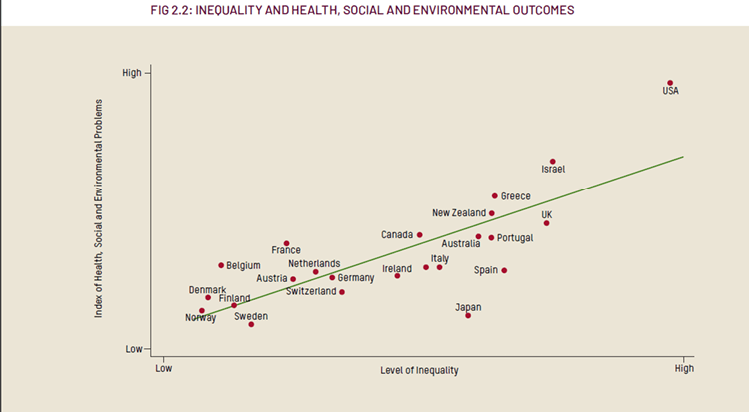
The report reveals the following statistics about current inequality:
- 83% of countries have high income inequality, accounting for 90% of the world’s population;
- Between 2000 and 2024, the richest 1% captured 41% of all new wealth, while the bottom half of humanity captured just 1%;
- The richest 1% have seen their average wealth increase by $1.3 million since 2000, while someone in the poorest half of humanity saw their wealth increase by an average of just $585 over the same period;
- One in four people globally (2.3 billion) face moderate or severe food insecurity, up by 335 million since 2019.
The colonial-industrial connection
The historical impact of inequality has been profound and intentional. Historians point out that today’s inequality also stems from older global systems of domination, especially the Doctrine of Discovery, the 15th-century legal and theological framework that authorized European powers to take lands inhabited by non-Christian peoples.
That doctrine supported centuries of colonization, Indigenous displacement, and the theft of wealth from Africa, Asia, and the Americas. Its legacy continues to influence global inequality:
Nations built on stolen land amassed great wealth, while colonized peoples faced forced labor, resource depletion, racial hierarchies, and long-lasting barriers to political and economic power.
Scholars contend that these historical patterns—sanctioned by law, justified by religion, and reinforced by imperial policy—created the structural imbalances that the G20 report now identifies as causes of today’s inequality crisis.
A call for justice
The African Union, through its Agenda 2063, aims to reduce inequalities by continuing to involve Member States in developing strategies and policies that foster inclusive growth, creating jobs and narrowing disparities.
Within the broader framework of the AU Agenda 2063, The Extraordinary Committee of Independent Experts on Global Inequality will examine the relationship between growth, inequality, and employment, providing policymakers with valuable insights.
The committee emphasizes that inequality is not a given; it can be combated and overcome. Inequality results from policy choices that reflect ethical attitudes and morals, as well as economic trade-offs. The committee proposes the establishment of an International Panel on Inequality to monitor trends and evaluate policies.
Professor Stiglitz stated that understanding the historical roots of inequality is essential to addressing it.
The report offered some solutions to address inequities in various countries including: improving access to food at stable prices; new models for trade cooperation and industrial strategies and addressing illicit financial flows which “would enable many countries to retain public revenues that are rightfully theirs.”
