










The U.S., its European partners, with their neoliberal free-market capitalism tactics, are in a race for the Global South’s, mainly Africa’s, critical minerals. China is also making strong inroads.
In response, the continent must find a way to downplay individual nation-state differences and make regional and continental organizations like the African Union and the African Continental Free Trade Area (AfCFTA) a source of protection and financial stability for its people and countries.

An open letter issued ahead of the forthcoming World Bank Group and International Monetary Fund annual meeting implored Global South leaders, including those in Africa, to urgently address the unsustainable and debilitating debt challenges faced by low-and middle-income countries and somehow turn debt into sustainability.
The letter published Oct. 12 titled “A Call for Urgent Debt Reform Ahead of the World Bank and IMF Meetings” was signed by 24 members of the UN Secretary-General’s Expert Group on Debt. The IMF (International Monetary Fund) often mires poorer nations in debt due to the conditions attached to the loans doled out.
“The problem is clear: countries around the world are paying exorbitant debt servicing costs instead of paying for schools, hospitals, climate action or other essential services. Many of these countries are not formally defaulting on debt, but they are defaulting on development.
African governments now spend an average of 17% of revenues on debt servicing. A cap of 10% in 21 countries could unlock enough money to provide clean water and sanitation to roughly 10 million people, as well as avert roughly 23,000 under-age-five deaths each year,” the letter read in part.
Africa’s debt as a form of imperialism went global, as mentioned in David Graeber’s 2011 book, “Debt: The First 5,000 Years.” He frames the IMF as the world’s debt enforcers or “the high-finance equivalent of the guys who come to break your legs.”
In his book, Graeber explained how modern-day capitalism encouraged the debt that has historically saddled underdeveloped Global South countries, including those in Africa.
“Unlike advanced (Western) economies, which have highly developed local-currency bond markets (financial markets where participants can issue new debt), African countries are subject to prohibitively high interest rates and often cannot borrow from international investors in their own currency (the ‘original sin’ of sovereign-debt markets).
Instead, over 80 percent of African countries’ external debt is denominated in dollars or euros, which heightens their vulnerability to monetary-policy changes by a handful of systemically important central banks—and thus to a ‘debt doom loop’ that only exacerbates their debt burdens,” economist Hippolyte Fofack wrote in an April 2024 article published on Project Syndicate.
Fofack is a former chief economist and director of research at the African Export-Import Bank and is currently a research associate at the Harvard University Center for African Studies.
In the meantime, the race for access to Africa’s vast mineral resources is pitting the U.S. and China against one another. It will be up to African nations to ensure they are not being exploited by either country.
In an October 12 article on theconversation.com titled, “China and the U.S. are in a race for critical minerals. African countries need to make the rules,” James Boafo, a lecturer in sustainability and a fellow at the Indo-Pacific Research Center at Murdoch University, raises the question of how Africa, with its abundance of mineral resources, can take advantage of this demand for its critical minerals to drive its own development.
Discussing the competition for the continent’s minerals, Boafo wrote, “The continent, with its 30% of the world’s critical mineral deposits, puts it at the center of the global geopolitical contest.” He explained that the U.S. and European Union have sought agreements to secure supplies and reduce reliance on China.
“The EU has strategic partnerships on minerals with the DRC (Democratic Republic of Congo), Rwanda, Namibia and Zambia. China has bilateral agreements with eleven African countries in the mining sector. The U.S. also has a trilateral agreement with the DRC and Zambia. Its purpose is to support an integrated value chain for electric vehicle (EV) batteries,” he explained.
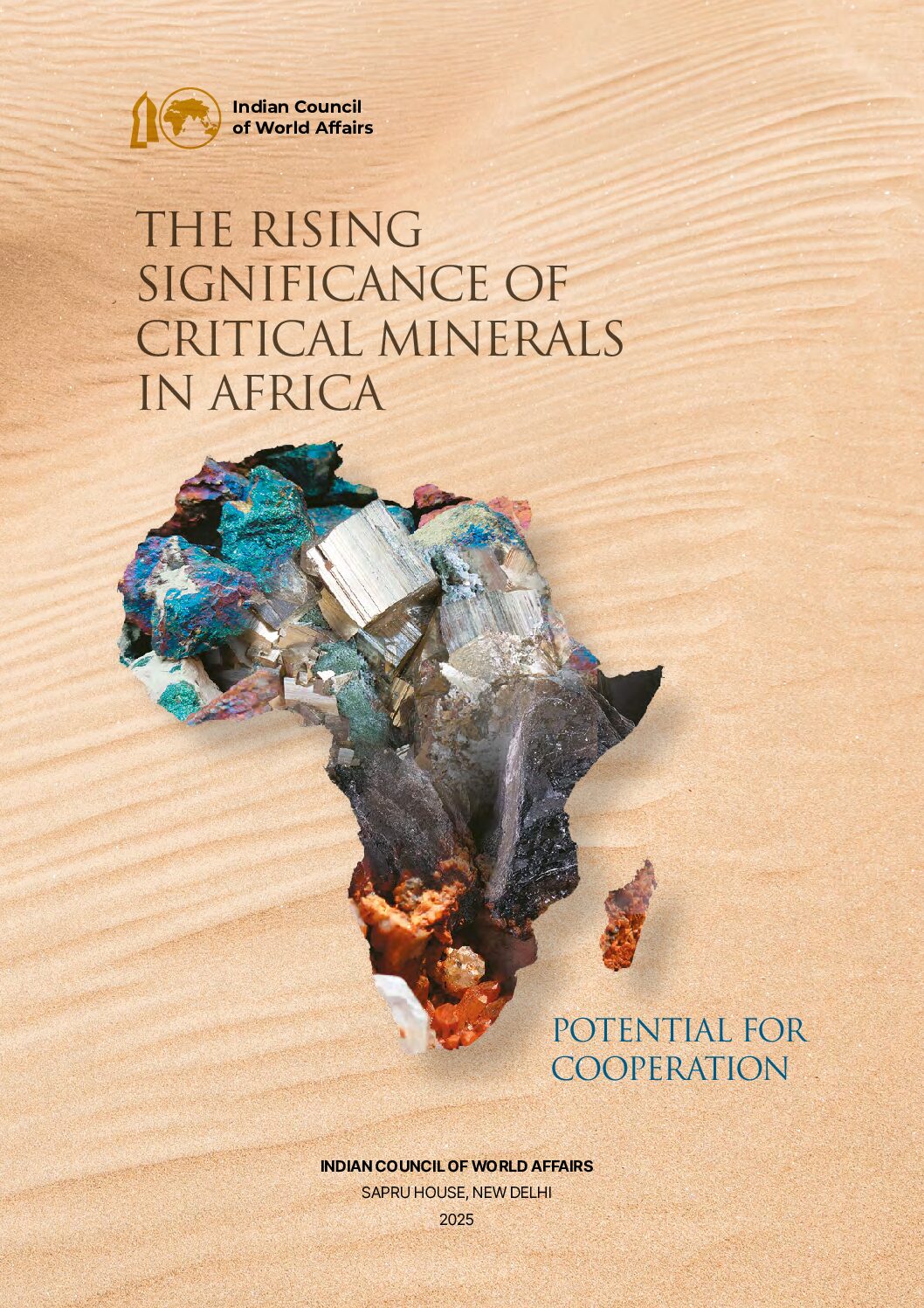
When it comes to China, according to a 2025 report released by the Indian Council of World Affairs, “The Rising Significance of Critical Minerals in Africa,” the Asian country’s focus is slightly different than that of the West, but the concern regarding possible exploitation is still a concern.
“Chinaʼs investment in Africaʼs critical minerals sector primarily focuses on export-oriented projects to supply its domestic industries. These investments often prioritize the extraction and shipment of raw materials, with limited emphasis on local value addition or industrial development within African countries,” the report notes.
“Similarly, large-scale infrastructure projects such as the Lobito Corridor and the rehabilitation of the Tazara railway are designed to facilitate the efficient export of raw minerals from Africa to global markets—including China, the U.S., and Europe.”
Africa is faced with increasing debt, limited investment capital and limited infrastructure development. Boafo explains these partnerships with China and the Global North “risk reinforcing Africa’s marginal position in the global value chain. They often reproduce conditions reminiscent of colonialism: dependency, resource extraction, and power imbalances.”
“Limited and volatile development finance is holding Africa back, slowing down progress towards achieving development goals,” explained the UN Trade and Development (UNCTAD) body in a 2024 article: “How Africa can harness critical mineral wealth to revamp economies.”
UNCTAD believes even with current multiple crises, including limited fiscal space, slow growth and high debt, the time is ripe for African countries to turn the tide by seizing the opportunity presented by the critical minerals boom.
“To do so, African nations must embrace a holistic approach that entails not only extracting and exporting raw minerals but also adding value domestically through processing and manufacturing to gain a larger share of the global market,” the UN article notes.
Controlling the mechanisms for processing enables countries to diversify their export baskets and make them less vulnerable to commodity price fluctuations, explained UNCTAD.
“African countries also need to fully integrate their mining sector into national (and regional) economic activities by promoting linkages with other sectors of their economies.”
Follow Jehron Muhammad
@africawatchfcn on X
