









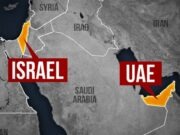

Israeli Foreign Minister Gideon Sa’ar visited Zambia to cap Israel’s steadily growing ties between the two countries and to mark what is being called, according to the news website Al-ahkbar, “a new phase in Israel’s push to expand its diplomatic presence across Africa.”
In August, Zambia reopened its Israeli Embassy after nearly 50 years. At the same time, Israel is increasingly being viewed on the world stage as a pariah for its genocide in Palestine.
With the steady increase of global political and economic pressure, sporting and cultural boycotts on the radar, global demonstrations against genocide in Gaza, and the walkout of the majority of the 193 member states at the UN General Assembly during Israeli Prime Minister Benjamin Netanyahu’s address, the regime is continuing to be isolated before the world.
Even the prime minister admitted that Israel is facing “a kind of” economic isolation on the world stage. The BBC reported that speaking at a finance ministry conference in Jerusalem, Netanyahu, “blamed the isolation on negative publicity abroad, and said Israel needed to invest in influence operations in traditional and social media to counteract it.”
Jeremy Issacharoff, Israel’s ambassador to Germany from 2017 to 2021, told BBC diplomatic correspondent Paul Adams, “he could not recall a time when Israel’s international standing was so ‘impaired.’”
But even as the world watches Israel’s massacre of Palestinians, which has caused nearly 70,000 deaths of mostly women and children and reduced a once thriving infrastructure to rubble under the weight of incessant Israeli air strikes, the regime’s right-wing government is attempting to make more inroads in Africa.
The question is, why? “By embedding itself in African security structures, Israel not only profits from instability but also gains partners less likely to challenge its brutal military occupation and its genocidal atrocities,” South African analyst Reneva Fourie told Al Jazeera.
“These partnerships normalize Israel as a counterterrorism ally while deflecting attention from the fact that it is the perpetrator of state terror against Palestinians (with special emphasis on genocide in Gaza).”
According to Al-ahkbar, Israeli Foreign Minister Sa’ar’s visit to Zambia’s capital, Lusaka, “framed the reopening (or diplomatic relations) as the first step in a broader African outreach, citing ‘historic ties and shared values as believers’ in Zionist ideals.”
According to the news outlet, the words and language Sa’ar used while in Zambia “underscored Israel’s reliance on Christian Zionist ideology in Zambia, a country whose constitution defines it as a ‘Christian nation’ and where biblical narratives are often invoked to justify support for Israel’s wars against its ‘enemies.’”
Outside of the Israeli and Zambian press, very little coverage has been given to the reopening of African diplomatic relations with Israel, which should be of great concern. According to the South Africa Jewish report’s website sajr.za.ca, “Sa’ar said that the new embassy marked the beginning of a new chapter between their nations.”
A recent article on Al Jazeera described the moves being made by Israel on the African continent, which includes Zambia, South Sudan and other countries, as appearing to be a “charm offensive, dangling aid and arms.”
“Many countries in Africa are lining up for Israel to open an embassy in their capitals, these days,” Sa’ar boasted in a speech at the ceremony. “We choose to begin in Zambia.”
The Zambian reopening event, noted Al Jazeera, “appears to be part of a series of calculated moves by Israel to pull African nations to its side at a time when its global standing is damaged.”
No list of African nation states, other than Zambia, was mentioned as part of Foreign Minister Sa’ar’s “charm offensive,” however, according to aljazeera.com, “Some say strengthening ties with Zambia appears to be Israel’s crack at weakening its regional neighbor, South Africa, which is Israel’s fiercest critic in Africa.”
The motive behind the Israeli regime’s insertion into the affairs of African countries is causing concern, and rightfully so.
“It’s a play of the decades-old divide and rule strategy to erode regional support among states and actors aligned with South Africa,” researcher Faith Mabera of the University of the Witwatersrand told Al Jazeera. Israel’s move could undermine Pretoria’s influence within the Southern African Development Community (SADC), Mabera told the outlet.
The Arab News reported that Israel also announced it will provide emergency humanitarian aid to South Sudan. “The announcement by Foreign Minister Gideon Sa’ar comes after media reports that Israel held talks with the African state to resettle Palestinians from Gaza—a claim South Sudan has firmly rejected,” the outlet noted.
News of Israel’s reported pledge to send South Sudan much-needed humanitarian aid, while at the same time denying the same aid to Palestinians, shows the continued “hypocritical” nature of Israel and why African nations should be very careful.
Follow Jehron Muhammad
@africawatchfcn on X
