







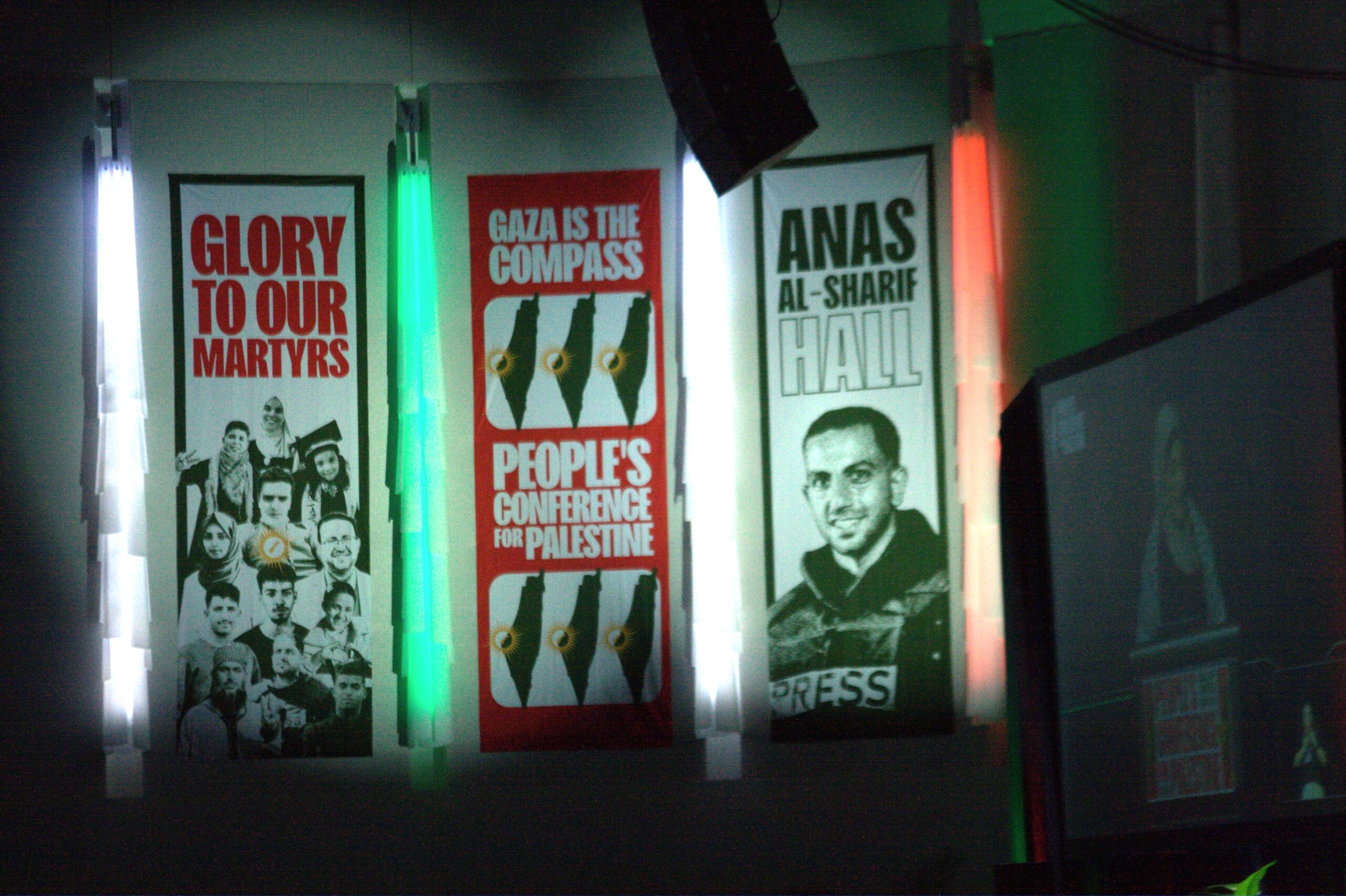

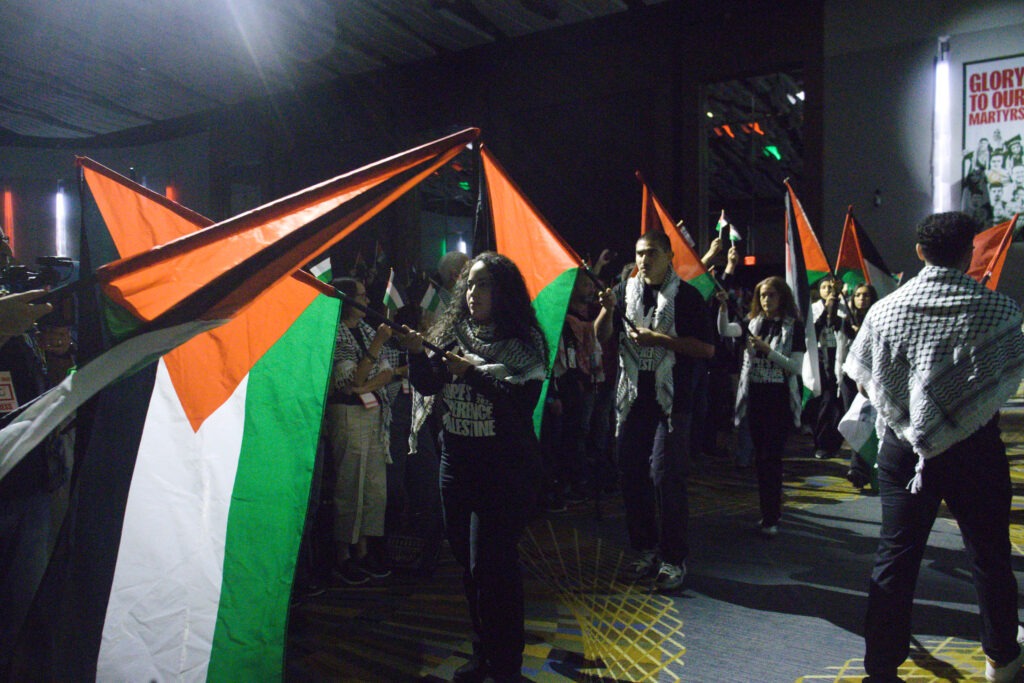
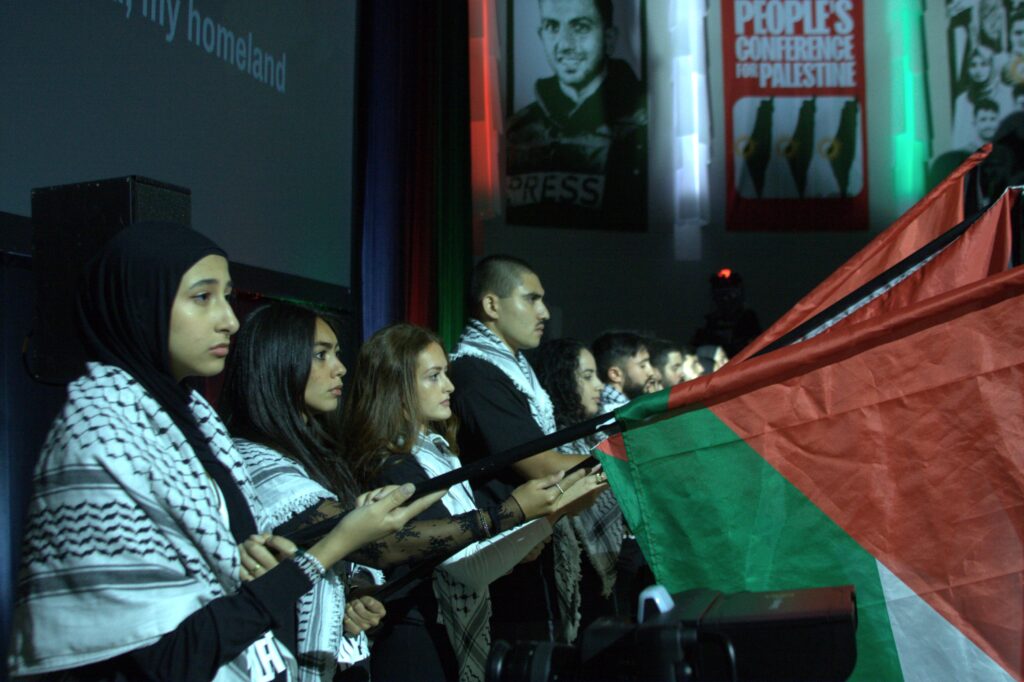
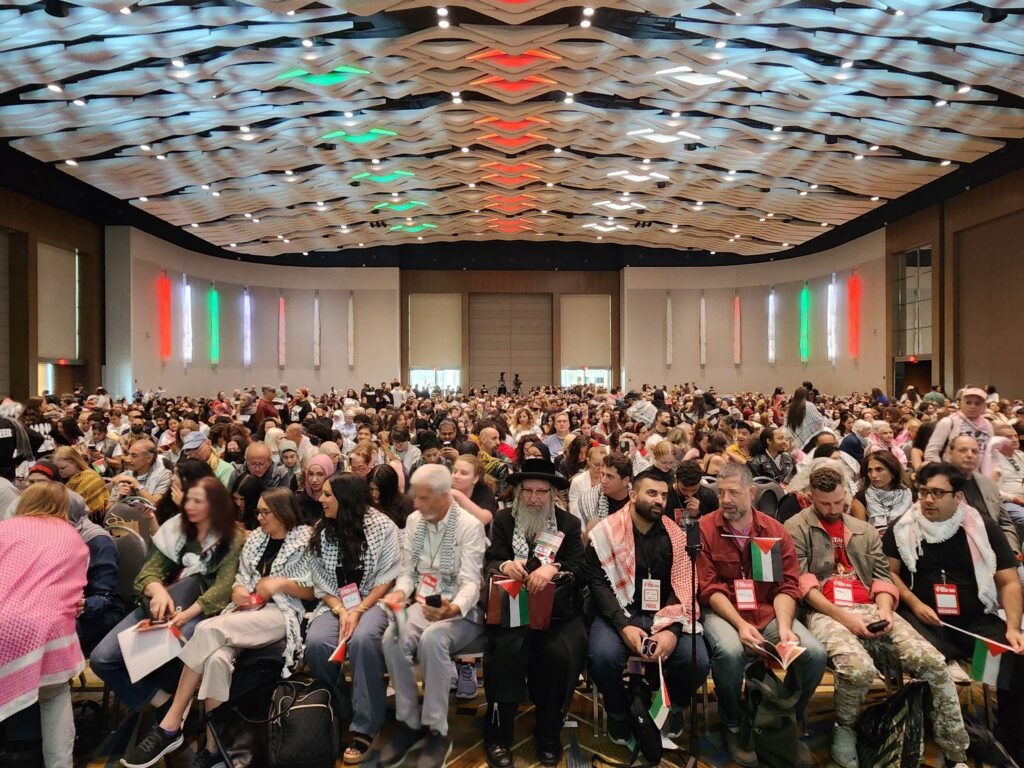
DETROIT—“Free, free Palestine!” thousands chanted as they waved their black and white keffiyehs and Palestinian flags in the air, with the beat of drums in the background. Thousands gathered for the 2nd annual People’s Conference for Palestine, which took place at the Huntington Place in Detroit on Aug. 29-31.
The conference occurred about five weeks shy of two years since Israel launched its U.S.-backed genocidal war on Gaza on Oct. 7, 2023. Operating under the theme.
“Gaza is the Compass,” 12 organizations convened the conference to address the genocide, to support the material needs and steadfastness of Palestinian people, to isolate and expose the atrocities of Israel and to offer concrete tools and lessons for attendees to take back to their communities.
“Welcome to the 2nd annual People’s Conference for Palestine,” Taher Dahleh, an organizer with the Palestinian Youth Movement and conference emcee, said in the conference’s opening remarks. “Our historic conference whose guiding principle is, ‘Gaza is our compass.’
Gaza, a tiny strip of besieged land which has transformed into the center of the world. Gaza, whose bravery and courage in the face of total onslaught from the United States and Israel has revealed core injustices at the root of our current reality and has moved millions into action.
Gaza, which demands of us that we here in North America commit every single fiber of our being to building a movement capable of ending the crimes of Zionism and of imperialism.”
Mr. Dahleh voiced some of the movement’s demands: a two-way arms embargo, complete economic and political sanctions on Israel, its military and its leadership, the free flow of lifesaving humanitarian aid into the Gaza Strip and an end to the genocide.
“This conference, brothers and sisters, is not only important because it brings together movements, organizations and leaders who have fought tirelessly to end the genocide and for the liberation of Palestine.
This conference is also important because it defies all the forces that conspire to stop and silence our movement,” Mr. Dahleh said. “They have tried to intimidate us with smears, with false accusations and with every single available threat at their disposal to stop this conference from happening. We will not stop.”
During the opening, attendees participated in a brief moment of silence and prayer for the martyrs of Gaza and for all of Palestine. Afterward, a Palestinian youth ensemble led the audience in singing “Mawtini” (My Homeland), an unofficial Palestinian national anthem by Palestinian poet Ibrahim Tuqan.
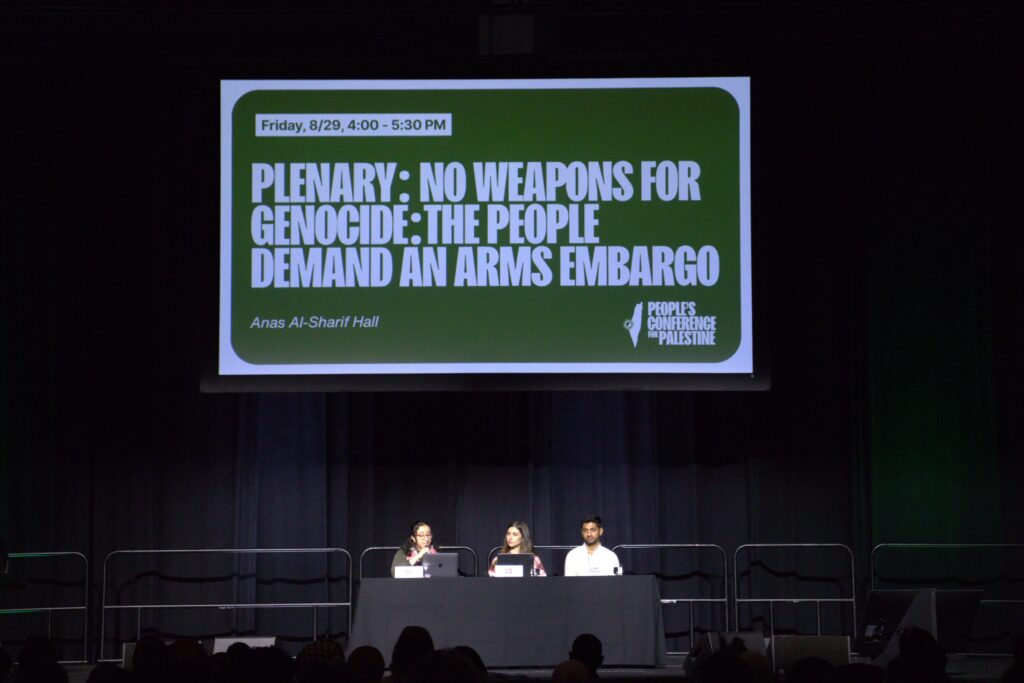
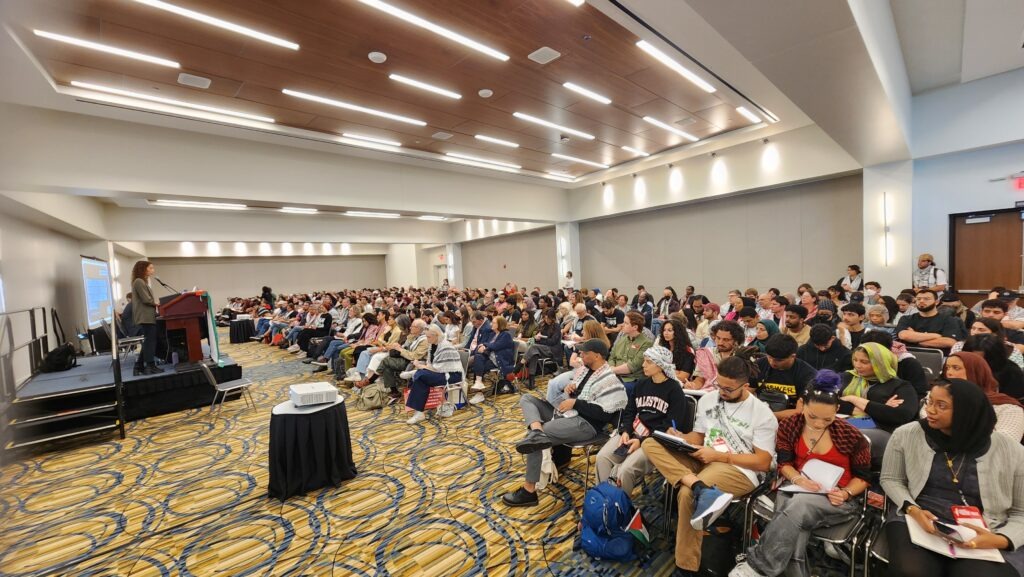
Plenaries covered Zionism and imperialism, the grassroots arms embargo, strategies to confront the genocide, starvation and siege, the fight for Palestine in North America, the Palestinian struggle behind bars and the current conditions of Palestine today.
Workshop session topics included how the genocide is changing Gaza, cultural resistance, food sovereignty, exposing companies and organizations complicit in the genocide, the student movement, strategies to isolate Zionism, Gaza’s medical capacity and healthcare, breaking the siege, legal action against war criminals and the global movement for Palestine.
This year’s conference also included a children’s program for ages 6-12.
Organizers incorporated art and culture through an art and photography exhibit, a virtual reality exhibit that took viewers on an immersive journey to the Gaza that existed before Oct. 2023 and performances featuring song and dance in the evenings. An auction for Gaza also occurred to raise funds for the Middle East Children’s Alliance.
Detroit is a majority-Black city situated next to Dearborn, which has an Arab-majority population.
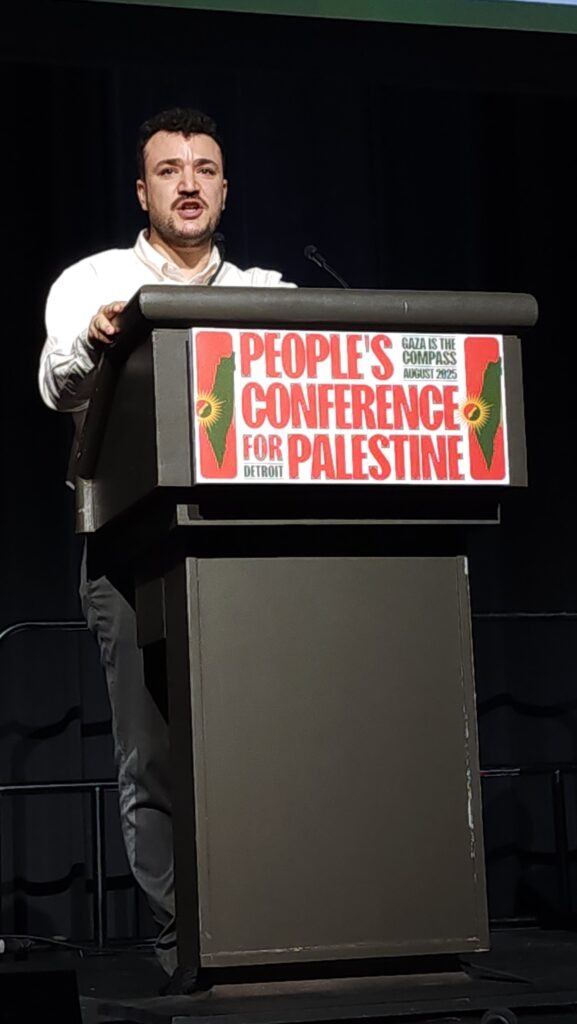
Metro-Detroit native Nelson Garay, a coordinating member of Detroit’s People’s Assembly and a son of Salvadoran immigrants, shared words about the unique history of Detroit.
Including the city being a key stop on the Underground Railroad during the Trans-Atlantic Slave Trade, the Blackburn Riots of 1833, when Black Detroiters rose up after the imprisonment of a Black couple.
The founding of the Nation of Islam in 1930, the Detroit Riot of 1967 and today, the continued fight against water shutoffs, gentrification, police violence and U.S. Immigration and Customs Enforcement (ICE) detentions and raids.
“Through this conference, I invite all of you to take part in the rich revolutionary tradition of Detroit and to add to this important legacy.
In one voice, let us declare that we will not stand for the dehumanization of the Palestinian people, and we will not settle for anything less than their true liberation from the genocidal apartheid state,” Mr. Garay said.
Palestine today
As Israel continues its genocidal war, Palestinians who live in the West Bank, Gaza and other areas of Palestine suffer from settler violence, territorial expansion, annexation, starvation, siege tactics and sustained military bombardment. A plenary session exploring these conditions looked at both achievements and setbacks in the struggle for liberation.
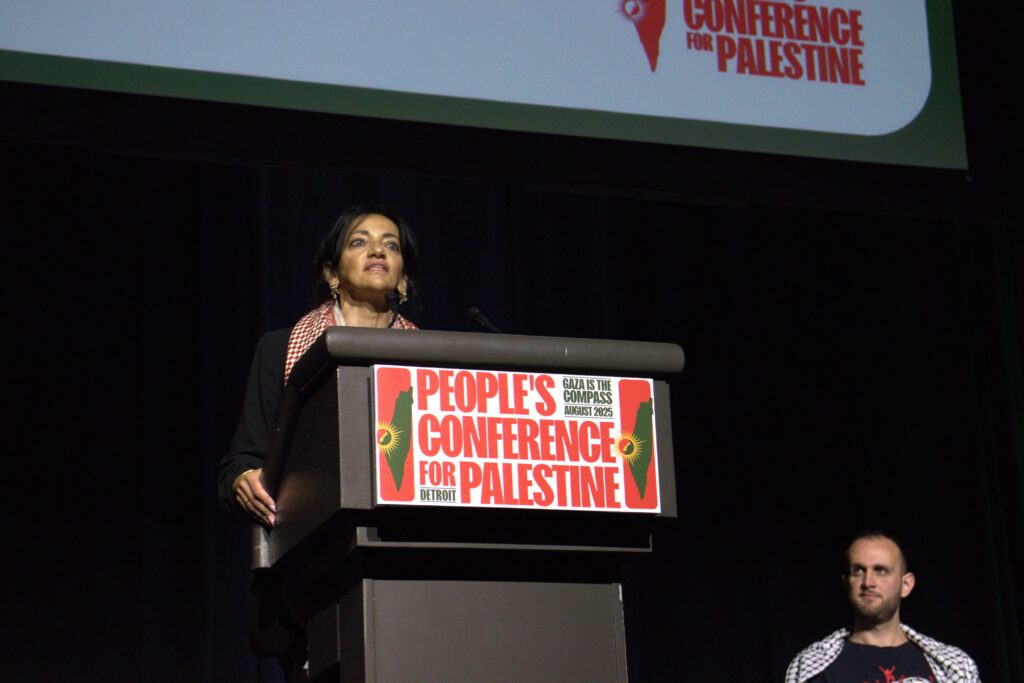
Panelist Fadi Quran, founder of Thiqa, an initiative working to reconnect Palestinian communities, discussed Israel’s strategy to use genocidal tactics and starvation in Gaza to fragment and dominate and to flood the West Bank with settlers, who have taken over much of the land.
He noted how Israel attempts to destroy everywhere Palestinians are resisting, including in refugee camps, and argued that part of Israel’s plan is to move toward giving Palestinians three options: becoming foreigners on their own land without rights, emigrate, or erasure and genocide if they refuse the first two options.
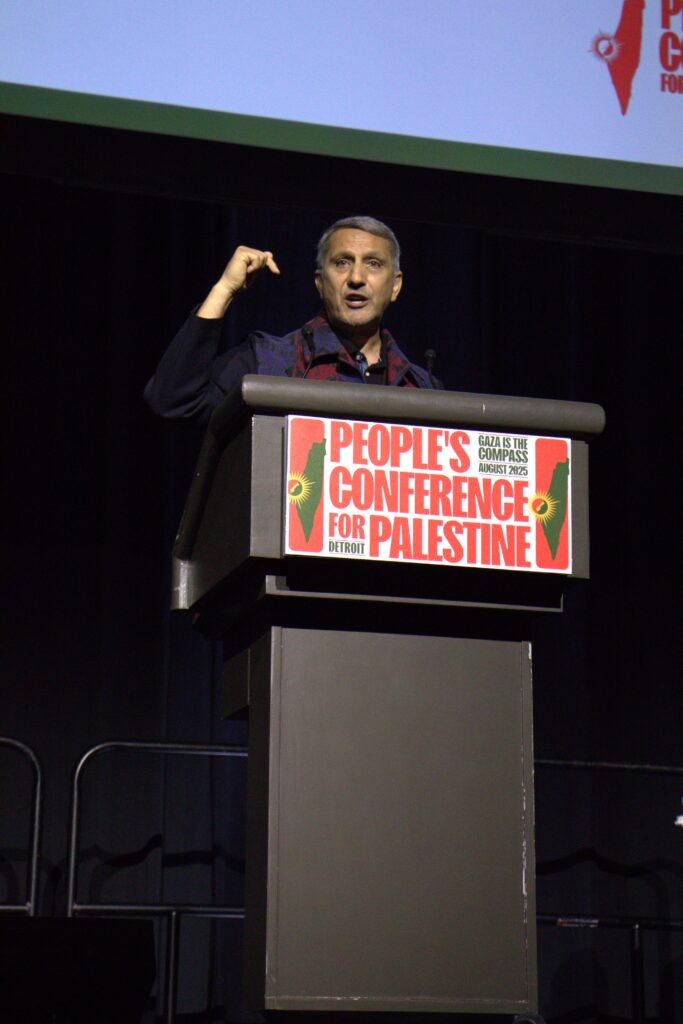
The panelists also addressed alleged internal repression by the Palestinian National Authority, which they referred to as the Palestinian Authority, or PA. They accused the PA of being designed to quell protests and described it as a dictatorship filled with corruption and bowing to U.S. and Israeli pressure.
“The PA is an enemy to resistance. As we speak, there are 400 resistance fighters in the prisons of the PA being tortured day in and day out,” Omar Assaf, a freed political prisoner, said, according to the Arabic-to-English translators.
He pinpointed pillars of resistance, including strengthening steadfastness, supporting the rural areas of the West Bank, centralizing the lists of companies and enterprises that should be boycotted and preparing a general strike and civil disobedience in the West Bank. He also echoed the need for international cases to be brought against Israel.
To overcome some of the present challenges in Palestine and to advance liberation, he ranked what the priorities should be, the highest on the list being to stop the genocide, starvation and war crimes in Gaza.
The second priority is to stop the settlements and confiscation of land; third, to stop the dictatorship taking over Palestinian leadership; fourth, to end the split in the political leadership in Palestinian factions; fifth, to end the corruption taking over leadership; sixth, to raise the consciousness of Palestinian people to work as a collective rather than as individuals and seventh, to look at the role civil society plays in the struggle.
The continued fight
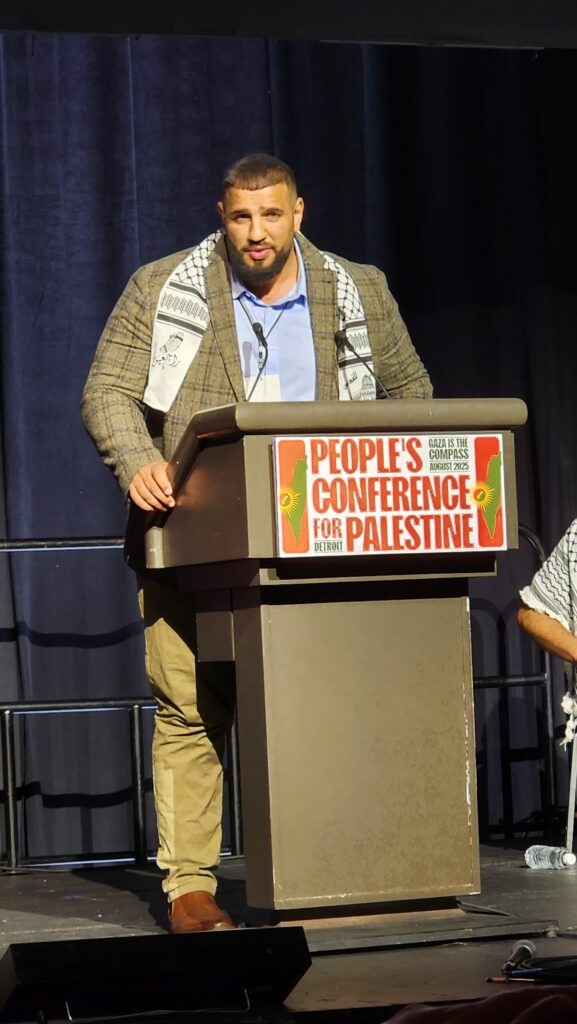
With family roots in Palestine, mixed martial artist and UFC champion Belal Muhammad was born a fighter. But addressing conference attendees, he shared how Palestinians have been fighting the real fight.
“When I fight, I go into the cage, 25 minutes. People ask, ‘Are you nervous? How does it feel?’ But I tell them this is not even a real fight. This is a game. The people of Palestine are fighting every single day to live, to see tomorrow,” he said.
“When I go into the cage and I’m fearless, it just pushes me to win and to never break. That’s what Palestine is. The people there will never break, they’ll never fold, they’ll never give up.”
He encouraged attendees: “Don’t shy away. Don’t be afraid. If you’re from Palestine, be proud of it. Walk with the flag. Walk with the keffiyeh. If people turn their head at you or look at you in a weird way, put your chin up, chest out. Show them we walk with pride. Show them who you are.”
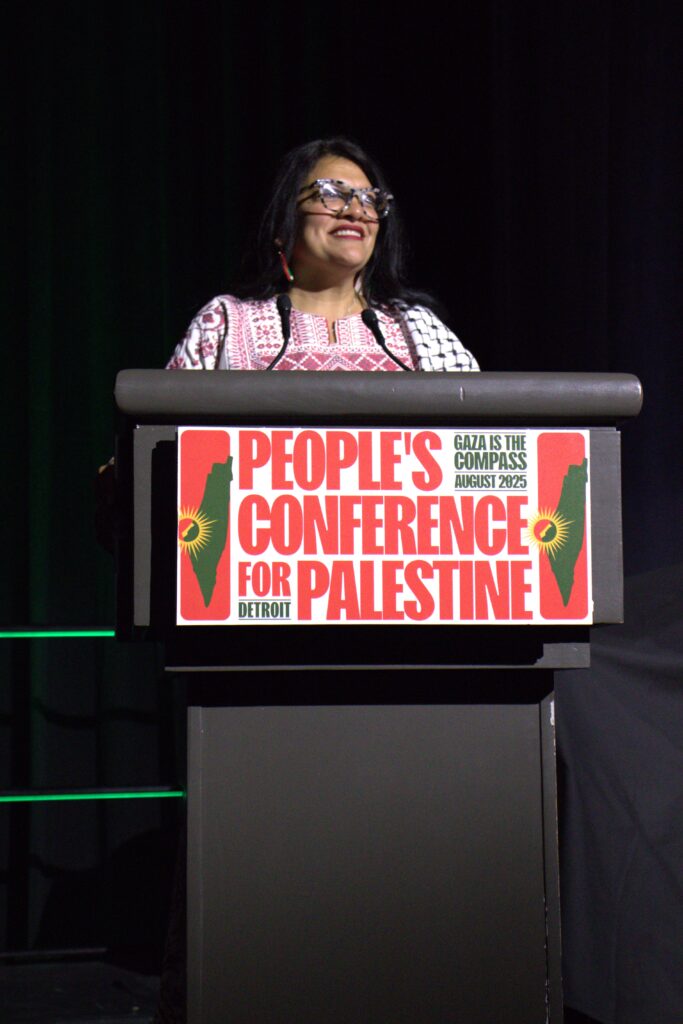
His remarks were followed by words from U.S. Congresswoman Rashida Tlaib (D-Mich.) of Detroit, who electrified the listening audience. She criticized the U.S. government for its role in the Palestinian genocide and called out the genocide enablers within the government.
“I want to say to all of them, every genocide enabler, look at this room … . We ain’t going anywhere!” she said. “It’s not the genocide-enabling Congress that will free our people. It is only us. It can only be us.”
She cautioned those in the audience that “what’s been tested on the killing fields of Gaza is already being deployed right here on the streets of America. What our government is willing to do to Palestinians, they are willing to do to all of you.”
The government that’s willing to supply Israel with bombs to destroy hospitals and to manufacture mass starvation “is also the same government that’s defunding health care and food assistance programs here in our country,” she added.
“It is no surprise that a government that uses its military force to kill and torture and kidnap people abroad will turn those same forces on its own people here on the streets. A government that doesn’t value human life in Gaza will never value human life in our country.”
In the conference’s closing remarks, Jenan Awaida with the Palestinian Youth Movement reminded attendees: “The purpose of this conference does not end when we leave this convention.”
“Liberation is achieved when the cost of occupation is higher than the cost of liberation, and this is what we must do from here in the diaspora. We must make the occupation and the genocide so untenable, so unsustainable, that they can no longer maintain it. Every sector of society must become a front for confronting Zionism,” she said.
“We are dealing with a world system that facilitates genocide through the role of government, corporations, media, institutions; a system manufactured by greedy corporations and billionaires. But comrades.
We come from a long legacy of people who have fought tooth and nail to take down these systems, people who have sacrificed their lives for this struggle, and we have a responsibility to keep fighting. And we fight not because we have hate in our hearts. We fight because we love life.”
She urged participants to go back to their cities and get involved in the campaign to cut the flow of weapons to Israel and the campaign to confront the pro-Israel lobby led by the American Israel Public Affairs Committee.
She also announced a mass protest that will take place outside of the United Nations General Assembly in New York City on Sept. 26.
“If the White House chooses to welcome war criminal Benjamin Netanyahu, we must show the world that we the people will never accept it. We will convene in the thousands in New York City to say that Netanyahu is not welcome, that he must be tried and convicted,” Ms. Awaida said.
Local Detroit resident and activist Raina Masra, 40, who attended the conference, enjoyed hearing from the diversity of speakers. “I think it’s critical to raise our voices.
I think people have been silent on this issue for too long, and it’s time for people to organize, get together, see what initiatives people are doing and learn how to join in,” she said to The Final Call.
She recognized that the conditions in Gaza and in the West Bank are already bad and are getting worse.
“We need to call for the Gaza Humanitarian Foundation to be shut down. It’s forcing people to go to militarized zones to collect aid, where they’re shot at and killed,” she said. “Aid needs to be let in, and the Palestinian people need to be liberated so they can be in control of their own destiny.”
