











by Janiah X
Contributing Writer
MIAMI—Katia (who did not wish to give her last name) is living in the dark. Her partner, Cuban reggaeton artist Leamsy La Figura, 34, is currently being held deep in the Florida Everglades at a newly built immigrant detention center dubbed “Alligator Alcatraz.”
La Figura, whose real name is Leamsy Isquierdo, was arrested on assault charges and then taken to a South Florida jail near Miami, Florida. From there, he wound up at the detention center about 75 miles away in a town called Ochopee.
“They don’t get a shower for like 5 days,” Ms. Katia described. “Sometimes the air conditioner is off.” Ms. Katia says Mr. Isquierdo does not pop up in any state, county, or even ICE locator. She knows he is at the facility because of her attorney. “He is not in a system,” she said. “It’s like he is a disappeared person.” She also shared her story on Instagram.
Ms. Katia is one of many who are concerned for their loved ones being detained at this particular facility. She, along with scores of immigration advocates, Indigenous people, attorneys, politicians, environmental advocates and community members, are sounding off against the controversial facility, which has become one of the latest pegs of the nationwide immigration crackdown kicked into high gear by the current presidential administration.
Allegations of concerning conditions, lack of oversight
Just days after receiving its first detainees, reports and allegations of inhumane conditions have surfaced out of the so-called “Alligator Alcatraz.”
Renata Bozzetto, deputy director of the Florida Immigrant Coalition, an organization focused on protecting Florida immigrants, described similar conditions to those of Ms. Katia.
“People are without a shower for 4 to 5 days,” she said. “People are receiving water once a day. They have reduced meals … . To have dozens of people inside one tent, the possibility of disease spreading is incredibly high, because there is no separation. People are in cages inside, so the conditions in the facility we know already are absolutely horrific.”
These accounts have been relayed to Ms. Bozzetto from anxious family members who have loved ones at the facility. They, along with members of the community, advocates, and attorneys, have reached out to the Florida Immigrant Coalition for support and action.
According to the Miami Herald, some of the first detainees complained of giant bugs, little or no access to showers or toothbrushes, and a lack of confidential calls with attorneys. They worry about being deported back to their home countries.
Florida Attorney General James Uthmeier announced plans to build the so-called Alligator Alcatraz on June 19, and two days later, protesters arrived at the site. Mr. Uthmeier called it “the one-stop shop to carry out President Trump’s mass deportation agenda.” By July 2, the facility had taken in its first detainees.
Florida Governor Ron DeSantis plowed ahead with the construction of the facility on the grounds of the Dade-Collier Training and Transition Airport, located in southwest Florida. The airfield, located on land owned by Miami-Dade County and preserved land, was not in use. Construction halted in 1970 because of environmental concerns.
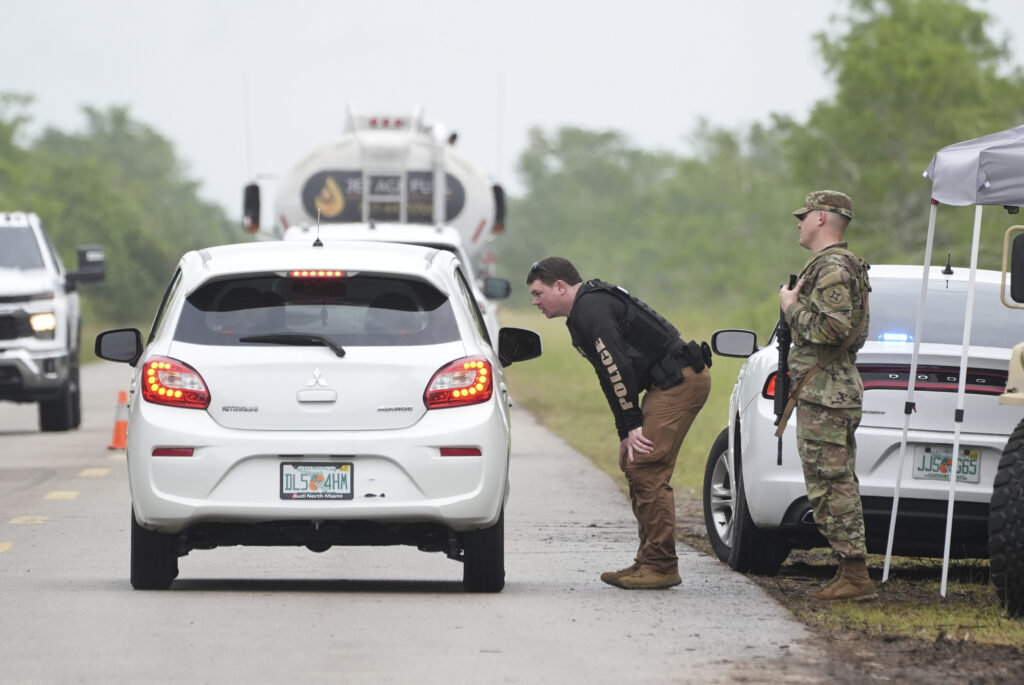
Gov. DeSantis seized control of the land in 2023 after signing executive orders to declare a statewide emergency on what he called an illegal immigration crisis.
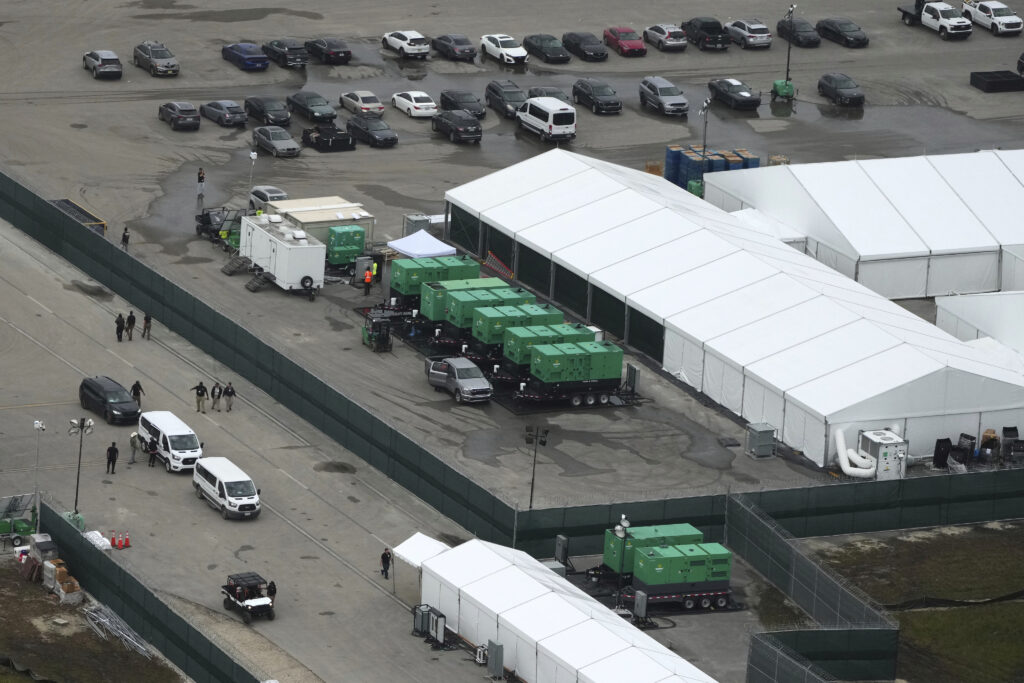
The camp, which Gov. DeSantis’s administration said is temporary, is a mass of heavy-duty tents, trailers and other buildings. It’s set to house 3,000 detainees and free up space in local jails. During President Trump’s tour of the facility on July 1, cameras showed bunkbeds in cages under a large white tent.
It is unclear how many detainees are currently there, although some reports state the number is estimated to be several hundred. The Miami Herald reported that “Mixed among the detainees accused and convicted of crimes are more than 250 people who are listed as having only immigration violations but no criminal convictions or pending charges in the United States.”
Days after detainees arrived, an ambulance was seen leaving the facility after a detainee reportedly suffered a medical emergency.
Tricia McLaughlin, assistant secretary for public affairs at the Department of Homeland Security, claimed on X that the detainee was not hospitalized, but was simply transported to a Miami-Dade hospital, and returned to the facility in about an hour and a half.
The Department of Homeland Security took to social media to refute claims of maltreatment at the detention facility. One post read, “All detainees are provided with proper meals, medical treatment, and have opportunities to communicate with lawyers and their family members.”
When five Democratic members of the Florida state legislature attempted to inspect the facility’s conditions for themselves on July 3, they were turned away, despite citing a Florida statute, which states legislators can visit all state correctional institutions “at their pleasure.”
“The administration that is in Washington, D.C., has shown themselves not to be friendly … or to show any type of humane treatment to immigrants,” said Florida State Senator Shevrin Jones.
State Senator Jones, whose district consists of a predominantly Black population in South Florida, was among the legislators who were turned away from visiting the facility.
“If you name something Alligator Alcatraz, in any type of leadership position, no matter whether I’m a Democrat or Republican, I would want to know how you have been able to create a detention center in 8 days,” State Senator Jones said.
“And then last, but certainly not least, is the treatment of the individuals who are inside the facility that we don’t even know if it’s true that it’s the worst of the worst of illegal criminals.”
The July 3 visit was among attempts at oversight of the facility. The Florida Division of Emergency Management later invited state and congressional lawmakers to the facility for a 90-minute tour. However, a group of them slammed the invitation as an attempt to sanitize the truth.
“As Members of Congress, we were planning an unannounced oversight visit of this Everglades detention facility,” they wrote in a joint statement. “Today, we received notice from the state announcing its own planned ‘tour’ at the same time, on the same day. We do not need permission to conduct lawful oversight.”
Miami-Dade County Mayor Daniella Levine-Cava also sent letters to the Florida attorney general, requesting visits to the site, weekly reports and remote video monitoring access.
The 5 Democratic leaders who attempted to visit the facility have since filed suit against the Florida governor, arguing that he overstepped his authority in blocking legislative oversight of the facility.
“The DeSantis Administration’s refusal to let us in wasn’t some bureaucratic misstep. It was a deliberate obstruction meant to hide what’s really happening behind those gates,” the lawmakers said in a joint statement.
“There is no statute that permits the Governor to overrule the Legislature’s oversight authority. This lawsuit is about defending the rule of law, protecting vulnerable people inside that facility, and stopping the normalization of executive overreach.”
Rep. Maxwell Alejandro Frost, 28, represents Florida’s 10th congressional district.
“We saw abhorrent conditions, a lot of crowding, 32 male individuals per cage. These people are being caged, 3 toilets per area and the drinking water comes from the toilet apparatus in the cell,” he told Democracy Now.
“I saw myself in those cages,” said Rep. Frost, who is Black and Cuban. “It was a lot of people who looked like me that were my age,” he added. “I’m the first Afro-Cubano in Congress.
I’m walking out of there thinking to myself, I’m going to be one of the only people that looks like me that is Latino that will walk into this facility and walk out on my own accord.” He said he refuses to call the facility by the moniker it has been dubbed.
One of the things that instantly caught people’s attention about this new facility? The name. “We very soon realized the marketing campaign that was involved in branding this detention camp as an ‘Alligator Alcatraz,’” Ms. Bozzetto said.
She called the marketing strategy “absolutely disgusting.” Merchandise lines popped up before the facility opened. According to Politico, the Republican Party of Florida sent out a fundraising email on June 27, urging supporters to buy a t-shirt or hat to “keep Florida tough on crime and tougher on borders.”
The marketing campaign and merchandise have used imagery of alligators and pythons guarding the detention camp. On social media, some people have taken pictures of alligators and joked that they were ICE agents.
Both Gov. DeSantis and President Trump have made references to the natural habitat.
“Snakes are fast, but alligators. … We’re gonna teach them how to run away from an alligator, okay, if they escape prison,” President Trump told reporters before visiting the facility.
During a news conference, Gov. DeSantis said, “Clearly from a security perspective, if someone escapes, there’s a lot of alligators you’re going to have to contend (with). No one is going anywhere once you do that. It’s as safe and secure as you can be.”
“People are absolutely not in favor of the detention camp, period, other than the individuals who jumped on the bandwagon of this marketing campaign and who are feeding the coffers of whoever is doing Alligator Alcatraz t-shirts as if it was a tourist attraction,” Ms. Bozzetto said.
She pointed to a poll done by YouGov, which found that 48% of the nearly 3,000 respondents were not in favor of the facility, while just 33% said they supported it; 18% were unsure.
Florida Rep. Michele Rayner, one of the Democratic leaders, turned away from the facility, said there’s a reason why it’s being associated with the infamous former federal maximum security prison, Alcatraz.
“Alcatraz is one of the most notorious prisons,” she told reporters. “If you’re trying to escape, they say that water was infested by sharks. The language is the same here. It’s in the swamp, and they say that it’s surrounded by alligators and pythons.”
Concerns the Florida Everglades and
Indigenous land are under threat
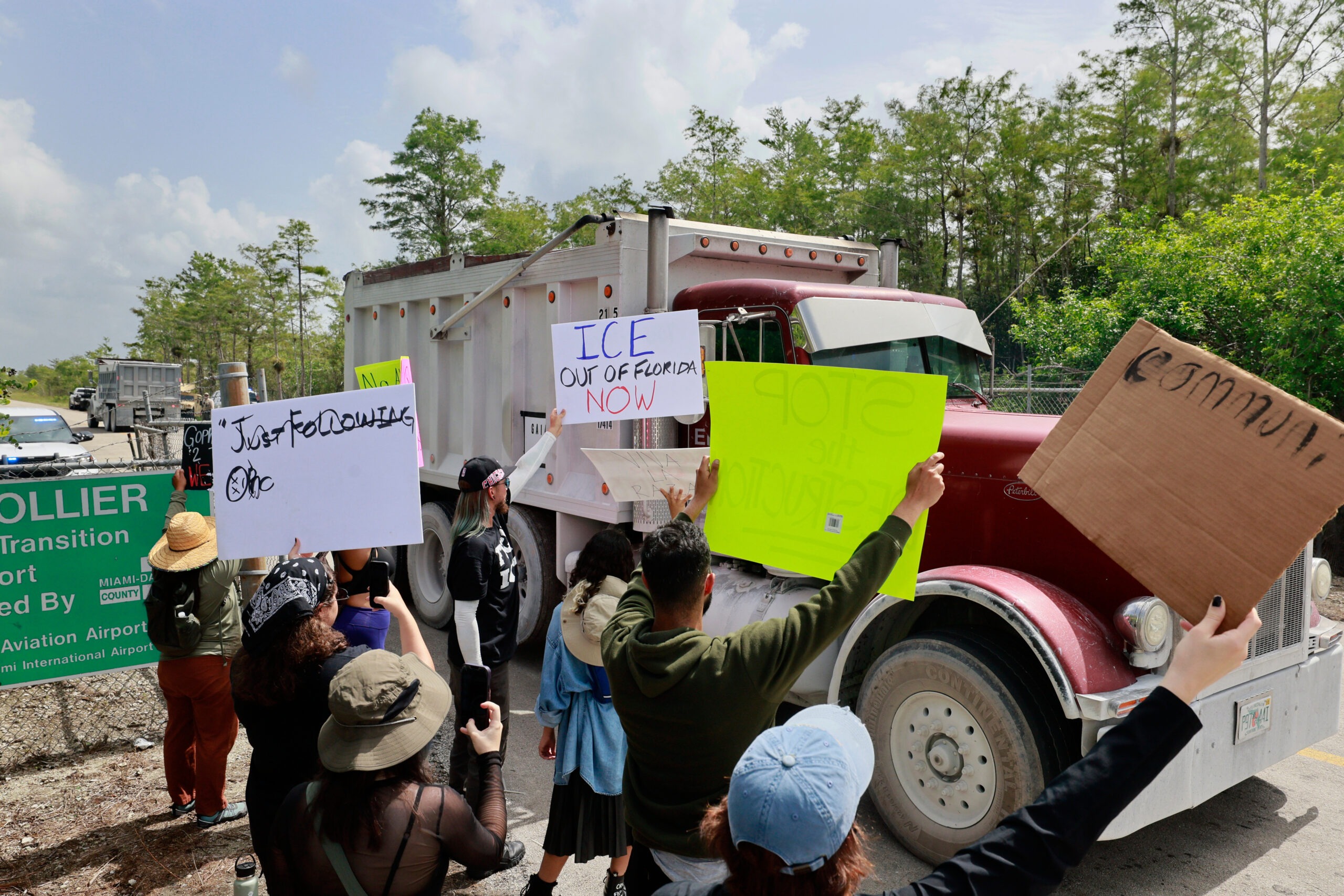
Since the announcement of “Alligator Alcatraz,” people have gathered outside the facility to protest its construction, particularly because of its threat to the rich ecosystem of the Florida Everglades.
The Everglades is a 1.5-million-acre wetland and is the largest subtropical wilderness in the United States. It is home to a diverse group of plants and wildlife, as well as a source of drinking water for about 8 million people.
Environmental groups worry the detention camp will hamper efforts to restore and protect the ecosystem. Among them, Friends of the Everglades, Earthjustice, and the Center for Biological Diversity. They filed a lawsuit to keep that from happening.
“This massive detention center will blight one of the most iconic ecosystems in the world,” said Elise Bennett in a news release. She is the Florida and Caribbean director and attorney at the Center for Biological Diversity.
“This reckless attack on the Everglades—the lifeblood of Florida—risks polluting sensitive waters and turning more endangered Florida panthers into roadkill. It makes no sense to build what’s essentially a new development in the Everglades for any reason, but this reason is particularly despicable.”
Furthermore, the facility sits on Indigenous land. Both the Seminole Tribe of Florida, which is Florida’s largest federally recognized tribe, and the Miccosukee Tribe of Indians have denounced the facility, and the threat it poses to the land where tribal members live, work, hunt and pray.
The detention camp sits 20 minutes from the main Miccosukee reservation and less than 100 yards from the Panther Camp, raising not only environmental, but also safety concerns.
Ms. Rayner says she spoke with one of the indigenous tribal leaders during her visit.
“When you put this facility up, this makeshift facility, you disturb the precious ecosystem,” Ms. Rayner said.
Another facility?
Gov. DeSantis reportedly plans to build a second ICE detention center in the Northeast part of Florida. It could potentially be built at a Florida National Guard training center known as Camp Blanding, about 30 miles Southwest of Jacksonville.
“It’s very interesting to me that Florida can find the amount of money to house immigrants, but we can’t find the money to house the unhoused that’s in our large communities,” State Senator Jones said. “The fact that we can do this and not make sure that our children are being educated is baffling to me.”
As for the newly built facility, Ms. Rayner says the Florida legislature plans to ask for oversight committees. Meanwhile, grassroots organizations and activists continue to protest.
Ms. Katia, along with many others with loved ones inside the facility, simply wants to know that her partner is safe. “I’m so worried,” she said. “I need him to get the opportunity to get due process, the right process, unlike the crazy process they’re doing right now, because he is a resident,” she said.
