





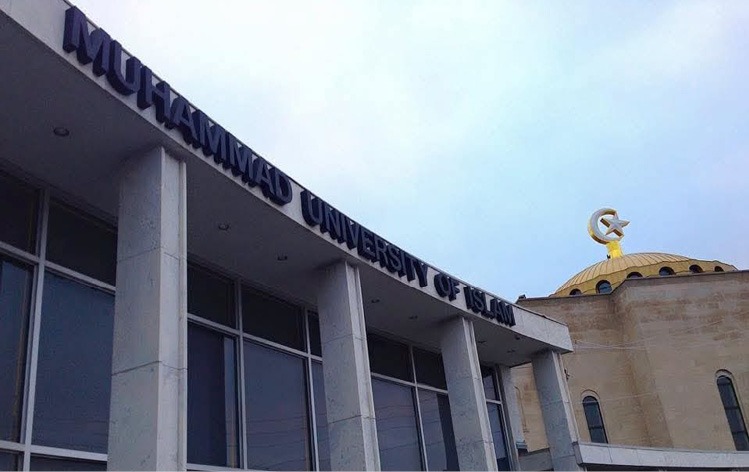

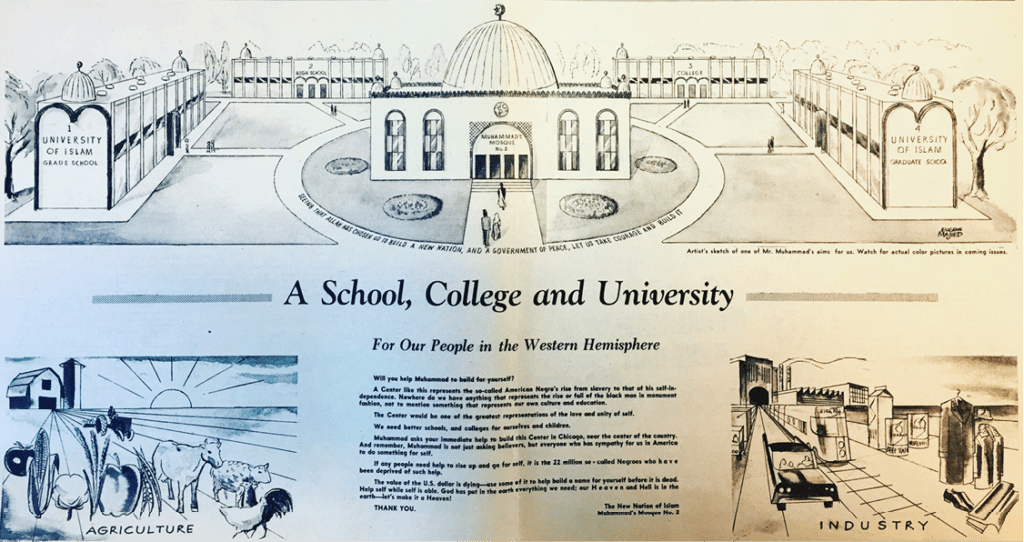
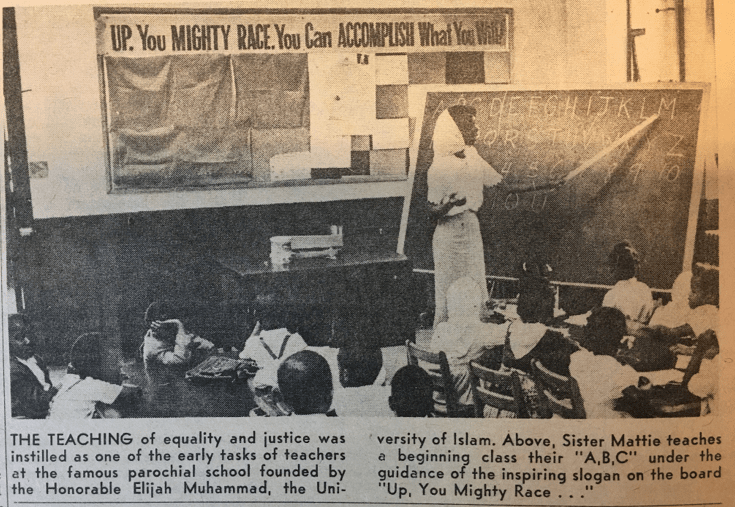
In the early 1930s, the Most Honorable Elijah Muhammad, Eternal Leader of the Nation of Islam, and His followers removed their Muslim children from the Detroit public schools and put them in the newly established Muhammad University of Islam (M.U.I.), an independent educational system still in existence today.
The Honorable Minister Louis Farrakhan, National Representative of the Most Honorable Elijah Muhammad, has pointed out that the current public school system in America is not beneficial for Black children.
“Elijah Muhammad taught us if a man won’t treat you right, what would make you think that man would teach you right? In the public schools, the enemy wants to make us better tools of service for him,” Minister Farrakhan said during his Holy Day of Atonement 2018 address in Detroit.
In his book, “A Torchlight for America,” published in 1993, he further stated, “The Honorable Elijah Muhammad said that education is the torchlight of civilization. If the educational system is declining, this is a sign that the whole of the civilization will follow into a state of decline.”
More than 30 years after his book was published, public schools in the U.S. are in a crisis. Nearly 1,200 public schools closed during the 2025-2026 school year, according to newly released data from the National Center for Education Statistics (NCES). This was the fourth consecutive annual increase in school closures. In comparison, 755 public schools closed in 2021-2022.
While the number of majority-Black public schools that closed has not been calculated, researchers have documented that majority-Black public schools are disproportionately likely to close compared with schools serving other student populations.
Racial inequities in public school closures
In a 2023 study, researchers Dr. Danielle Greene-Bell and Dr. Francis Alvin Pearman examined racial inequity in school-closure patterns in California and across the country.
They looked at public school closures from 2000 through 2018 and found that majority-Black schools represented about 10% of U.S. public schools but were more than three times as likely to close as schools with other racial compositions. Differences in enrollment, achievement, school size, poverty, location and other measurable characteristics did not fully explain the gap.
Dr. Greene-Bell, chief engagement officer at Richmond Public Schools, started her research into public school closures at a majority-Black high school in Oakland, California, where she noticed anxiety around the school possibly closing.
“People, when I would ask about it, would say, ‘Well, you know, we’re one of the only majority-Black schools. You know they love to close down Black schools,” she said to The Final Call.
From there, she pulled data from the NCES and worked with her professor at the time, Dr. Pearman of Stanford University, to demonstrate scientifically that “majority-Black schools across the nation are more likely to be closed.”
“If you have two schools that are essentially identical, and the only difference is one is majority-Black and one is any other racialized composition, the majority-Black school will be the one that is more likely to be closed,” she said.
In the paper, the researchers argue against those who attempt to dismiss anti-Black racism as one of the reasons for Black public school closures.
“What I say instead is while I can’t say for certain, scientifically, that it’s anti-Black racism, we also can’t say that it’s not,” Dr. Greene-Bell said. She gave the example of a school that was closed in Virginia because it was built on a landfill.
“The reason people will say, ‘It’s not because the kids there are Black. It’s because it was built on the landfill, and it is toxic to the children. It’s actually better for the Black children that their school gets closed.’
But actually, when you think about it, why would a school be allowed to have been built on a landfill, and would a school have been able to be built on a landfill if it had been built for any other children other than those who are Black?” she questioned.
A March 2026 analysis added another layer to Black school closures: the language used to justify closures. It argues that districts often frame decisions through technical terms such as “right-sizing,” “portfolio management,” or “efficiency optimization,” while failing to acknowledge priorities expressed by Black residents.
Black communities in different parts of the country are currently being challenged with school closures. In metro-Atlanta, the DeKalb County School District announced in February its consideration of closing 27 schools, citing a decline in student enrollment. DeKalb County is 51% Black, according to the U.S. Census Bureau.
A local news outlet in San Jose, California, reported in February that the local school district’s “choice to close up to nine elementary schools this year will disproportionately impact Black and Latino students.”
East Arcadia School, a majority-Black school in North Carolina, had its last day of classes on June 4 before being closed for good. Board members cited declining enrollment, financial issues and staffing challenges, according to The Assembly, a media outlet in North Carolina.
The outlet reported that 11 public schools with majority-Black student populations closed in North Carolina this year and that 73% of the state’s traditional public schools that closed between 2011 and 2025 disproportionately impacted non-White students.
In July, parents in Pittsburgh filed a civil rights complaint alleging that approved school closures discriminated against Black students. On May 27, the Pittsburgh Public Schools Board of Directors approved a plan to permanently close nine school buildings and 12 schools, reconfigure 10 schools and terminate magnet programs.
“The Plan disproportionately burdens Black students by causing them to lose the unique educational resources provided at their schools, failing to explain how those resources will be provided at reassigned schools, and disproportionately requiring Black students to absorb the disruption, transportation, and academic costs of transitioning to a new school,” the complaint says.
What happens to Black communities when majority-Black schools close? Dr. Greene-Bell said the neighborhood is more likely to be gentrified.
“In some places, schools are community hubs. They provide community resources. They provide grounding. They offer historicity to the area,” she said. “People talk about those schools as if they are part of their identity.”
“For the children inside of those schools, you have to think about what it means to be moved from your norm, a place where maybe you have strong relationships with your teachers, strong relationships with your friends, and school might be the only consistent thing for you in your life,” she added.
Taking control of our own education
As public schools close, advocates of homeschooling and independent Black education said they have seen upticks in Black parents looking to other options. In fact, that may be one of the reasons for declining enrollment in public schools, they said.
“What we’re finding is that there are a lot of students that are leaving public schools for charter schools, for private schools. Homeschooling has also taken a surge in the last 20 years or so, but certainly since COVID, and so a lot of people are pulling their children out of public school,” Baye Kemit, president of the Council of Independent Black Institutions, said to The Final Call.
Joyce Burges, co-founder of the National Black Home Educators, said more Black people are choosing to homeschool their children for a variety of reasons, including family togetherness, spending one-on-one time teaching their children, tending to children with developmental challenges and keeping their children safe and secure.
“Children learn better face-to-face. You can’t beat one-on-one instruction,” she said to The Final Call. “A parent can pour into a child academically, because that child is right there, and they’re giving that child one-on-one attention.
Especially a parent who really desires for their children to learn to read, learn to do basic mathematics, on and on, how to write, a parent can spend that time one-on-one with that child and know that that child is getting exactly what they need.”
She started homeschooling her children in 1990. Now, her children are homeschooling their children. “When I look at the children and how they are raising their kids, I see that homeschooling benefited our family greatly. That is proof to me that homeschooling worked for our family,” she said.
Mr. Kemit and his wife founded two Black/African-centered schools in Trenton, New Jersey, and Atlanta.
“Independent Black schools protect the Black child. Independent Black schools are created as a complement to the Black family,” he said. Mr. Kemit said their goal is to look at how this type of education is going to better our families, our communities and our people.
“We’re not just necessarily trying to have our children pass a test. We’re not necessarily trying to make them good workers for someone else’s corporation. We’re trying to make them think in a way that is going to create a nation of self-sufficiency for Black people,” he added.
He shared that historically, as early as the 1790s, from abolitionist Prince Hall in Boston to the Nation of Islam, Black people have always sought to educate their own children in the U.S., recognizing education as essential to freedom and self-determination.
“The first thing that we talked about when we came out of enslavement is that we need land, we need families and we need schooling,” he said. “It was always this push for education all throughout all of our movements, through our challenges here in America.
We are not in any situation today that we have not ever been in. We’ve been in the same situation for [400] years in this country. And until Black people understand that the government, that the state, is not going to educate your children in the way that is going to save our families, then we’re going to continue to have the problems that we have.”
Today, Black independent schools stand on the shoulders of those who suffered, like the Most Honorable Elijah Muhammad and the early pioneers of the Nation of Islam, who were arrested in Detroit for taking their children out of the public schools to teach and educate them in their own school.
“When we took our children out of the public school, they came to the school and arrested the teachers. Elijah Muhammad went to the jail and said, ‘I am their teacher so if you’re going to arrest them, arrest me too,’” the Honorable Minister Louis Farrakhan said in his 2018 Holy Day of Atonement address.
“Today if you have an independent school, somebody paid a price. If you have Afrocentric education, somebody paid a price. If you know how to stand up for your beautiful Black self, somebody paid a price.”
In a 2012 interview with Cliff Kelley on Chicago’s WVON 1690AM radio station, Minister Farrakhan said Black people need to “scrap” that which has proven to be unworthy.
“I know that our children are being given an inferior education; and those who want to control the minds and hearts of the American people have purposely dumbed down the American people. We must change the education in the public schools,” he said. “We have to be concerned about education, the right kind of education, for all American children: Black, Brown, Red, Yellow and White!
“America’s education system has failed—but we, The Nation of Islam, have a System that would not only be good for Black people, it would be good for White people! It would be good for all people, because everyone needs a Superior Education in order to master the circumstances that Life presents,” he added.
“While the education model we have is not yet perfect, and we are perfecting our model, we are still a long way from the madness that we see in our public schools.”
He shared the desire for American educators to allow the Nation of Islam to help teach Black students who attend public schools. “We’re not there to teach them hatred of any people, but to get them to fall in love with themselves!” he said.
“And the more you teach them the richness of their history and The Nature of God that sits deep within them—and the power that they have once they are ‘turned on’: We’ll never have to beg another people again.”
