








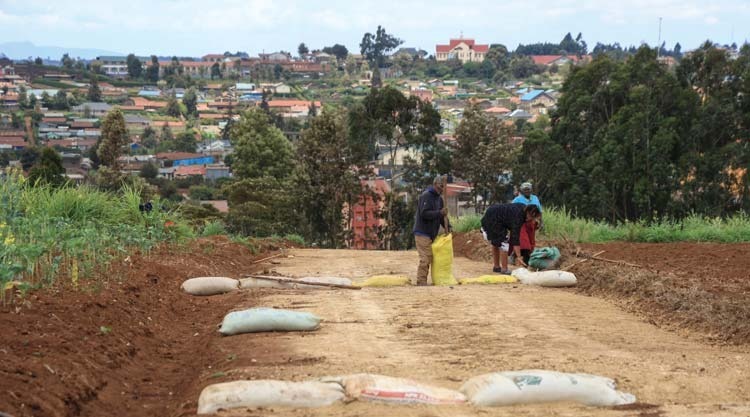

Parts of the Motherland are working to preserve farmland that could be in jeopardy. To curb soil erosion from heavy rains in October and forecast to last through December, Kenyan farmers are digging ditches, placing sand, soil-filled sandbags, and planting deep-rooted vegetation. Heavier-than-normal rainfall in East Africa, driven by a weather pattern called “El Niño,” has accelerated topsoil loss, runoff , and landslides across sloped and agricultural areas.
Kenya and some other parts of eastern Africa have two main rainfall periods: the “long rains” season of March to May, and the “short rains” season of October to December.
After a devastating year of topsoil loss from heavy rain two years ago, Elizabeth Itotia told Associated Press that she is taking no chances as Kenya faces the October–December rainy season, which is expected to bring heavier-than-usual downpours.
“You can see a grader has cleared, a trench (was dug) so the runoff water wouldn’t flood our farms. That’s why we are putting in place trenches like bumps so that the runoff water will not have so much force. But rather will stop and irrigate our farms,” said Itotia, reported apnews.com in an article titled, “Kenyan farmers race to protect crops and soil ahead of El Niño rains.”
El Niño is a weather pattern that may be driven by warmer-than-average Pacifi c Ocean waters, but its effects can be felt thousands of miles away, bringing heavierthan-usual rainfall across East Africa.
The farmers protecting the soil are vital, not just to save this season’s harvest, but to keep soil productive for years to come.
In an analysis in December 2023, a group of scientists from the World Weather Attribution, noted that human caused “climate change” actions played a role in extreme weather and they it had made last year’s “short rains” season in Kenya and other parts of East Africa up to two times more intense, reported AP news service.
A “Famine Early Warning System Network (FEW NET)” report titled, “El Niño impacts leads to poor production across East Africa’s high potential zones,” noted that. “A well-established El Niño is expected to significantly enhance the October–December (OND) 2026 rainfall season across much of Eastern Africa. The latest outlooks, El Niño continues to strengthen, with a greater than 90 percent probability of persisting through early 2027.”
Another study by the Institute for Security Studies (ISS), “A Super El Niño could turn Africa’s food crisis into conflict,” laid out that solutions should include, “… integrated agricultural, economic and security responses to protect vulnerable communities and prevent instability.”
According to the ISS report, “The world will experience a Super El Niño event from December 2026 to February 2027, the World Meteorological Organization (WMO) says—with devastating effects on African agriculture and food security.”
The Honorable Minister Louis Farrakhan, National Representative of the Most Honorable Elijah Muhammad, has taught on the ultimate cause and source of severe weather that impacts the U.S. and other parts of the world. In his 2016 interview published in The Final Call, Minister Farrakhan stated the following: “Now, they can blame it on El Niño, but El Niño is a force that is under the control of Him who can create the weather that was prophesied to come.”
The Most Honorable Elijah Muhammad taught that Allah’s (God’s) Judgment of America will include it being punished by the forces of nature and His top student, the Honorable Minister Louis Farrakhan, teaches the same and also explained that other areas of the Earth will be impacted.
“Remember His (the Most Honorable Elijah Muhammad’s) words from the book ‘The Fall of America’; that God is going to use the Four Great Judgments of rain, hail, snow and earthquakes: ‘The four great judgments that Almighty Allah (God) is bringing upon America are rain, hail, snow and earthquakes. The forces of nature are great weapons as we see them in play upon America. … What can you do with a God like that?’” Minister Farrakhan said in his message, “God Will Send Saviours,” delivered February 27, 2011.
Follow Jehron Muhammad @Africawatchjfcn on X
