










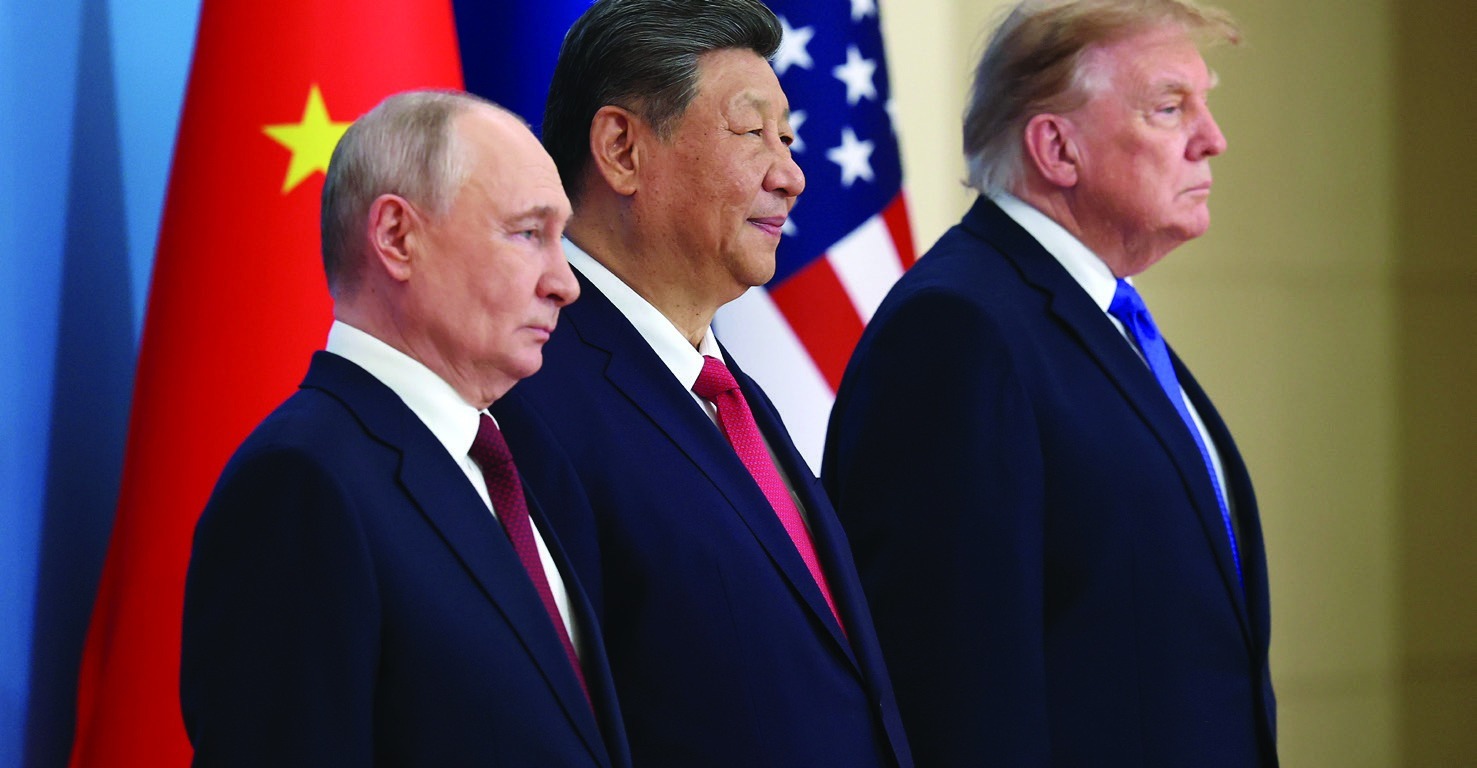

Eyes around the world were on Shenzhen, China, Nov. 19, as U.S. President Donald Trump, China’s President Xi Jinping, and Russia’s Vladimir Putin emerged from a nearly 90-minute historic meeting in which global issues were discussed.
Referred to as a “trilateral summit,” it was a first-ever simultaneous meeting between leaders of the three countries. President Putin proposed the meeting during a phone conversation with Mr. Trump, suggesting it be hosted by President Xi during Mr. Trump’s visit there for the Asian Pacific Economic Countries (APEC) forum.
Although no announcements were made on the much-anticipated updates on the wars in Iran and Ukraine, outcomes of the meeting were to reform the United Nations to its mission of international peace and security; Increase the production of refined petroleum products and to stabilize energy flows; reaffirm the need to reduce risks of nuclear war; and ensure that the International Criminal Court (ICC) and similar bodies do not abuse their jurisdictions.
Mr. Putin currently has an ICC arrest warrant as an alleged war criminal.
Leaders expressed various opinions about the summit. Malaysian Prime Minister Anwar Ibrahim told the South China Morning Post there is a need for dialogue toward “lasting peace and harmony,” While Dylan Loh, associate professor of foreign policy at Nanyang Technological University in Singapore, thought Southeast Asian countries like Singapore and Malaysia would take a “wait and see” approach to whatever comes out of the meeting.
Benjamin Ho, an assistant professor at the S. Rajaratnam School of International Studies in Singapore, however, said the meeting would have worried Japan and Europe more than Southeast Asia, especially as Japan’s ties to Beijing have soured, particularly over Taiwan.
“I don’t think there is anything from that trilateral meeting that suggests that smaller and middle countries are going to be irrelevant,” he said, according to the Post.
Observers agreed that “middle countries” could benefit from a multi-polar world while also being concerned about the concentration of power among a few dominant states.
In conversations about Ukraine, for example, “the Ukrainians are not in the room, Europeans are not in the room, and other key stakeholders are not,” Dhruva Jaishankar, executive director of the Observer Research Foundation America, a Washington think tank, told India’s Asian News International.
Japan’s Prime Minister Sanae Takaichi told a press conference that Japan is “closely monitoring the impact” of the meeting and would “respond appropriately,” according to New York’s Newsday.
For Dr. Gerald Horne, a University of Houston history professor, Mr. Trump’s trip represents a “setback in U.S. imperialism.” Since Mr. Xi came to power, he and Mr. Putin have met over 50 times. That basically shouts, “two against one,” he said.
Mr. Trump agreed to the meeting because he’d like for Russia and China to reduce their backing of Iran and to make progress in bringing an end to the Ukraine conflict, Dr. Horne told The Final Call.
“As a former television personality, Mr. Trump can appreciate a picture that might help to distract audiences in the United States from the smashing defeat of the GOP” in the midterm elections, he said.
Now Mr. Trump has to return home as incoming congressional investigators prepare to launch probes into the Nvidia scandals and how the president’s investments in the semiconductor company skyrocketed. Recent news revealed allegations of an extramarital relationship between Nvidia co-founder and longtime CEO Jensen Huang and an alleged Chinese spy.
In a meeting between Presidents Xi and Putin, the leaders echoed a desire for a multipolar world, providing a balance of power that would diminish U.S. influence across Asia and Europe.
Mr. Xi described the China-Russia relationship as solid “as a rock through wind and rain” and, in an apparent rebuke of Mr. Trump’s trade wars, he told the APEC conference that “unilateralism and protectionism are rampant.”
Both countries have supported Iran throughout the U.S.-Israel aggression.
Mr. Trump came to China after experiencing a rejection of his policies, demonstrated by the loss of Republican control of both Houses of Congress.
Observers characterized the trilateral summit as a boost for Xi and Putin, two nations the U.S. has viewed as challengers to its global hegemony and that the West has at times characterized as authoritarian dictatorships.
In this instance, observers point to Mr. Xi in the middle of official photos from the summit as symbolic of China’s rising significance in world affairs and Mr. Putin’s inclusion allows him to emerge from Western isolation, despite his aggression in Ukraine.
“The trilateral summit was a giant gift to Putin,” Michael McFaul, a former U.S. ambassador to Russia now at the Hoover Institution at Stanford, told The Los Angeles Times. “It put him on a stage where he does not belong. The photo of that meeting will be seen throughout the world, making it look like Putin is a respected leader of a great power. What did Americans get in return? Nothing, absolutely nothing.”
As the leaders concluded their meeting, another meeting in Berlin, Germany, was underway where 40 European leaders gathered to voice concerns about issues discussed in their absence.
“There is no decision about Ukraine without Ukraine in the room (and) there’s no decision about European security without Europe represented in the room,” British Prime Minister Andy Burnham told leaders in Berlin at the conference dubbed the “Coalition of the Willing.”
Ukrainian President Volodymyr Zelenskyy said the meeting in Berlin bore “testament” to Russia’s failure to sow division among European allies, according to euronews.com.
Dr. Horne said North Atlantic countries, the U.S., and Black America must reassess changing realities. He agrees the UN needs reform, including seats for Africa and South America on the Security Council.
North Atlantic countries must make “an agonizing reappraisal” of their positions in the world. “China is in the passing lane. It’s assisted by Russia,” he said. “That is precisely the new world order that the North Atlantic countries are facing and which Mr. Trump encountered in Shenzhen, China.”
For Black America he called for organizations and organizing that focuses on Africa, the Caribbean and U.S. foreign policy.
“We are facing a new world order, and I trust and I hope that our leaders, our organizations, our intellectuals, will respond accordingly,” he said, calling for groups like TransAfrica, which worked to influence U.S. policy to free South Africa from apartheid.
“Foreign policy in the Democratic Party is influenced unduly and unnecessarily by neoconservatives who do not have Black people’s interests at heart,” he continued. “To the extent that we’re not organized … [neo-conservatives] can do significant damage, which only prepares the way for a revival of Trumpism in 2028 or 2030.”
