




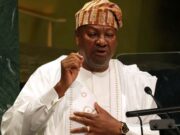




Family, community, and elected leaders celebrate a civil rights pioneer who turned struggle into progress and vision into lasting change
GARY, Ind.—A new street sign now bears the name of a legend. On Oct. 13, city officials, community leaders, and family members gathered to celebrate the life and legacy of the late Mayor Richard Gordon Hatcher—the first Black mayor of Gary and one of America’s trailblazing political figures—with the renaming of Grant Street to Richard Gordon Hatcher Boulevard.
The unveiling ceremony, emceed by community leader Markel Watkins, took place outside St. Timothy Community Church on 25th and Grant and drew an appreciative crowd of residents, elected officials, and supporters from across Northwest Indiana.
Held on Indigenous People’s Day, the event was more than a name change—it was, as one speaker put it, “a declaration of perseverance, pride, and progress.” Just 30 minutes from Chicago’s South Side, Gary once again stood as a symbol of Black political power, unity, and cultural pride.
“We come before you today with hearts full of gratitude and pride as we gather to honor a great servant and trailblazer, Mayor Richard Hatcher,” prayed Pastor William Horn, who opened the ceremony. “May this sign stand as more than just a marker, but a symbol of perseverance and the power of belief in our people.”
A legacy beyond politics
Mayor Hatcher, who served five consecutive terms from 1968 to 1987, made history as one of the first Black mayors of a major U.S. city. His leadership during the turbulent Civil Rights era transformed Gary into a symbol of Black self-determination and urban political empowerment.
“Richard Gordon Hatcher was not simply the first African American mayor of our great city. He was a pioneer whose courage gave shape to possibility,” said State Senator Mark Spencer, recalling how Hatcher’s faith and conviction “turned barriers into bridges.”
Speakers throughout the program described Mayor Hatcher as a man who led not for comfort but for conviction—a visionary who faced fierce resistance but never retreated.
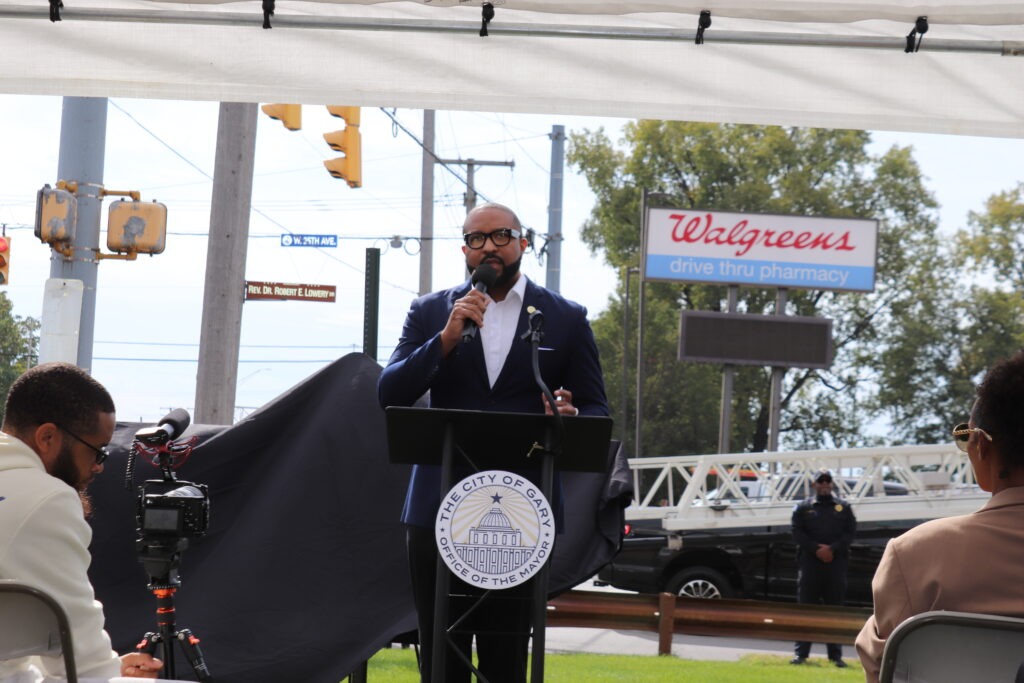
“Leadership is not about titles or applause,” said his daughter Reagan Hatcher, who spoke on behalf of the family. “It’s about persistence—showing up every day to serve, even when the spotlight goes elsewhere.”
The Honorable Minister Louis Farrakhan, who shared a close relationship with Mayor Hatcher rooted in dedication to the advancement of Black people, has called him “my friend, brother, leader, teacher, companion in the struggle, and a guide to us all.” Minister Farrakhan made those remarks at the October 9, 2019, unveiling of a bronze statue of Mayor Hatcher in front of Gary City Hall.
Minister Farrakhan, National Representative of the Most Honorable Elijah Muhammad, participated in both the 1972 National Black Political Convention and the 1984 National Black Political Convention, both hosted in Gary under Mayor Hatcher’s leadership.
Minister Farrakhan’s message at each convention echoed the call for independent political action, self-determination, and moral renewal within the Black community—
Principles that aligned closely with Mayor Hatcher’s vision for transforming Gary into a model of Black excellence and empowerment. Mayor Hatcher was one of the first mayors to issue a city proclamation giving the Honorable Elijah Muhammad the keys to the city.
Minister Farrakhan once said of Mayor Hatcher after his passing in December 2019, “The grave can never destroy the good that those of us do in the name of God.”
Their friendship reflected a shared belief in self-determination, integrity, and service. Mayor Hatcher’s leadership in hosting the 1972 National Black Political Convention in Gary set the stage for a generation of Black political activism.
History and heart
Community historian Carolyn McCrady, who worked closely with the late mayor, offered a passionate account of his life’s journey—from losing an eye as a boy playing stickball to fighting segregation as a young lawyer and later building a national movement from City Hall.
“The real test came when he ran for mayor,” she recalled. “They tried to intimidate him, even fired shots at him, but the good people of Gary stood by him—and he won. Thousands danced down Broadway in celebration.”
Despite White flight, economic decline, and political isolation, Mayor Hatcher refused to give in. Under his leadership, Gary built new housing, elevated Black leadership, hosted the 1972 National Black Political Convention, and became a model for progressive urban reform.
“He was internationally known as a defender of Nelson Mandela, and when Mandela was freed, he traveled to South Africa to help build their new constitution,” Ms. McCrady said to applause.
Mayor Eddie Melton, who led the city’s official renaming, said the new boulevard ensures that future generations will know Hatcher’s name and story.
“This renaming permanently etches his legacy into the geography of Gary,” Mayor Melton said. “His victory in 1967 was not just a local win—it was a national breakthrough. He showed the world that urban America could rise, rebuild, and lead.”
A family’s reflection
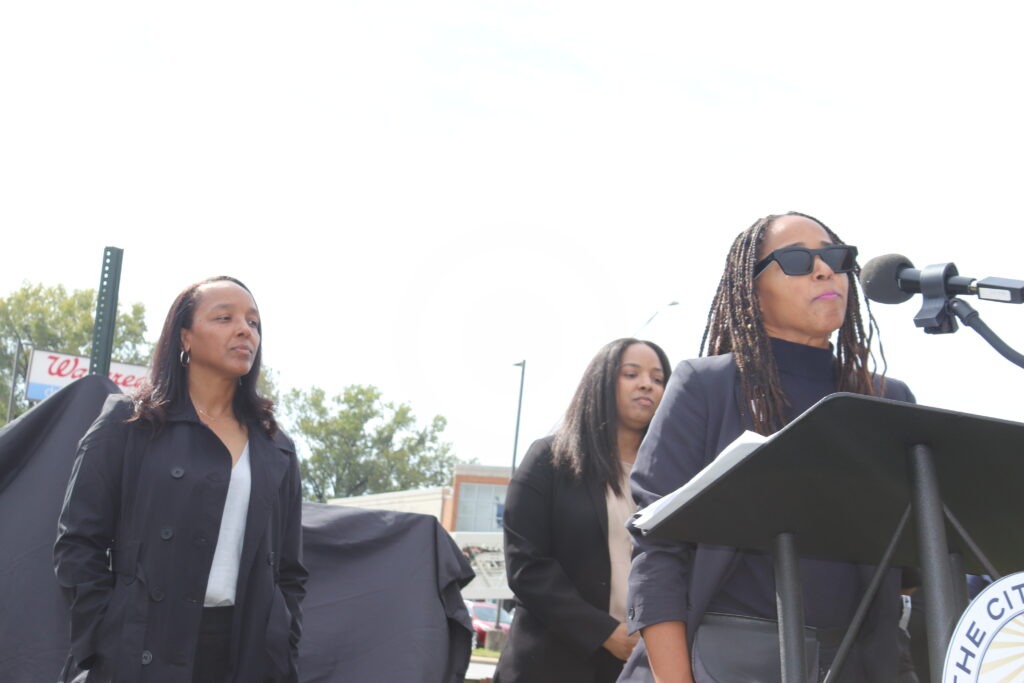
Standing before the crowd with humility and pride, Mayor Hatcher’s daughters, Rachel, Renee, and Reagan, with their mother, Ruthellyn Marie, watching in the front row, spoke about their father’s integrity, compassion, and unshakable love for the city he served.
Rachel reminded the crowd of her father’s favorite words: “Don’t give up, don’t give in. Keep on fighting until we win.”
Renee reflected on her father’s belief in justice beyond politics. “He wanted America to face its history honestly, to recognize the pain of Indigenous and Black people alike,” she said. “He sought to make the nation live up to its highest ideals.”
Reagan concluded the program with emotion: “When you speak the name Richard Gordon Hatcher, every syllable carries weight—the weight of struggle, triumph, and love for this city.”
“We have to give our people their flowers while they’re here,” said emcee Markel Watkins, who credited Mayor Melton and others for keeping that tradition alive through murals, monuments, and events that honor local heroes.
Following the ceremony, The Final Call spoke with residents who shared memories and reflections on how Mayor Hatcher’s leadership impacted their lives.
Roger Hayward, founder of It’s Gary’s Time, Inc., said he attended because of his long connection to the city. “I came here about 20 years ago and I’ve always been interested in Gary. I donated memorabilia to Reagan a while back, and I like to stay involved in what’s going on,” he said.
Beryl Fitzpatrick, who grew up under Mayor Hatcher’s administration, became emotional recalling lessons from his mother, a teacher. “She used to give her students assignments to write about Mayor Hatcher and say one thing they liked about him,” he said. “My parents wouldn’t let anyone talk bad about him. My mother always said, ‘If you disagree, pray for him.’”
As the new Richard Gordon Hatcher Boulevard sign was revealed, the crowd cheered—some with tears in their eyes. For many, it was more than a ceremony. It was a reaffirmation that Mayor Hatcher’s dream for Gary—a city of dignity, unity, and self-determination—still lives.
“His presence is still here—in these streets, in these hearts, and in the spirit of Gary,” said Reagan Hatcher. “Today, his name takes its rightful place in the landscape of the city he loved.”
—Toure Muhammad, Contributing Writer
