












AI (artificial intelligence) data centers are sprouting up all over the country. Many of these facilities are being built or proposed in proximity to Black neighborhoods that have already been suffering the brunt of environmental racism and injustice for decades.
Billionaire Elon Musk’s artificial intelligence company, xAI, and its project, Colossus, a large AI supercomputer, is being constructed in Memphis.
Black residents and activists in that city have been fighting xAI for more than a year, but Memphis is not the only city dealing with the issue of AI data centers and the concerns that come with them.
Anthony Karefa Rogers-Wright visited Memphis, Tennessee, in October. Among his observations, he told The Final Call, “the air is foul.”
“You could almost see the sky pulsing because of all the chemicals just being spewed at such an accelerated rate,” he said. Mr. Rogers-Wright, an environmental justice advocate, traveled from Omaha, Nebraska, to Memphis to witness firsthand what he had been hearing about: the alleged environmental and health impacts reportedly caused by Colossus on the community. the community.

What are data centers?
The Climate Justice Alliance defines data centers as “buildings which house rows of computers and equipment, which store, process, and transmit massive amounts of data.”
The organization notes on their website that “certain data centers, called AI data centers or hyper-scale data centers, are built specifically for the purpose of training, deploying, and delivering AI services.”
“Basically, it’s just a place that houses different processing equipment for computers. Recently, there’s been a surge in data centers because of increased use of artificial intelligence, or AI, which takes a lot more of the processing power than our typical needs with a Google search or using email,” Ryan Anderson, an Alabama-based staff attorney with the Southern Environmental Law Center, said to The Final Call.
Data centers are not new. The International Business Machines Corporation (IBM) traces their origin to the 1940s and the first “hyperscale” data center to 2006.
But proposals for data centers are increasing, with Goldman Sachs Research forecasting that global power demand from data centers will increase by as much as 165% by 2030.
In the U.S., data centers have been surging across the southeast, with more than 20 proposals in metro-Atlanta and a large project proposed in Bessemer, Alabama. Atty. Anderson attributed the reason for data center growth in the southeast to the large amounts of power and water required.

“Here in the southeast, we have very abundant water resources, and we also have cheap electricity,” she said. “There’s a lot of appeal for data centers to locate here, but of course, that comes at a cost to the communities who live here.”
Goldman Sachs Research estimated that about $720 billion would need to be spent on the electric grid through 2030 to keep up with data centers’ growing need for power.
In a 2024 report, researchers with the Lawrence Berkeley National Laboratory, under contract with the U.S. Department of Energy, forecasted that data center electricity demand would triple by 2028.
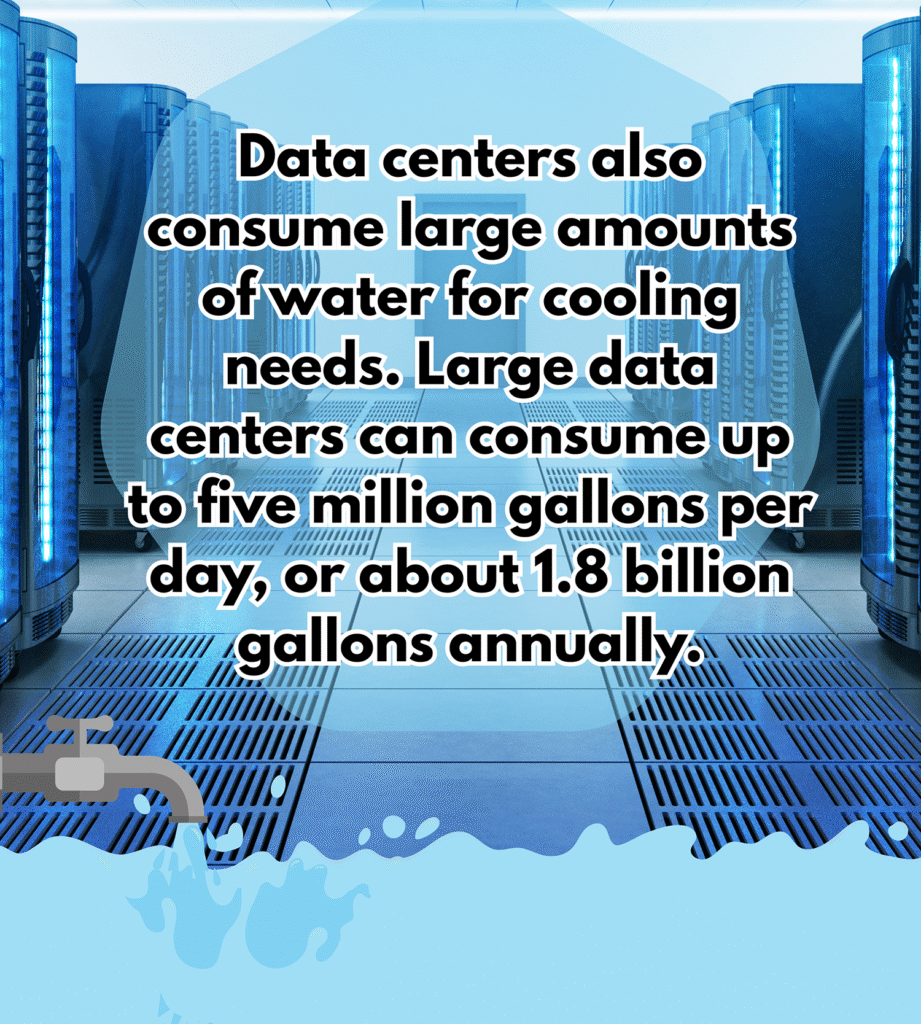
Data centers also consume large amounts of water for cooling needs. Large data centers can consume up to five million gallons per day, or about 1.8 billion gallons annually, according to a June article by the Environmental and Energy Study Institute. This equates to the usage of a town of 10,000 to 50,000 people, the article said.
Several reports have emerged in recent months highlighting the impact of data centers on rising utility costs. In a September article, Bloomberg published an investigation finding that electricity costs as much as 267% more for a single month than five years ago in areas located near significant data center activity.
As an environmental justice attorney, Ms. Anderson has been working on “Project Marvel,” a 4.5 million-square-foot data center proposed in Bessemer, Ala. “It would require 1,200 megawatts of electricity, which is the equivalent of 760,000 residential homes in Alabama. It would also require about two million gallons a day of water,” she said.
Bessemer is a majority-Black city located in the metro-Birmingham area, approximately 15 miles from Birmingham.
Environmental racism
Growing up, Mr. Rogers-Wright remembered playing in the Harlem Little League and witnessing his teammates suffer from asthma. He started doing environmental justice work about a decade ago and felt it was obvious the proliferation of data centers would hit Black people first and worst.
He described data centers as “the new Frankenstein of environmental racism” due to the centers increasingly being built in Black, Hispanic/Latino, Indigenous and poor White communities.
“We know that because they are using coal or a combination of coal and methane gas, that these emissions are disproportionately impacting the public health of our communities, as they have been for years. But then you also have an economic aspect of it. They are raising power bills,” he said.
“Black folk, our people, already suffer from what’s known as high energy burden,” he added.
xAI’s project, Colossus, was built in Boxtown, a majority-Black neighborhood in South Memphis that was founded by former slaves. The Tennessee Valley Authority (TVA), a not-for-profit public power company owned by the federal government, agreed to supply power to Colossus in 2024, a move that sparked opposition.

“The same playbook that Tennessee Valley Authority is using for Boxtown and Black communities in Memphis is now being used by a public power district for a majority-Black community in Omaha,” Mr. Rogers-Wright said.
LaTricea Adams, founder and president of Young, Gifted & Green, attributes the reason data centers are now entering majority-Black communities to cheaper land due to lower property values and the presence of blight, which is the deterioration and abandonment of properties.
“In many of these instances, it’s literally vacant; commercial property from previous industries that were also polluters. So, it’s like compounding pollution. It’s legacy pollution. It’s generational pollution and toxicity over time,” she said to The Final Call.
In Memphis, xAI is working on another project, “Colossus 2,” which is multiplying activist concerns.
“This project continues to grow, continues to hyperscale, and we are paying the price,” KeShaun Pearson, co-founder of Memphis Community Against Pollution, said to The Final Call.
xAI uses 35 methane gas turbines to power its supercomputer and is purported to have acquired 66 more for Colossus 2. Methane is a toxic air pollutant that can cause or worsen breathing problems, heart disease, cancer and strokes, according to the Environmental Defense Fund.
Time magazine requested researchers at the University of Tennessee, Knoxville, to run an air quality analysis in South Memphis. The researchers found that average concentrations of nitrogen dioxide increased by 3% when comparing the periods before June 2024.
And afterward and that peak nitrogen dioxide concentration levels increased by 79% from pre-xAI levels in areas immediately surrounding the data center, and by 9% in Boxtown, according to a Time article published in August.
Short-term exposure to nitrogen dioxide can aggravate respiratory diseases such as asthma and can cause coughing, wheezing or difficulty breathing, according to the Environmental Protection Agency. Long-term exposure due to elevated concentrations can contribute to the development of asthma and potentially increase susceptibility to respiratory infections.
Since the development of Colossus, elderly people in Memphis who have never had asthma have been diagnosed within the past year, and people who have lived with COPD (Chronic Obstructive Pulmonary Disease) have seen worsening conditions, Mr. Pearson said.
“We are seeing a continual spike in respiratory issues, and that is directly correlated with a higher mortality rate. And we have to do something. We are not at a place where we can sit on the sidelines and wait for somebody to save us. The onus is with us,” he added.
He considers the proliferation of data centers in Black communities to be “digital redlining.”
“Digital redlining is the practice of building infrastructure that supports technology in redlined communities. It’s a continuation of a systemic practice that subjugates Black people specifically and other poor communities to toxins in our air, toxins in our water and consistent land grabs,” he said.
“We are continuing to see this same process that proliferated in the industrial era in this new era to support this hyperscaling of data centers for Meta, xAI, Google. So, these large billion-dollar conglomerates are dictating the futures of our community and subjugating us to more pain and more oppression and are a detriment to our public health.”
The Final Call reached out to xAI but did not receive a response by presstime.
Lack of transparency
Ms. Adams’ mother and father grew up in Southwest Memphis, where they met, fell in love, and married. When she first found out about xAI’s Colossus in June 2024, she was blindsided.
“Our mayor, the utility president, and most infamously, the president of the Memphis Chamber of Commerce essentially had been brokering this deal with xAI, unbeknownst to constituents,” she said.
She explained that traditionally, developments must go through land-use laws, but xAI unveiled a gap in the city’s land-use code. Since the company had not made significant changes to the facility housing Colossus, xAI was able to obtain a bypass permit, allowing the company to skip the traditional process required for land use, which includes a city council vote.
After finding out about xAI’s project, which was still being planned at the time, Ms. Adams’ organization, along with Memphis Community Against Pollution and Protect Our Aquifer, released a joint statement addressing air pollution concerns.
“You completely disregarded the community, particularly with a project that is this immense and has so many implications for a community that has already suffered and bear the brunt of environmental racism for decades,” Ms. Adams said.
In Bessemer, local government officials signed non-disclosure agreements pertaining to “Project Marvel.”
“We’ve really just seen a complete lack of transparency from the city when they’ve been asked important questions like, ‘Where is water going to come from? Where is the power going to come from? What kinds of impacts is this going to have to the neighborhoods right next to the data center?’” Ms. Anderson said.
“The government is charged with working in the interest of the people, and when government officials sign these kinds of agreements that shield them from disclosing really basic details about impactful projects like this, it just comes at a real cost to the people that will be impacted the most.”
“What it comes down to is that in the however many years that this nation has been in existence, this so-called United States, Black people have always been dehumanized, not seen as a full person.
And therefore our communities are the first to be treated as energy economic sacrifice zones, because why not put it there? We’re not humans anyway, right? And that’s it. That’s literally how environmental racism works,” he added.
The fight ahead
As technology continues to evolve, data centers will continue to be built. The activists The Final Call spoke to recommended several solutions to increase sustainability and to protect Black and other vulnerable communities.
Solutions include imploring zoning bodies to require certain information from developers up front, such as power and water needs, to give communities the power to decide whether or not the development is worth the cost;
Building water reuse facilities; relying on clean and renewable energy sources; implementing more regulatory oversight on the local, state and federal levels and providing benefits to companies that use renewable energy sources such as solar panels.
“From a personal perspective, I am not anti-technology,” Ms. Adams said. “However, with any type of innovation, it has to be responsible implementation and deployment, and so adopting this Silicon Valley type of rhetoric where you have to go really fast. To whose expense?
“Slow down. Really assess the risk, try to mitigate the risk. … There’s a way that this could be done where it doesn’t create harm to communities. There has to be a culture shift where we’re not prioritizing profit, where we’re not prioritizing capitalism over the sake of lives,” she added. “We cannot continue to trade humanity for money.”
Mr. Rogers-Wright described the fight against data centers as a long road. He referenced President Trump’s July 23 executive order “accelerating federal permitting of data center infrastructure,” which he said made it easier for tech companies.
He sees more Black people embracing the need to have independent social, community and political power to keep themselves safe.
“These data centers and the way they are to be powered and what they are being used for is nothing less than a declaration of war,” he said. “A declaration of war against us as Black and African folk in general, a declaration of war against our humanity, against our self-determination, against our agency.”
