







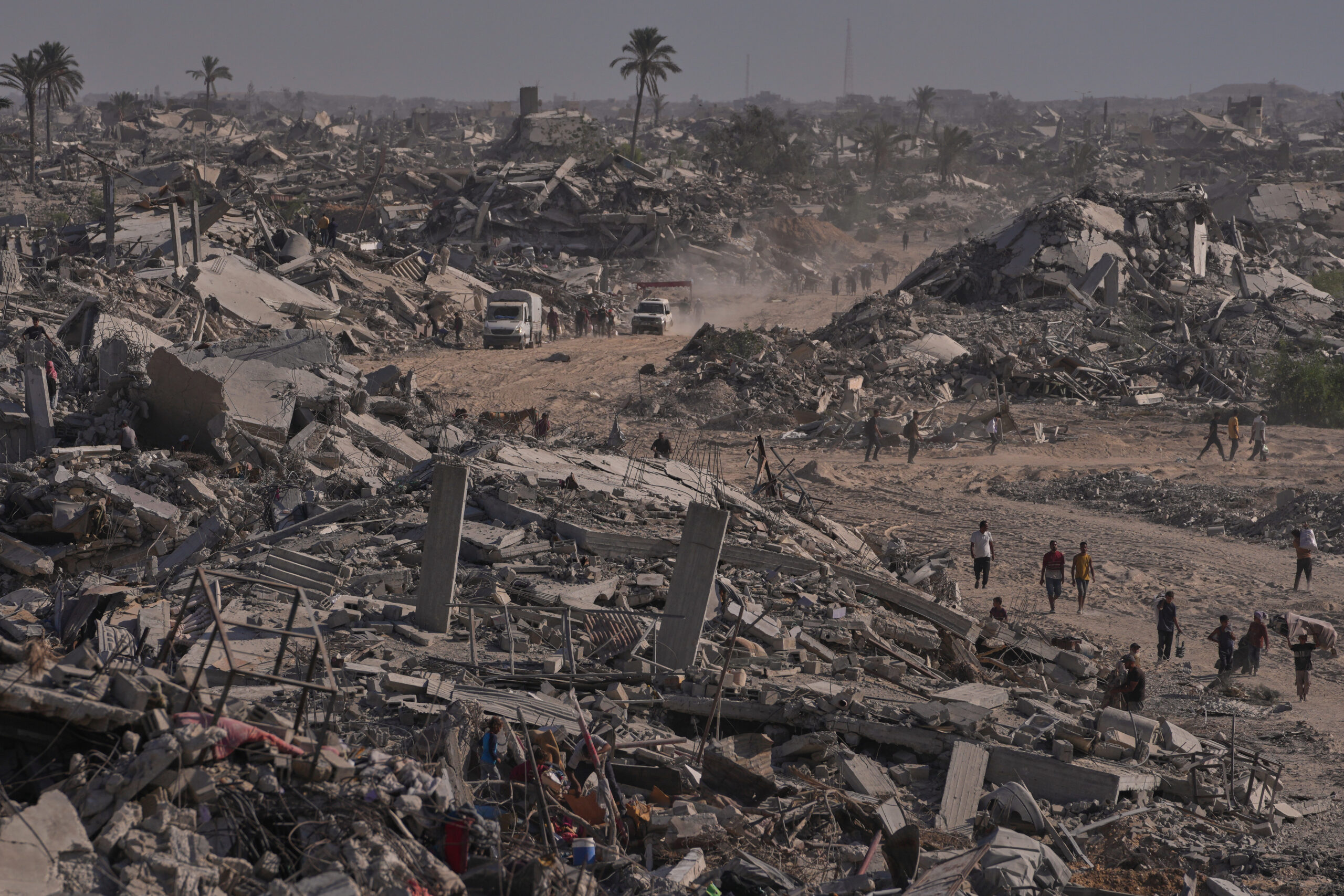

During a week of negotiations in Sharm el-Sheikh, Egypt, on Oct. 9, Israel approved the first phase of U.S. President Donald Trump’s “peace plan” for Gaza, resulting in a ceasefire, but concerns remain on the ceasefire’s longevity and Gaza’s reconstruction and governance.
“Trump’s peace plan has really three components. The first is the hostage exchange/prisoner exchange, humanitarian relief and Israeli withdrawal. The second is focused on what comes after:
The transition from genocide to governance of Gaza and the recovery and humanitarian relief that needs to be surged at scale,” Palestinian writer, political analyst and human rights attorney Zaha Hassan said to The Final Call via a voice message on WhatsApp.
“Whether or not the Trump administration will show some flexibility in negotiating the second phase and the ultimate objective, which is a sovereign Palestinian state, remains to be seen. But what we will have is an agreement on a ceasefire, even if for limited duration to allow for the prisoner exchange,” she added.
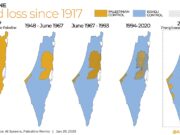
After Israel ratified the first phase of the ceasefire deal, the Israeli military had 24 hours to withdraw to an agreed-upon yellow boundry line in Gaza, based on a map presented by President Trump, and Hamas had 72 hours to release 20 Israeli captives and the remains of 28 deceased Israelis. However, at the yellow line, Israel still controls more than half of the Gaza Strip, according to a visual by Al Jazeera.
In the prisoner exchange, 250 prisoners serving life sentences and 1,700 prisoners from the Gaza Strip who were arrested after Oct. 7, 2023, will be released, in addition to the release of all women and children, Hamas official and chief negotiator Dr. Khalil al-Hayya said in a statement on Telegram.
Addameer Prisoner Support and Human Rights Association reported over 11,000 Palestinians held in Israeli detention facilities on Oct. 5.
In a video posted on The White House’s X account, the president said captives should be released on Oct. 13 or 14. The U.S. is also sending about 200 troops to Israel to reportedly monitor implementation of the ceasefire, to facilitate the flow of humanitarian aid and to monitor the transition of Gaza into a civilian government, U.S. officials told the Associated Press.
Celebrations rippled through Gaza, as Palestinians celebrated the approval of the first part of the plan.
“For the people in Gaza, they feel like whatever. Just end it. Just end this bloodshed, this genocide. This genocide is to be stopped, and the ethnic cleansing is to be stopped. That’s what they want the most,”
Palestinian commentator Taghreed El-Khodary said to The Final Call via a WhatsApp call. But she has mixed feelings about President Trump’s plan. All her family has been forcefully displaced from Gaza, and she’s lost many loved ones to Israel’s atrocities.
“I am very happy that Trump, unlike Biden, has made the call, has pushed Israel to end this genocide, to stop it,” she said. “We’ve lost a lot, let alone the complete destruction, almost complete destruction of the health infrastructure.
The education infrastructure, the streets, the houses, the homes, the places that we’ve known since our childhood. We lost all of that, and that’s why I am happy it’s finished.” At the same time, she acknowledged that “the U.S. is not a fair broker.”
“I hope, but it’s wishful thinking, because the U.S. has been always on the side of Israel. And I am a realist. I do not believe that all of a sudden Trump is going to bring us the Palestinian state,” she said.
During the first week of negotiations, Israel continued to bombard areas in Gaza. On the day of the ceasefire’s approval, the state killed at least 29 people, according to WAFA, a Palestinian news and information agency.
The following day, after official ratification of the first phase of the ceasefire deal, Al Jazeera reported several Israeli attacks in Gaza, including air raids and heavy tank fire.
The Council on American-Islamic Relations condemned Israel’s continued assault.
“Trying to kill as many Palestinians as possible before the Israeli cabinet’s official vote is not self-defense. It is sadism. Such actions reveal a level of cruelty and disregard for human life that should shock the conscience of the world,” the organization said in a statement.
“No one else should die in a war that is already supposed to be over. President Trump should demand that all attacks on Gaza stop immediately, without any delay.”
Israeli settlers also continued to attack Palestinians in the West Bank, and Israeli officials made continuous calls for Hamas to be destroyed.
“I have no trust in Netanyahu at all and his government. Netanyahu was never interested to end this. What served him the most is the continuation of the genocide and going forward with the ethnic cleansing. That was his agenda, and he wanted to continue with that, and he will,” Ms. El-Khodary said.
“Also, listen, the West Bank is not mentioned in this agreement at all. There is no cessation of … the expansion of the illegal Israeli settlements in the West Bank. So, what does that mean? And he is very clear about his position of being against the Palestinian state.”
Khalil Shikaki, director of the Palestinian Center for Policy and Survey Research based in Ramallah, Palestine, sent a written statement to The Final Call on the challenges ahead. He said the second phase of President Trump’s plan, which includes creating a temporary Palestinian committee to govern Gaza, disarmament of Hamas and full withdrawal of Israeli troops from Gaza, will be difficult.
“This is extremely difficult to agree on in the absence of an agreement on the larger question of the future of the conflict, the creation of the Palestinian state in the third phase of the plan within the context of a two-state solution,” he said.
Ms. Hassan critiqued President Trump’s plan for its limited inclusion of Palestinians in the future development of Gaza.
“There is some discussion of Palestinian service providers operating underneath a U.S.-led board that includes business interests and at least one Palestinian out of a board of 7-10 people.
So obviously this is going to be really problematic for Palestinians to accept; not just Hamas but the Palestinian Authority and the Palestinian people at large.
It’s also going to pose a problem for neighboring Arab countries Jordan and Egypt, who recognize that this is not acceptable and it’s not going to be a recipe for a permanent end of violence and stabilization in the region,” she said.
For President Trump’s plan to be less one-sided in favor of Israel, she said the U.S. would have to impose real leverage on Israel.
“There needs to be real concerted action by the Arab states led by Saudi Arabia in partnership with countries like France and the EU with President Trump, encouraging President Trump to use American power on Israel to get it to accept what needs to happen,” she said.
Health and human rights organizations have called for access to Gaza to deliver life-saving aid.
“Stopping the bombing alone will not end survivors’ suffering. Displacement is widespread. Famine is still spreading. Essential infrastructure has been destroyed. Humanitarian organizations must have full, unrestricted access to bring in food, medicine, shelter materials, and other essential supplies that Gaza has been deprived of for two years,”
Jan Egeland, secretary general of the Norwegian Refugee Council, said in a statement, adding that the organization has hundreds of truckloads of aid ready to enter Gaza.
The death toll in Gaza rose to 67,211, with 169,961 injuries since Oct. 7, 2023, according to an Oct. 10 report by the Gaza Ministry of Health. In addition, Gaza’s Government Media Office reported that the health system in the Gaza Strip had collapsed entirely and that Israel destroyed 670 schools, prevented the entry of hundreds of thousands of aid trucks and forcibly displaced two million Palestinians.
“This massive global momentum calling for accountability for Israel’s actions, calling for human rights for Palestinians, self-determination, freedom, I believe, is the reason why we are now reaching this, what you call it, the peace plan,” Ms. El-Khodary said.
But she questioned whether the plan would lead to Palestinian self-determination.
“If there is no justice, it cannot work. If it’s not based on international law, it cannot work. If it’s not leading to self-determination, equality, it’s hard,” she said. “When Trump is giving his speeches …, if you notice, he will talk and talk about the Israeli hostages.
But how many sentences or words has he mentioned when it comes to Palestinian suffering? You have more than 67,000 Palestinians dead. Among them, more than 20,000 children. … And this guy, Trump, during his speeches, he doesn’t tell me that my life counts.”
President Trump traveled to Egypt on Oct. 12 to sign the ceasefire agreement. He also accepted an invitation to address Israel’s parliament.
