






DETROIT—The People’s Conference for Palestine brought together experts who exposed Israel’s barbarism in its attacks on Gaza’s food and health care systems, as the occupier state’s genocidal war and expansion plans continue.
“In the last two years, we’ve seen a thoroughly planned and deliberate attack on Gaza in what can only be described as a campaign of annihilation and total destruction of Palestinian people, land, life and future,” Ibtihal Malley, workshop moderator for a panel confronting the genocide, starvation and siege on Gaza, said.
“Israel’s scorched earth policy has decimated the very infrastructure that is meant to sustain any form of life. We’ve seen entire areas reduced to rubble, targeted assassinations, total destruction of hospitals and schools, and we’ve also seen the targeted use of engineered famine and starvation to carry out this barbaric genocide.”
A scorched earth policy is a military tactic destroying anything that the opposing military force might be able to use to fight back, including food and water, plants and crops, animals, buildings and infrastructure.
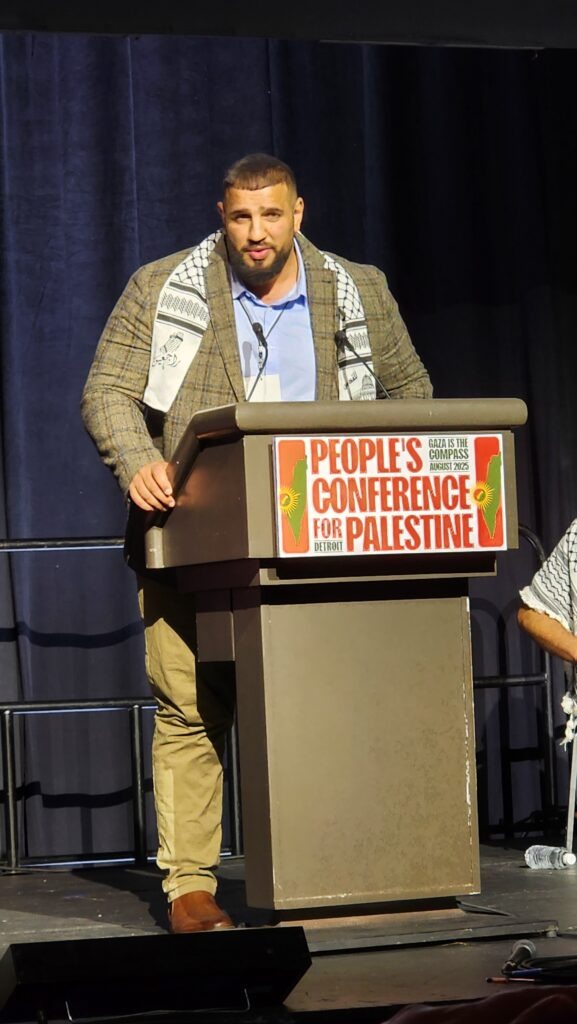
Panelist Dr. Ghassan Abu-Sittah, a plastic and reconstruction surgeon, accused Israel of reinventing “scorched earth policy” and exposed Israel’s systematic plans in dismantling Gaza’s food and health care systems.
After Israel launched its war in October 2023, Dr. Abu-Sittah started working in al-Shifa Hospital and then al-Ahli Arab Baptist Hospital. During his time working in the Gaza Strip, Israel launched a missile, killing almost 500 people.
Dr. Abu-Sittah outlined the destruction that followed within the past two years, including the attacks on three pediatric hospitals that are now non-operational.
The first siege of al-Shifa Hospital “and so on and so forth until now we’re left with three partially functional hospitals out of 39.” He explained how some hospitals were reopened several times across the war before finally being forced to close.
“That component is the destruction of buildings. We then have the systematic murder of a whole generation of health workers,” he added. He cited that more than 1,600 health workers have been killed in Gaza.
“From early October (2023), we were working in Shifa and every day one of our colleagues would be killed within half an hour of going home to their house,” he said. “We have whole specialties that have been completely wiped out.”
During a panel discussion on Gaza’s medical capacity and health care during the conference which was held Aug. 29-31 in Detroit, Dr. Thaer Ahmad broke down several ways that Gaza’s health care system is being attacked:
The siege, with trucks carrying anesthetics, antibiotics, Band-Aids, IV fluids, gloves and other items being stuck at the borders of Gaza and Palestine; American-supplied F-35 fighter jets bombing hospitals;
Israeli missiles striking and killing doctors and their families in their own homes; the abduction of doctors who are now languishing in Israeli prisons, being subjected to torture and abuse; The failure to safely evacuate health care workers and their patients after targeted attacks on hospitals, causing children in incubators to die;
The lack of accountability after a hospital is destroyed or a health care worker is killed and the lack of safe passage for humanitarian actors to provide food and aid and attacks and killings of humanitarian actors that attempt to provide aid.
During a keynote address, Dr. Mohammed Mustafa, a Palestinian refugee and an emergency physician trainee, shared how the World Health Organization declared health care a human right after World War II but said “in Gaza, that promise is broken. Health care is not failing by accident. It is being sabotaged by design. Hospitals bombed. Doctors killed. Aid blocked.”
He recalled a story from his experience serving in one of Gaza’s emergency rooms. After an Israeli airstrike, a mother entered the room carrying plastic bags that contained the remains of her children.
“She looked at me in the eyes as if to ask, doctor, is there anything we can do? Is there anything left? There was nothing I could do. And that’s the reality of Gaza,” he said. “So, I ask you this. Why is baby formula banned in Gaza?
Why is feeding a child considered a threat? Why are incubators, ambulances, hospitals, the very lifeline of life turned into targets of war? When did milk become a weapon? When did bread become contraband? When did saving a child’s life become a crime?”
He described how starvation is being used as a weapon of war, creating irreversible damage, as malnutrition levels “have reached so deep in these children in Gaza that they are changed at the genetic level, changes that will be passed onto generations not yet born.”
Along with the intentional destruction of Gaza’s health care system and man-made famine and malnutrition, Israel “weaponized water and sewage” from the very beginning by bombing Gaza’s water desalination plants and sewage treatment plants, resulting in the growing spread of rare diseases on epidemic levels, Dr. Abu-Sittah said.
With the added manufactured famine, patients are too malnourished to survive surgeries, and the surgeons, doctors and nurses are too malnourished to finish shifts to work and help people, he added.
“Israel was able to weaponize life itself as part of its genocidal project,” he said.
The Gaza Soup Kitchen is one of the organizations attempting to curtail Israel’s manufactured famine. In spring 2024, chef Mahmoud Almadhoun began foraging for food and cooking for the community in Gaza. He was killed by an Israeli drone strike in late 2024.
“They thought that we would stop working, but we did not. Every single family member of ours, every single crew, they said no, people will still starve after chef Mahmoud, and they kept cooking for the community,”
The chef’s brother, Hani Almadhoun, said in the conference’s plenary session on starvation. “We want to make sure our families have food and our neighbors are taken care of.”
He argued against the narrative that it’s complicated to get aid into Gaza. “I don’t care what Israel says, ‘It’s complicated.’ It’s not complicated,” he said. “And we did it,” he added, sharing that the Gaza Soup Kitchen provided aid to 1,200 families in six hours.
Palestinian poet Mosab Abu Toha shared the story of his father-in-law, who was a strawberry farmer getting food to his family when he was killed in an Israeli airstrike. Mr. Toha emphasized the responsibility of Americans to assist the Palestinian cause, as American tax dollars are being used to help Israel kill.
“We should make this very clear to the government, to the congresspeople, that we do not want our taxes going to Israel,” he said. “It’s not like we need American people to give us food. We don’t want anyone to help us. We can help ourselves. What we need is that this country and other countries do not send weapons to Israel,” he added.
Dr. Nidal Jboor, co-founder of Doctors Against Genocide, and Dr. Jill Stein of the Green Party spoke of an international initiative led by civil society to get the United Nations to hold Israel accountable by sanctioning the state, imposing a military embargo, stripping Israel of its credentials in the UN general assembly and sending in a peace force to protect civilians and send in aid and food.
In his keynote message, Dr. Mustafa challenged people to stand for Gaza.
“There is no comfort in standing up for Gaza. There is only pain,” he said. “You may lose your job. You may be imprisoned. You may be illegally bordered. You may lose your reputation. You’ll be vilified.
You’ll get death threats. But think about what we call sacrifice. We fear losing a title, a paycheck, a platform, while the people in Gaza are losing their homes, their families, their children and their very lives.”
