









These young deaths are “the latest in the war on children and childhood in Gaza,” Philippe Lazzarini, head of UN Palestine refugee agency UNRWA, said in a tweet on Aug. 13.
The toll also includes some 40,000 boys and girls reported killed or injured due to bombardment and airstrikes, at least 17,000 unaccompanied and separated children, and one million deeply traumatized youngsters who are not getting an education. “Children are children,” he said.
“No one should stay silent when children die, or are brutally deprived of a future, wherever these children are, including in Gaza.”
A somber reunion
Thousands of sick children in Gaza need urgent medical evacuation, according to UN aid coordination office OCHA.
Olga Cherevko, a spokesperson for the agency, recalled the moment she recognized a young girl requiring treatment in a Gaza hospital after a year’s interval, once again suffering from malnourishment. “I remembered her long eyelashes,” the veteran humanitarian told UN News, describing seven-year-old Janah, who she came across at Gaza City’s Patient Friendly Hospital on Aug. 12.
“The first time I met her was in the IMC Field Hospital in southern Gaza in April 2024. Back then, she was severely malnourished and was getting treatment. And she gradually became better and was released eventually and went home.”
Evacuation saves lives
However, Janah was now back in hospital “because the malnutrition became aggravated and the condition that she has also is not properly diagnosed and cannot be properly diagnosed.”
The girl is on a list of people to be medically evacuated for treatment outside Gaza. The most recent evacuations took place on Aug. 13 when the World Health Organization (WHO) supported the transfer of 32 children and six adults to Italy, Belgium and Türkiye, but more than 14,800 patients are still waiting.
Ms. Cherevko stressed the importance of ensuring that evacuations continue to save as many lives as possible.
More aid needed
She also pointed out that for children and adults with pre-existing conditions, their situation becomes worse with malnutrition. “It wouldn’t be this way if they had proper nutrition, because these conditions existed before the starvation crisis and they weren’t getting as sick as they are now,” she said.
“This is why it’s imperative to make sure that we have proper conditions on the ground for adequate volumes of supplies to be entering—everything from food to medicine to nutrition to shelter,” she continued.
“And these lifelines have to be really enabled for us to be able to deliver this aid to the people in need.”
Dying from hunger
Her appeal comes as the Gaza health authorities reported on Aug. 13 that eight people, including three children, died due to malnutrition and starvation over the past 24 hours.
“Such reports have become a daily occurrence, reflecting the deepening humanitarian crisis and the urgent need for sustained assistance,” UN Spokesperson Stéphane Dujarric told journalists in New York. He said WHO also conducted a refresher training at the Rantissi Children’s Hospital in Gaza City on Aug. 13, focusing on the inpatient management of malnutrition.
Rantissi is one of the five nutrition stabilization centers in the enclave and the course aimed to help staff members stay current with new information. “The recent surge in malnutrition cases among children has necessitated the establishment and scaling-up of these centers,” he explained.
Since January, more than 340 children have been admitted for malnutrition treatment. As of August 5, 49 validated child deaths from malnutrition have been reported, with 39 among children under the age of five.
“There may very well be others who have died from the same causes that were not recorded” either by the UN or by local health authorities, Mr. Dujarric said in response to a reporter’s question.
Trauma and mental health issues
In other developments, data collected by the UN and partners from over 900 households across Gaza in July indicated continuous trauma leading to mental health issues, including anxiety and depression.
Care staff also are traumatized, and partners working in the protection sector have started providing mental health and psychosocial support for their personnel. Meanwhile, UN efforts to bring aid into the Gaza Strip continue.
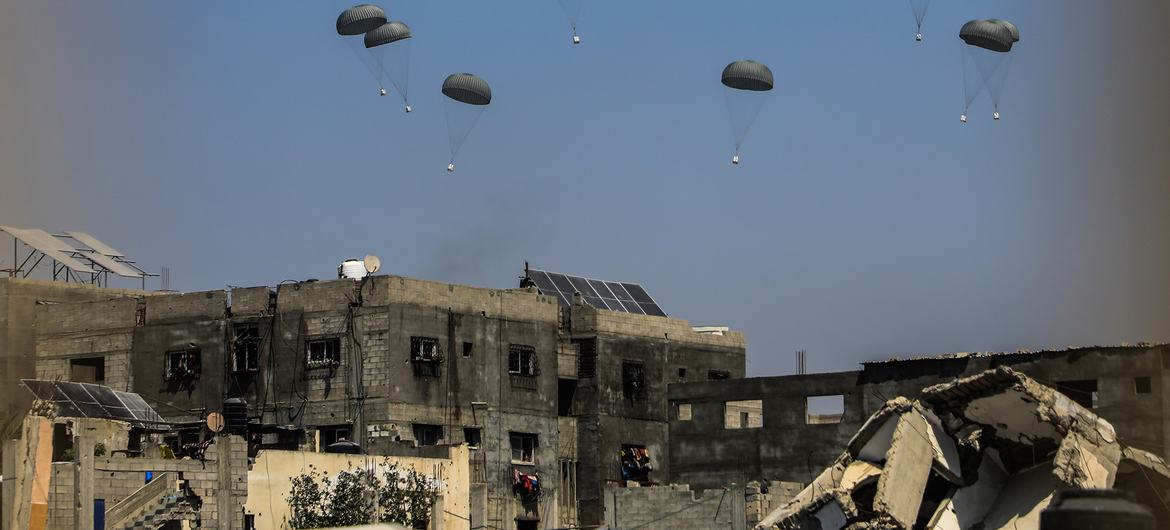
Teams collected food and fuel from the Kerem Shalom and Zikim border crossings on Aug. 12 and other missions are still ongoing.
Goods enter but cash is low
Mr. Dujarric said the entry of goods has improved the market situation in terms of both prices and availability.
For example, a bag of sugar now averages 40 shekels, roughly $12, per bag, after peaking at about 600 shekels, equivalent to about $175.
“However, severe cash shortages are preventing families from being able to buy food, being able to buy water and being able to buy medicine,” he said.
Humanitarians have repeatedly stressed that the amount of aid and goods that can be brought into Gaza does not meet the minimum requirements of the population.
They continue to call for a ceasefire and for aid flows to be scaled up. (UN News)
Israeli minister unveils plan to build 3,000 new settler units in occupied West Bank
Extremist Israeli finance minister Bezalel Smotrich has announced his intention to approve the construction of over 3,000 settler units in the highly contested E1 area of the occupied West Bank, a move that will effectively end prospects for a Palestinian state.
Smotrich said he intends to authorize tenders for the settlement expansion in an area designed to connect the existing settlements in Maale Adumim, located in the occupied West Bank, with occupied East al-Quds.
“Approval of construction plans in E1 buries the idea of a Palestinian state and continues the many steps we are taking on the ground as part of the de facto sovereignty plan that we began implementing with the establishment of the regime,” he said.
“After decades of international pressure and freezes, we are breaking conventions and connecting Maale Adumim to Jerusalem. This is Zionism at its best—building, settling, and strengthening our sovereignty,” he added.
The announcement appears to be a direct response to recent declarations by France, Britain, Canada, and Australia expressing their intent to recognize a Palestinian state at the upcoming United Nations General Assembly next month.
The E1 project aims to sever connections between Palestinian communities and greatly hinder territorial continuity. It will create a separation between East al-Quds and certain areas of the West Bank, compelling Palestinians to undertake long detours when traveling between cities and towns.
Despite the fact that the E1 construction plan dates back to the 1990s, its execution has consistently faced delays owing to global opposition.
In March, the so-called political-security cabinet of Israel sanctioned a distinct roadway for Palestinians situated to the south of the E1 region, connecting the northern and southern parts of the West Bank. The road was regarded as a preliminary measure for enhancing settlement expansion in the region.
More than 700,000 settlers live in over 230 settlements built since the 1967 Israeli occupation of the West Bank and East al-Quds.
The international community views the settlements as illegal under international law and the Geneva Conventions due to their construction on occupied territories. The UN Security Council has condemned Israel’s settlement activities in several resolutions.
In July 2024, the International Court of Justice (ICJ) declared Israel’s decades-long occupation of historical Palestine illegal.
The ICJ demanded the evacuation of all existing settlements in the West Bank and East al-Quds. It was mere words. (PressTV.ir)
