





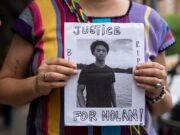







Despite nationwide protests and outcries from activists, organizations and everyday residents about police killings, the brutality and violence have not stopped. Additionally, Black people continue to be disproportionately victimized and targeted by law enforcement.
According to Campaign Zero, a police and prison reform advocacy organization and its interactive database called Mapping Police Violence, so far in 2025, 692 people have been killed in the U.S., 138 have been Black. There has been only one day so far this year when police have not killed someone, the organization noted.
And while the group noted that police have killed 39 fewer people this year through June compared to the same time last year, that is not progress, with over 5 months left in the year. It is clear that Black life is still not valued by law enforcement in America.
The Honorable Minister Louis Farrakhan has, for decades, warned about these actions by police.
“I want Black youth to hear this message, because police authorities are the same today as they were during slavery. In fact, this is how policing began. Police were formed to catch runaway slaves, bring them back to their masters and make examples of them to throw fear into other slaves.
It’s the same today. Police authorities are trained to kill, as well as to protect. But where Black people are concerned, police legitimize their mob attacks under the name of ‘backup.’ Police backup is often no different than the lynch mobs 100 years ago.
The killing of our people, shooting them with many bullets when one would have done the job. And then, that deliberative body which is to discuss the brutal murder of our people by looking into the facts, comes away calling it justifiable homicide,” Minister Farrakhan stated in his message, “Justifiable Homicide: Black Youth in Peril,” delivered October 28, 2007, in Chicago.
Campaign Zero declared 2024 the deadliest year for police violence in the U.S. since the group began recording stats in 2013. In 2024, 1,365 people were killed by U.S. law enforcement, according to Mapping Police Violence.
“Despite a national decrease in violent crime, police killings continued to rise, further exposing the urgent need to rethink public safety. These numbers serve as a stark reminder of the historical and systemic nature of police violence,” stated Campaign Zero.
On average, law enforcement kills someone every 6.44 hours, according to key findings of MPV’s 2024 year-end report. In addition, there was a “near-daily occurrence,” as there were only 10 days in 2024 when U.S. law enforcement did not kill someone, the report continued.
The report findings are “nothing new under the sun,” said Damon K. Jones, the New York State Representative of Blacks in Law Enforcement.
“I was in law enforcement for 33 years and the reports go back to the 1990s. The report is a good report, but it ain’t telling me anything new,” he told The Final Call.
Mapping Police Violence researchers say this crisis continues to disproportionately impact Black, Latino, and Indigenous communities, highlighting a severe and ongoing public safety issue. Researchers found that racial disparities persist. For example, compared to White people killed by police:
• Black people were 2.9 times more likely to be killed;
• Native Hawaiian & Pacific Islanders (just 0.3% of the national population) faced the highest racial disparity, being 7.6 times more likely to be killed;
• American Indian/Alaska Native individuals were 3.1 times more likely to be killed;
• Latinos were 1.3 times more likely to be killed; and
• Asian people were 0.3 times more likely to be killed.
The following three cities and states had the largest increases in police killings according to Mapping Police Violence researchers:
• New Hampshire, 225% increase from the previous 11-year average.
• New Mexico, the highest per capita rate of police killings (13.7 per million); and
• Corpus Christi, Texas, the highest per capita rate of police killings among large U.S. cities (22.1 per million), a 288% increase over the prior 11-year average.
Amina Lei is a California-based artist and activist of Asian descent. She told The Final Call that a significant portion of police killings among Native Hawaiian and Pacific Islanders involved individuals experiencing mental health crises.
However, data aggregation under the broader “Asian American and Pacific Islander” category obscures their specific experiences, relegating them to being hidden in national statistics and limited media attention, she said.
“Mental health struggles are significant in the Asian American, Native Hawaiian, and Pacific Islander community, but they’re often overlooked,” she said. Also, barriers such as language differences and lack of culturally sensitive providers—obstacles particularly great among first-generation immigrants—make it difficult to access appropriate care, she said.
Dismantling harmful stereotypes, increasing access to culturally appropriate mental health services, and implementing alternative crisis response strategies not relying on the police, and “our unity,” are some solutions, she added.
Mr. Jones explained that the failure to change the culture of policing is one of the reasons the problems of police killings have not ceased. “We’ve failed to address use-of-force policies. We’ve failed to be accountable for the training of officers, to address the bias and racism in the police department,” stated Mr. Jones.
He feels a part of the problem is the thought by some politicians that there’s no racism in police, despite there being racism in society. It is the denial and weakness of politicians over major cities that contribute to the problem, said Mr. Jones. “They just manage their police departments and not change the culture and challenge the culture from their position of leadership,” he stated.
The solution is unity and accountability, said Mr. Jones. “When are we going to begin to take on the responsibility to take block by block and make it safe ourselves?” he asked.
The Honorable Minister Louis Farrakhan made a clarion call for 10,000 Fearless men and women to help make their community a safe and decent place to live during the 20th anniversary of the historic Million Man March (“Justice or Else” 10/10/15), as a solution.
“… as the Honorable Elijah Muhammad said, ‘Make where we live a safe, clean, successful community.’ That’s within our power to do. Let’s get busy, and make our neighborhoods, our community, safe and good for our people to live in,”
Stated Minister Farrakhan, during a Sept. 14, 2015, address in South Carolina, to street organization members. His divine directive from nearly a decade ago remains as applicable and relevant today.
Because, despite the concerns that activists and others still raise about police killings, a new federal executive order issued in April could potentially make the problem worse. The order by President Donald Trump instructs the U.S. Attorney General and other department and agency heads to use federal resources to bolster state and local law enforcement.
By July 27, the U.S. Attorney General and Secretary of Defense, in consultation with other agencies, are expected to increase military and national security assets to assist state and local law enforcement, according to the executive order. (See The Final Call, Vol. 44 No. 32)
Dionne Smith’s son, 16-year-old James Rivera Jr., was killed in a hail of bullets by Stockton Police and a San Joaquin County deputy on July 22, 2010, the day before his 17th birthday.
The family reached a settlement with San Joaquin County, but in Nov. 2019, the judge declared a mistrial in a federal civil rights trial of two Stockton police officers in James’ killing when the federal jury reported it was hopelessly deadlocked after only a few hours of deliberation, according to the Stockton Record.
Mapping Police Violence report noted that the most significant decrease of police killings in cities was in Stockton, California, with reduced police killings to zero after averaging 6.9 per million people per year over the prior decade. Blacks make up approximately 12% of Stockton’s population.
However, Ms. Smith was not optimistic that the scourge of police killings would change, despite the reduced killings in Stockton. “I think it’s going to get worse before it gets better,” said Ms. Smith.
“We still have police out here. I have not seen any killings but a shooting and abuse,” she told The Final Call. “I feel that we’ve still got to organize. We’ve still got to make them be held accountable. We’ve still got to educate people in our community and let them know, no matter how it looks, we still can’t give up on the fight,” she said.
—Charlene Muhammad,
National Correspondent
