


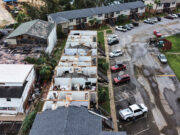




Perpetrated during America’s era of public lynchings and racist oppression, the 1921 Tulsa Race Massacre in Oklahoma continues to haunt its survivors, their descendants, and a decades-long roll call of activists who demand justice for the intentional destruction of “Black Wall Street” 104 years later.
The massacre–where White mobs killed and terrorized hundreds of Black men, women and children, torched their homes and razed to the ground the city’s once prosperous Greenwood District—remains a stain on the city’s history.
The current debate about how and in what form reparations should be realized, with public and private parties contending over the concept of repair, remains unresolved. The source of funding to restore a community that never fully recovered, and who should represent Black Tulsa at the table, also remains unresolved.
On June 1, the office of Tulsa Mayor Monroe Nichols announced the creation of the Greenwood Trust. A trust is a legal arrangement where a trustee holds and manages property or assets for the benefit of a third party, the beneficiary, and may also be used to shield such assets from taxation and/or for bequeathing said assets to subsequent generations.
“Today at the Greenwood Cultural Center and on Tulsa Race Massacre Observance Day, Mayor Monroe Nichols brought forward a plan for a Road to Repair that will help unify Tulsans and heal multi-generational wounds from the 1921 Tulsa Race Massacre, which stands as one of the worst race massacres in U.S. History,” the statement said in part.
The statement also stated that the private charitable trust “will serve as an avenue to encourage economic growth and development in North Tulsa, the historic Greenwood District, and surrounding neighborhoods, with a focus to address disparities experienced by Tulsa Race Massacre survivors, descendants, Historic Greenwood District and North Tulsa residents and businesses.”

The trust will be created with the goal of securing $105 million in assets with most of the funding secured, or committed, by June 1, 2026, the 105th Anniversary of the Tulsa Race Massacre, the statement said. “Assets could include property transferred to the Trust, philanthropic funding, and public funding, if desired,” the statement continued.
The trust is to include an executive director, paid for by private funding, a board of trustees and a board of advisors to manage and operate the daily functions of the trust. “Mayor Nichols said the first operational year of the Greenwood Trust will serve as a planning year to stand up some of the Trust’s initial programs and the hiring of initial staff to carry out fundraising efforts.”
What is unclear at this time is what type of private funding sources will be pursued or who will be tapped for the boards or staff. The Final Call contacted Mayor Nichols’ office but received no response.
While the new Black mayor introduced the Greenwood Trust, which would be funded through private funding, there is another plan in place that was introduced by the previous mayor, G.T. Bynum, who was White. That plan, already in motion, has opened the door to outside developers. There are questions about both proposed plans.
Tulsa City Council member Vanessa Hall-Harper told The Final Call in a telephone interview that she and many of her constituents are expressing concern over the ways and means by which justice will be served for the Greenwood District and whether or not outside interests will do through gentrification in the early 21st century what angry White mobs did between May 31 to June 1, in 1921.

“There is a CDC, a Community Development Corporation, that’s being created as an extension of the city. This was put into place years ago, well before Mayor Monroe Nichols won in his election,” Councilmember Hall-Harper said of the previous administration. Mayor Nichols was elected in 2024.
The CDC established by the previous mayor was not under a banner of “reparations” but under “community development,” which some critics argued is code for “White developers,” and White residents at the expense of Greenwood and North Tulsa’s Black residents.
“They are making decisions of the leadership without the community. It is a 9-member board; they’ve already seated 5 without any input from me, the elected leader, or anyone in the community,” she said of Greenwood’s current residents and the district’s leadership who reportedly had been shut out of the closed-door meetings surrounding the district’s future.
She does support Mayor Nichols plan.
“A trust structure is really what we need because CDCs (the Greenwood Legacy Community Development Corporation or Greenwood Legacy Corporation, GLCDC) can be manipulated and bought and paid for,” said Councilmember Hall-Harper.
She said that her constituents are concerned with who will occupy the remaining seats without a legitimate vetting from the community. “The White power-structure knew and knows they can manipulate it to their benefit and that is why I’m actively opposing that CDC.
And the land that is owned by the Tulsa Development Authority in our community. I am pushing for that land to be placed in the trust,” she said of the “Road to Repair” initiative of the Greenwood Trust.

Despite Mayor Nichols’ proposal, the CDC set up by the previous mayor, which is funded by public funding, is still moving forward.
“As the District 1 elected City Councilor, I am compelled to warn my community,” Councilmember Hall-Harper said in a June letter shared with local media. “The entire process was a scam on the Black community to make it appear from a national perspective, that during the centennial commemoration of the Race Massacre that Tulsa was finally going to do right by our community.
It was all a lie, and things are right back to the normal status quo of White supremacy in Tulsa,” she wrote, referring to the previous mayor’s proposed plan.
“The structure and process of the GLCDC will only ensure that development and opportunities to build wealth remain with the White male majority in Tulsa and we, the Black community, will be lucky to receive a few crumbs off the table,” she insisted in her letter to the media.
The “Road to Repair” proposal is still in the very early stages, so no details are known yet in terms of who will be appointed to that board.
There are two known survivors of the Tulsa Race Massacre still living, both over 100 years old: Viola Fletcher is 111 and Lessie Benningfield Randle is 110. Both are represented by Attorney Damario Solomon-Simmons, who is a Tulsa native.
He is also the founder and executive director of the Justice for Greenwood initiative. On a recent podcast, Atty. Solomon-Simmons said both Ms. Fletcher and Ms. Randle were excited for the Tulsa community in the aftermath of Mayor Nichols’ announcement.
“We’re still working with our mayor to talk about exactly what that’s going to mean for them as individuals … we’re engaged in those discussions as we move forward,” Atty. Solomon-Simmons said on the Native Land Pod podcast on June 7.

Robin Rue Simmons is the founder and executive director of an Evanston, Illinois-based group working to advance local reparations around House Resolution 40 (H.R. 40) introduced by the late Congressman John Conyers (D-Mich.).
She told The Final Call that she started her work with the city of Tulsa following the 2021 centennial observance of the Tulsa Race Massacre and helped to organize Evanston’s own local reparations effort.
The existence and subsequent destruction of Black Wall Street still kindles intense interest among Black people and groups from various locations throughout the United States, she said.
“I’ve now been to over 100 cities that have engaged with the reparations process, but it is important that reparations be informed by the Black community,” Ms. Rue Simmons stated. She noted that developing a consensus among Black people is the best way to establish legitimacy within the reparations movement.
“Some communities have very strong emphasis on housing, with others it’s been education, for some it’s been health, for others it’s been cash, and some communities want the ability to repatriate,” she said.
The Most Honorable Elijah Muhammad and His National Representative, the Honorable Minister Louis Farrakhan, teach that separation is the best and only solution for Black people. Minister Farrakhan has addressed the need for reparatory justice that is owed to Black people and has stated that Black people are owed “reparations.”

These two Divine Servants also teach that Black people must own land as a means of independence. In the Muslim Program by the Most Honorable Elijah Muhammad, published on the inside back page of The Final Call newspaper, Point No. 4 of “What The Muslims Want” points this out.
It states: “We want our people in America whose parents or grandparents were descendants from slaves, to be allowed to establish a separate state or territory of their own–either on this continent or elsewhere.
We believe that our former slave masters are obligated to provide such land and that the area must be fertile and minerally rich. We believe that our former slave masters are obligated to maintain and supply our needs in this separate territory for the next 20 to 25 years–until we are able to produce and supply our own needs.
“Since we cannot get along with them in peace and equality, after giving them 400 years of our sweat and blood and receiving in return some of the worst treatment human beings have ever experienced, we believe our contributions to this land and the suffering forced upon us by white America, justifies our demand for complete separation in a state or territory of our own.”
Regarding widespread concerns that an undisciplined drive for reparations could lead to gentrification in Tulsa, Ms. Rue Simmons stated that she feels land ownership through land grants is an effective form of restorative justice.
A land-grant is a gift of real estate, land, or its use privileges made by a government or authority to another group, body, or people for a specific purpose.
“I fully support land-grants as a form of reparations,” Ms. Rue Simmons said. “I think land-grants would be the leading model for repair. It builds wealth … it allows for legacy building, whether it is for housing or Black institutions, access or culture.
It allows us to become a self-determined people when we do have land, and it offers ways to cultivate, harvest and monetize land and establish our legacy,” she said.
Student Minister Jamal Ali-Muhammad, coordinator for the Nation of Islam’s Tulsa Study Group under the leadership and guidance of the Honorable Minister Louis Farrakhan, told The Final Call that now more than ever, Black unity is the key to the preservation of Black Wall Street’s legacy and for any hope for the Greenwood community to return to its former state of Black enterprise, self-sufficiency and excellence.
“When people come to me at community events, I try to give them the truth that the Most Honorable Elijah Muhammad and the Honorable Minister Louis Farrakhan have given to us,” Student Minister Jamal Ali-Muhammad said.
“We must come together in unity. We cannot do anything as separate individuals or separate organizations, and that is the hardest thing for our people to see and overcome. Gentrification has not stopped in North Tulsa, and we must speak with one voice,” he said.
Final Call staff contributed to this report.
