











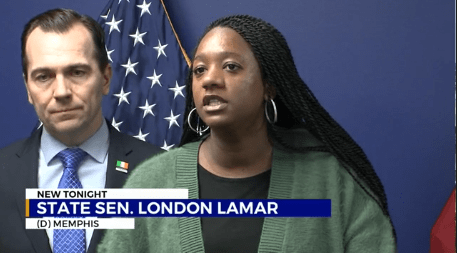

“It’s like death. … Having children that’s out in the world, and you can’t physically see, touch or anything like that. It’s mind-boggling,” stated Bianca Clayborne, describing her feelings after being separated from her five children, for 55 days after a minor traffic stop by Tennessee State Troopers.
She shared her harrowing ordeal with WKRN News 2, an ABC Nashville affiliate, shortly after the incident. Though the incident happened two years ago, in 2025, she is still fighting for justice.
Ms. Clayborne, her boyfriend Deonte Williams, and their five children—ranging in ages from a breastfeeding 4-month-old to a 7-year-old—were on their way to a funeral in Chicago from Atlanta when they were pulled over in Coffee County for a slowpoke violation (driving in the fast lane, left lane without passing). But three other cars had just done the same, according to her federal lawsuit, filed on Feb. 8, 2024.
After four Tennessee Highway Patrol troopers—Ruben Basaldua, Donnie Clark, Douglas Foster, and James Thompson—pulled over the family’s car on Feb. 17, 2023, police detained the family for about 2.5 hours in near-freezing temperatures, the lawsuit states.
Troopers reportedly found less than five grams of marijuana, which under Tennessee law is only a citation offense, according to the lawsuit, amended on Feb. 26, 2025, to add named defendants.
“My oldest child, he was just looking at me, … confused, and I just came up, and I told him, it’s not your fault,” stated Ms. Clayborne, during a WKRN News 2 report shortly after the incident.
Officers found a gun belonging to Ms. Clayborne in her purse. However, it is “presumptively legal in Tennessee for a person to own and carry a handgun—even without a permit,” argued the complaint.
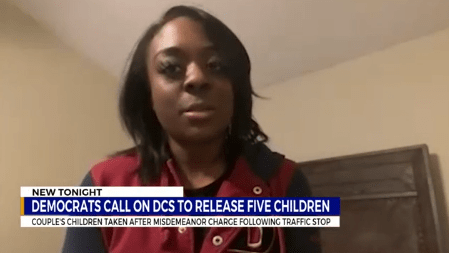
The troopers decided to arrest, not cite, Ms. Clayborne and Mr. Williams for simple possession.
Cradling her infant baby in her arms, Ms. Clayborne pleaded with officers not to summon Department of Children’s Services (DCS) for her children.
At the jail, despite a trooper’s assurance that Ms. Clayborne was not being arrested and was a good mother with no abuse or neglect issues and that the family should not be separated, DCS employees arrived and, among other things the lawsuit alleges:
• Illegally detained and interrogated the family;
• Illegally forced Ms. Clayborne to try to provide a urine sample (forcing her to disrobe in the presence of DCS personnel and her children); and
• Illegally had officers place spike strips around her car to keep her and her children from leaving.
The complaint states, in part, that Coffee County Sheriff’s Department (CCSD’s) “… Chief Deputy (Frank Watkins) tried to call the District Attorney to figure out if a law had changed that allowed the CCSD to take the children from their mother without a court order (it hadn’t).
Then, in a remarkable and as-yet-unexplained turn of events, Judge Perry called a County official (James Sherrill) on his cell phone regarding the case—without any representative for Plaintiff involved.
In the presence of CCSD Chief Deputy Watkins, Sherrill told Judge Perry: ‘If we get involved, there’s going to be a damn lawsuit for sure.’
In response, Judge Perry told Sherrill to arrest Clayborne for disorderly conduct, remove her children from her, and not to worry about getting sued because ‘I’ve got judicial immunity.’”
According to the Harvard Law Review, judicial immunity shields judges from civil liability for judicial acts.
Houston-based Attorney Pamela Muhammad explained to The Final Call that, “Qualified immunity” entitles governmental workers to use qualified or absolute immunity as a defense in civil lawsuits when they are performing the discretionary functions of their job if their conduct does not violate clearly established statutory or constitutional rights of a reasonable person.
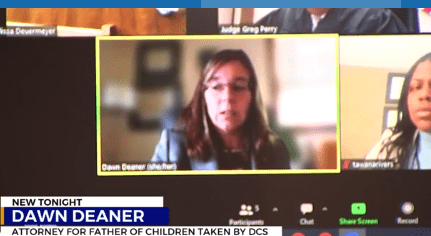
“This is the law by which these governmental workers kind of do what they want to do and then rest on, ‘Oh, well, even if I was wrong, you can’t sue me.’
We’ve seen many actions of abuse by these government officials, I mean, these are some of the same protections that allow police brutality to occur,” said Atty. Pamela Muhammad.
DCS initially placed two children of Ms. Clayborne and Mr. Williams in one foster home and three in another and later placed the children in new foster homes but did not tell Ms. Clayborne.
Some of the children were shuffled from foster home to foster home, where in one, they had to be removed after a domestic dispute between the foster parents, the suit alleges.

On approximately March 3, 2023, DCS placed the children with a family friend in Nashville. On April 13, 2023, Judge Perry finally ordered DCS to return custody of the five children to their mother. On August. 15, 2023, the citation against her for simple possession of marijuana was dismissed.
According to the amended complaint that was filed, Ms. Clayborne experienced severe emotional trauma from being separated from her children. She suffered from anxiety, depression, and mental anguish.
Her breasts became engorged and painful from not breastfeeding. Over time, her breastmilk dried up and she developed a breast infection. She could hardly get out of bed and could barely sleep—and when she did, she cried herself to sleep.
“Clayborne was depressed, in shock, and started having panic attacks. She went to a doctor who prescribed her an anti-depressant. She also had to see a therapist,” the complaint indicates.
Her children worried about whether their parents had abandoned them, and continue to suffer trauma from this experience, including nightmares, a visceral reaction to seeing police, problems sleeping, and pleading, “Please don’t let them come back and take us,” the amended suit says.
Atty. Pamela Muhammad shared her observations and concerns about what the family in this case endured. “These people are out in the middle of nowhere or at least they’re far from home and I can’t imagine just how terrified they were without having any legal representation, or any real access to legal representation,” said Atty. Pamela Muhammad. The mother should have been allowed to leave with her children, she argued.
“It makes you wonder at what point did they (DCS) determine that they wanted to remove those children?” she continued. Atty. Muhammad stated that her research has shown that the federal incentives and the money attached to the children in foster care are sometimes used to fund municipalities.
“You kind of look at this money where potentially after these litigations are done and 55 days are up, then your child is returned, but that’s only after the damage has been done,” she added.
The Tennessee District Attorney’s Office said they could not comment on pending litigation, despite Chad Kubis, Press Secretary & Assistant Dir. of Communications, returning a call to the Final Call Newspaper and asking that questions be sent via email.
A deliberate and broader pattern?
This case appears to be part of a broader pattern concerning child removal cases in Tennessee, as mentioned by Cheryl Huff, president of the Middle Tennessee National Action Network.
“It was unbelievable when I first heard it. I couldn’t believe it, but (it) being in Tennessee, so I could,” she said. “I have 17 cases that I deal with right now of the same situation. This is really bad, especially in Tennessee,” she told The Final Call.
One of her cases involves a grandmother fighting for her grandchildren who were allegedly beaten, sexually assaulted, and starving in foster care, according to Ms. Huff.
Despite legal efforts, she said the children remain in foster care. Another case involves a mother whose children were taken away because she pulled off the interstate to a gas station to rest.
Under current federal law, most U.S. children aren’t separated from their parents due to abuse but for “neglect”—often a euphemism for poverty conditions like inadequate food, housing, or clothing.
This results in disproportionate separation of Black families, which the American Bar Association finds especially shameful given the underlying cause.
“In 2020 over 70 percent of all children, and 63 percent of Black children, removed into the U.S. foster system were taken from their families for reasons related to ‘neglect.’
Due to historic injustices, Black children are significantly more likely to grow up in homes experiencing poverty, the ABA reported in a recent article, “Racial Discrimination in Child Welfare Is a Human Rights Violation—Let’s Talk About It That Way.”
In the U.S., five percent of all children spend some time in foster care and 37 percent are involved in a maltreatment investigation by a child protective services agency by age 18, according to the National Bureau of Economic Research Digest’s, “Racial Disparities in Foster Care Placement.”
The percentage of Black children involved in such investigations is nearly double the percentage of White children, and Black children are also twice as likely as White children to spend time in foster care, The Digest reports.
Qiana Manns is an associate judge of the 309th District Court in Houston. She explained that the Family First Act (signed into law on Feb. 9, 2018, to ensure that children in foster care are placed in the least restrictive, most family-like, and appropriate settings, and for other purposes) led to a reduction of children being removed from homes in the Midwest.
Those families hooked on “ice” (crystal methamphetamine), and similar drugs, who weren’t necessarily Black or minority, cried out and advocated which resulted in federal programs being earmarked for them, Judge Manns explained.
“The numbers have gone down, but it’s still higher in terms of our community, I can say, here in Texas, (more) than any other community. So, there still is a disproportionate amount of our children, just based on the sheer population, that are here that’s in foster care,” she said.
According to Texas state data for 2019, Black children are vastly overrepresented at every stage of the Texas child welfare system, indicates the non-profit research agency, Texans Care for Children.
Black children account for 11 percent of the state’s child population but 18 percent of reports to CPS, 20 percent of CPS investigations, and 20 percent of the children who are removed from their families and placed in foster care, the agency reported in 2020.
Compared to White and Latino children, Black children are much more likely to be removed by CPS and out of every 1,000 Black children in Texas, 4.3 percent were removed from their families in 2019, compared to just 2.5 percent for White children and 1.9 percent of Latino children, according to the state data.
“I would suggest that we continue to document as much as we can in terms of always having, if it’s available, a device to record, to make sure that while it’s fresh on your mind that you’re taking names and that you have your recollection of the events.
And what happened written down as soon as possible, so that your facts and your description of how everything unfolded is accurate, and it’s fresh at the time that it happens,” stated Judge Manns.
In addition, do what the Black community has always done and that’s “invite the village,” she added, meaning to create safe spaces where struggling parents can get help without fear of losing their children and to stand firm against those with harmful intentions to protect the community from victimization, she encouraged.
