










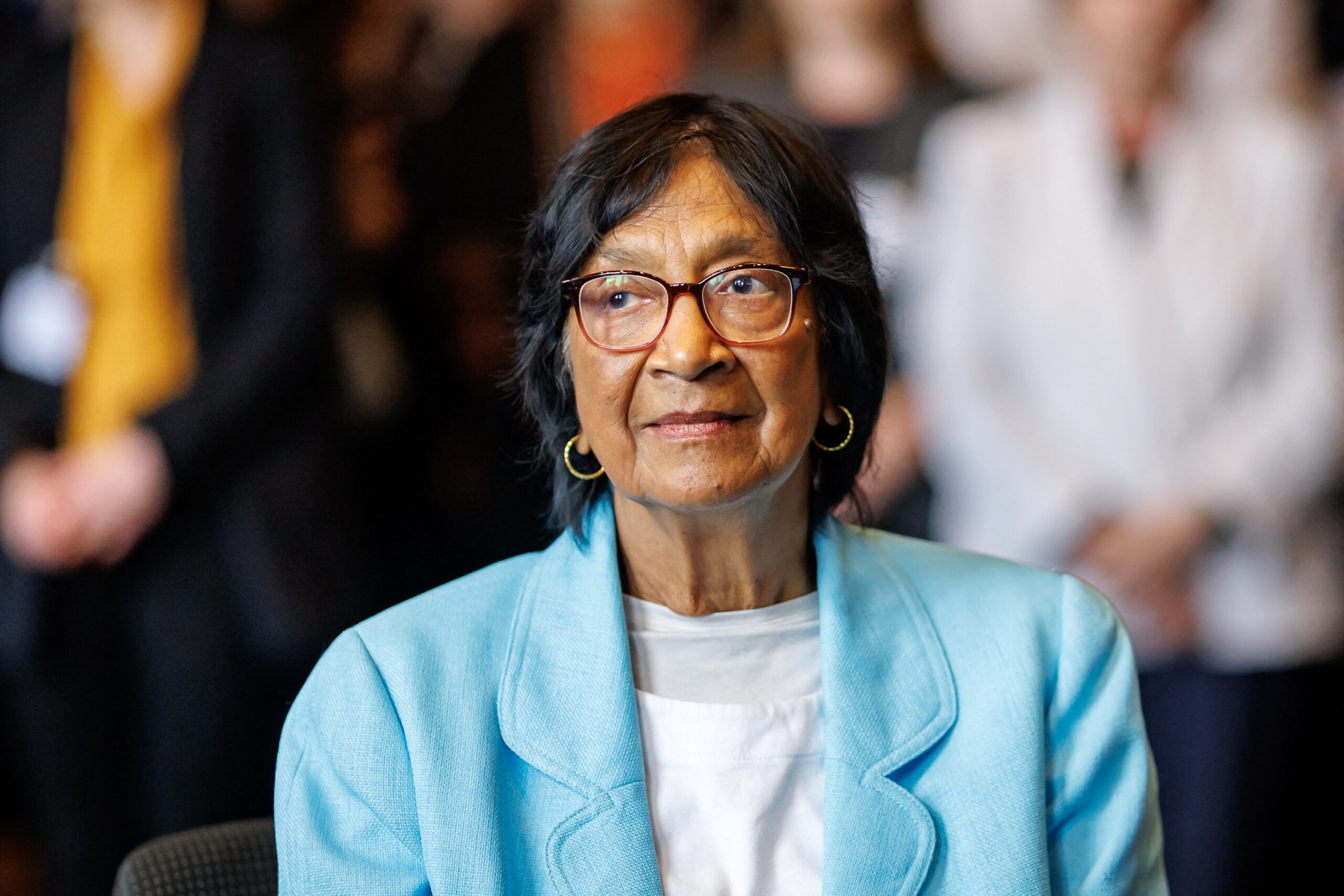

On October 9, South African jurist Navanethem “Navi” Pillay, who led the United Nations inquiry that concluded Israel committed genocide against Palestinians in Gaza, was awarded the 2026 Nobel Peace Prize.
Judge Pillay is the first non-White woman to set up a law firm in KwaZulu-Natal province, in South Africa, during White minority rule. She went on to serve as a judge on the UN-backed International Criminal Tribunal for Rwanda.

Which focused on the genocide in which 800,000, mostly ethnic Tutsis, were brutally killed. As a jurist, Pillay carved out a reputation as a brave, strong and resolutely determined defender against genocide committed under apartheid regimes.
Judge Pillay described winning the 2026 Nobel Peace Prize as deeply humbling and a surprising personal honor that she shares with all the institutions, survivors, and human rights defenders she has served.
She delivered her acceptance speech in the Historic Courtroom 600 where the Nuremberg trials were conducted. “We are living through an era when international law and human rights are under significant political attack.
This worsening reality is particularly visible with the attacks on the International Criminal Court. As the Nobel Committee has rightly stated, ‘an international legal system in which war criminals are held to account and the victims of abuse see justice served is a precondition for a peaceful world,’” Judge Pillay said in her remarks.
She added, “These efforts to weaken international criminal justice endanger the progress painstakingly made since Nuremberg and risk returning us to a world in which power, rather than law, determines whose suffering matters.
This award strengthens my conviction that we must stand together in defense of the rule of law, independent courts and an international legal order based on principle rather than selectivity.”
Her advocacy for Palestinian human rights made her a target by Israel after the announcement that she is this year’s Nobel Peace Prize winner. Israel’s Foreign Ministry and its ambassador to the UN, Danny Danon, were vitriolic in their responses to her award and their concern that her global status may be increased.
Haaretz, Israel’s oldest continuously published daily newspaper, published an article titled “Israel’s War on Nobel Laureate Navi Pillay Is a War on International Law Itself.” The article quoted the foreign ministry’s criticism of Pillay for daring to point out Israel’s genocide against the Palestinian people, a charge Israel continues to deny, despite evidence to the contrary.
The Israeli government’s reaction, according to Haaretz, “reflects the chasm that has opened in the last decade between Israel on one side and UN agencies and the mainstream of international law on the other. The relationship with Pillay, which has mostly seen downturns since 2011, is a mainstay of this chasm that will largely shape Israel’s relations with the world in the coming decades.”
The Nobel Peace Prize recipient’s journey with Israel has gone from a state visit in 2011 to severe criticism of the occupation and Israeli human rights violations in the West Bank.
While heading a UN commission of inquiry, Judge Pillay went from lambasting Hamas on October 7, 2023, to harsh reports on suspected Israeli war crimes in Gaza, even concluding that Israel’s actions amounted to genocide, Haaretz noted.
According to Haaretz, “As evidence mounted of possible war crimes by Israel, Judge Pillay’s reports became increasingly harsh. Throughout 2024 and 2025.
She published reports on systematic sexual violence against Palestinian detainees and civilians and the destruction of Gaza’s healthcare system. In September 2025, the commission published its most scathing report, declaring that Israel had committed genocide.”
While appearing on Al Jazeera in 2023, she was asked whether she considered Israel’s horrific response “self-defense or collective punishment and brutal revenge?”
Judge Pillay replied, “This is indiscriminate attacks against civilians, excessive and does not conform to the requisites of international law, which is proportionality and focus(es) on protection of civilians. And therefore, we think this cannot be equated with self-defense.” She called what Israel was committing “collective punishment.”
Born in Durban in 1941 to a family of Tamil descent, Navi Pillay grew up in a poor district of the city. She studied law and earned a master’s and doctorate at Harvard. A longtime anti-apartheid activist, in 1973, she won the right for political prisoners at the notorious Robin Island prison to have access to lawyers.
During Nelson Mandela’s second year as president of South Africa, she became the first non-White woman appointed to South Africa’s high court, Agence France-Presse (AFP) reported.
According to Haaretz, “Due to Pillay’s standing and the commission’s meticulous investigation, the panel has special status in the world of international law. Israel, of course, angrily rejected the report and berated its authors and conclusions. But the chasm that has opened between Israel and the doyens of international law can no longer be bridged.”
Follow Jehron Muhammad @Africawatchfcn on X
