




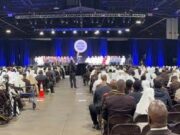

The recent 81st session of the United Nations General Assembly (UNGA 81) opened under the theme “Restoring trust, managing transformation: A United Nations that delivers for all.”
During the high-level general debate, over 50 African heads of state, vice presidents, and foreign ministers mounted the podium and delivered remarks on UN Security Council reform, debt relief, value-adding to critical raw minerals, finance, and AI (artificial intelligence).

According to the news media and analysis platform Africa Briefing, African leaders have rarely sounded more aligned on the need to rebalance global power.
“That does not mean Africa suddenly agrees on everything. It plainly does not. But on Security Council reform, the cost of capital, critical minerals, climate finance and new technologies, the common ground is hard to miss,” reported Africabriefing.com.
According to the UN General Debate transcript, Kenya President William Samoei Ruto emphasized that the continent’s 54 nation-states comprised almost a quarter of the UN’s membership, and its people represent about one-fifth of humanity, yet the continent still has no permanent Security Council seat.
“That imbalance might have reflected the world of 1945; it does not reflect the world of today,” Ruto said, arguing that change cannot be managed through institutions that refuse to change themselves. “Reform must lead to equitable and permanent representation for Africa, with all the prerogatives and privileges of permanent Council membership,” he said.
“Political reform and financial reform are not separate projects,” he continued. Rather, they ask the same question: do global institutions reflect sovereign equality? Or do they preserve inequalities which go back to another era.”
Ruto then explained that, “In 2024, developing countries accounted for less than a third of the record $102 trillion in global public debt, yet they paid about $1 trillion in interest—money that would be put to better use in education, which he labeled ‘the infrastructure of opportunity.’”
Telling those members of the General Assembly that Africa is not coming to the podium asking for anything, he said, “We come to propose.” He then pointed to Africa’s mineral wealth and agricultural potential and renewable energy resources. He also pointed out the continent has the world’s youngest population.
Change is already happening in the cocoa, cotton and energy sectors, he said, adding that the “African Continental Free Trade Area must become a platform on which Africa makes more of what it now imports.”
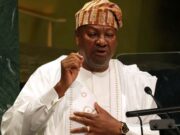
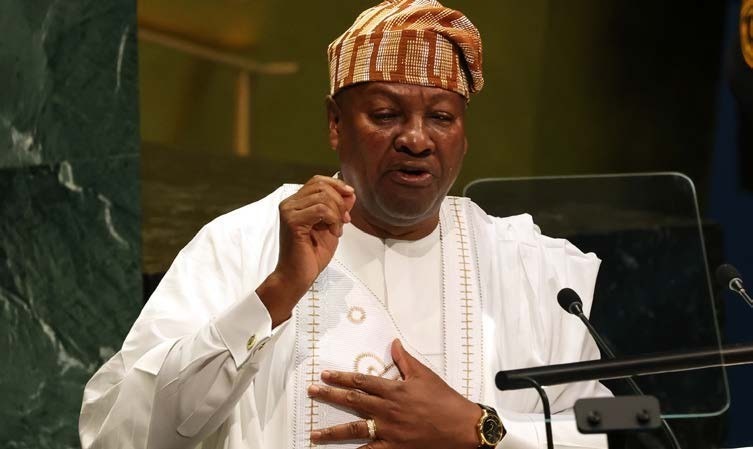
Ghanaian President John Mahama, adding to Ruto’s remarks, said while addressing the General Assembly, “Security Council reform is not a favor to Africa; it is an imperative for the legitimacy, credibility, and survival of the United Nations.” He added, “African leaders are no longer talking only about getting a seat at the table. Increasingly, they want a say in writing the rules as well.”
South Africa’s Foreign Minister Ronald Lamola exposed the in-plain-sight secret that should shame into reality the permanent members of the UN Security Council. “Over the past decade, 70% of Security Council resolutions have concerned conflicts on the African continent.
We are the Council’s main business, and we have no permanent say in it,” he said. Zimbabwe’s President Emmerson Mnangagwa, whose country will assume a non-permanent seat on the UN Security Council during the 2027 to 2028 term, said..
“Multilateralism is a crucial equalizer—it ensures that all have an equal voice under international law and an equal role in shaping our shared future,” he said. Mnangagwa added that the UN Charter remains the common compass.
In directing his criticism at the permanent members of the Security Council, he declared, “International law cannot be a shield for some and their sword against others.” He underscored, stressing, that “The United Nations has a sacred duty to save succeeding generations from this scourge of war.”
Recalling that Zimbabwe has more than 40 critical and rare earth minerals, Mnangagwa gave voice to his country’s efforts to promote value addition and beneficiation at source, including exporting locally produced lithium sulfate, demonstrating that retaining value at the source is possible for shared prosperity.
He also said that Zimbabwe’s national development initiatives have continued to be undermined by unilateral coercive measures imposed by some Western countries and called for their immediate and unconditional removal.
Désiré Assogbavi is Advocacy Advisor for Africa at the Open Society Foundations and blogs at assodesire.com. He shared his analysis and insight in his recent post titled, “What Africa Told the World at the UN General Assembly 2026 (UNGA81).”
“None of this demand is new. What was new came from Sierra Leone’s Julius Maada Bio, who coordinates the AU’s Committee of Ten on reform. He said years of negotiations without results have tested the credibility of the process, and that member states should have a consolidated model before this session ends, as promised in the Pact for the Future. That is a deadline, and deadlines can be tracked,” he wrote.
In his commentary, Assogbavi said that in his view, Bio also gave the most useful sentence of the debate. “Representation becomes meaningful when it changes decisions and improves lives,” he wrote, quoting Bio.
Assogbavi added, “Let’s be honest about the obstacles, though. Any change to permanent membership needs a Charter amendment ratified by two-thirds of member states, including all five permanent members. And the AU has still not decided which African countries would take the proposed seats, while Nigeria, Egypt and South Africa are all eyeing the role.”
Follow Jehron Muhammad @africawatchfcn on X
