








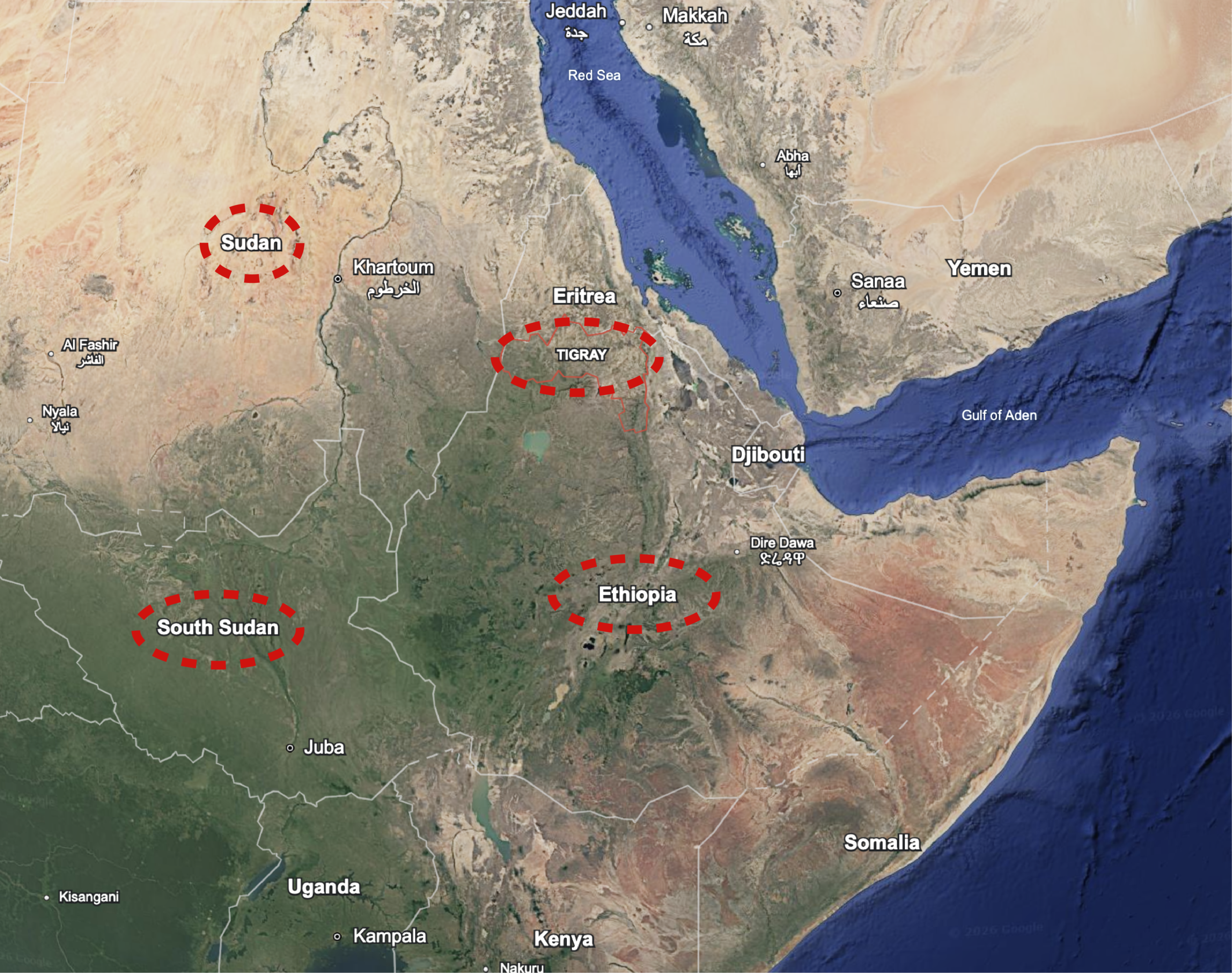

Recent growing tensions between Addis Ababa and Mekelle, the capital of Tigray, suggest that a civil war between the Ethiopian government and the Tigray People’s Liberation Front (TPLF) may be returning to an even broader war. This is despite the 2022 Cessation of Hostilities Agreement.

Under the negotiated agreement mediated by the African Union (AU) by the AU High Representative for the Horn of Africa and former Nigerian President Olusegun Obasanjo, that the warring parties signed in Pretoria, the TPLF promised to disarm, and the parties agreed that Tigray would have an interim administration governing with the approval of both sides.
The International Crisis Group noted on its website, crisisgroupl.org, that while the Pretoria agreement was welcomed for bringing the conflict to an end, “the Pretoria deal left a number of open wounds.”
Among these wounds, “The TPLF felt aggrieved by what it considered a lopsided settlement and, according to the (Ethiopian) government, it failed to honor its disarmament pledge.
Eritrea, which had overcome enmity with the federal government to join the anti-TPLF campaign, felt it had been inadequately consulted on the final deal and wished the government had pushed to achieve a full battlefield victory.
The status of hotly contested territories that the Amhara region had seized from Tigray during the conflict was left unresolved—leaving Tigrayans displaced from these areas languishing in temporary camps,” the International Crisis Group, a Brussels, Belgium-based independent nongovernmental organization, explained.
According to Alemayehu Weldemariam, a professor of law at Indiana University, Ethiopia’s federal government bears partial responsibility for the collapse of the Pretoria Agreement. He told Al Jazeera that “This war has been in the making for a while now.
Much of the provisions in the cessation of hostilities (in the 2022 agreement) were primarily sabotaged by the federal government itself.” He cited fuel, service, and cash restrictions imposed on Tigray, and the government’s failure to set up the interim administration the deal had promised.
The TPLF, which “dominated Ethiopian politics from 1991 until Prime Minister Abiy Ahmed came to power in 2018, has recently joined six other armed groups in a new opposition alliance, reported Radio France Internationale (Rfi), a prominent French public radio network.
The opposition groups formed an alliance to overthrow and remove Prime Minister Ahmed and his government from office. The coalition calls itself the Ethiopian Peoples’ Forces Alliance for Survival.
The loose coalition includes the Amhara Fano National Movement, the Oromo Liberation Army, the Ogaden National Liberation Front, the Afar Revolutionary Democratic Unity Front, the Benishangul Peoples’ Liberation Movement, the Gumuz Peoples’ Democratic Movement and the TPLF.
In a joint statement issued by the Alliance for Survival, they stated in part, “… we, the peoples’ forces concerned with the survival of Ethiopia’s peoples, bear the historic responsibility of overthrowing this regime, safeguarding the survival of all nations, nationalities and peoples, and opening a new chapter.”
According to Agence France-Presse (AFP), army chief Field Marshal Brian Jula said, “We are fighting forces that are organized and allied to serve the interests of external forces. Neither Shaebia (Eritrea) nor the TPLF can achieve anything alone, even if they are allied, unless they are backed, supported and supplied by Sudan, Egypt and other external powers.”
Regarding Sudan, according to reporting by the International Crisis Group, “Ethiopia’s leaders are furious at the Sudanese army for hosting thousands of Tigrayan fighters in territory under its control, whom they fear could attack Ethiopia from across the border or return to Tigray to join in battling the government.”
According to the crisis group, “Many of these fighters have aided Khartoum in its own civil war with the paramilitary Rapid Support Forces (RSF). Seeing the Sudanese army as part of a regional axis coordinating with Ethiopian opposition forces.
Addis Ababa has reportedly responded by allowing arms flows to the RSF and permitting it to operate from Ethiopian territory near Sudan’s Blue Nile state, where the paramilitary has made a series of gains.
Ethiopia is also a close ally of the United Arab Emirates (UAE), which is widely seen (despite its denials) as the RSF’s main backer. Meanwhile, the UAE’s Saudi rivals are aligned with the Sudanese army, as are Egypt and Eritrea, both arch foes of Ethiopia.”
Rfi reported the Alliance for Survival’s latest offensive into Afar also “threatens routes linking landlocked Ethiopia with Djibouti, through which the vast majority of the country’s international trade—including fuel supplies.”
According to Euroobserver.com, about 97% of Ethiopia’s trade goes through Djibouti’s port, and a series of regional chain reactions is possible, including the prospect of a civil war in northern Ethiopia.
Add to the above, theconversation.com explained the relationship between Ethiopia and Eritrea has “deteriorated sharply over the demand by Ethiopia, which is landlocked, to have access to the Red Sea. Statements from Ethiopian officials contemplating the acquisition of the Eritrean port of Assab by force have caused alarm in the Eritrean capital of Asmara.”
Abiy Ahmed government’s Ethiopian National Defense Force is recognized as one of Africa’s five most powerful militaries. It has over 503,000 active personnel, a multi-billion-dollar defense budget, and an advanced arsenal of combat aircraft and unmanned aerial vehicles, or drones.
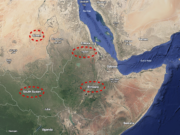
If these tensions between Ethiopia and Tigray continue escalating, coupled with fighting still happening in Sudan, concern is mounting that the Horn of Africa could become engulfed in war.
Follow Jehron Muhammad @africawatchfcn on X
