









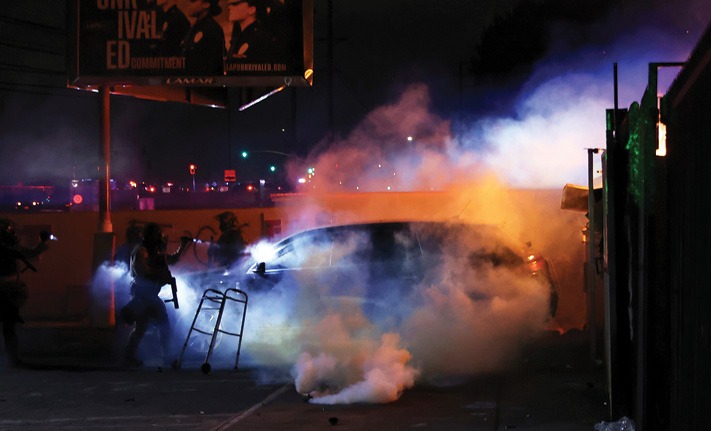

LOS ANGELES—A federal judge heard arguments on August 14 over whether to sharply curtail how U.S. Immigration and Customs Enforcement (ICE) conducts operations across Southern California. In the hearing, plaintiffs and advocates framed this as the next major turn in a 14-month legal battle over the constitutionality of the agency’s tactics in the region.
The fear is what Armando Gudino, executive director of the Los Angeles Worker Center Network, wants people to understand first.
“It’s hard to describe the type of fear and intimidation that a community, particularly Brown communities, immigrant communities, are experiencing right now,” Mr. Gudino told The Final Call, in an interview following a federal court hearing on ICE enforcement tactics in Southern California. “… the fear of not knowing if you’re going to be able to go out and take your kid to school and come back home,” he said.
Children are afraid to leave their parents’ homes, families losing income when a parent is detained, and what he called “catastrophic impacts” on communities’ emotional and mental well-being. The effects, he said, will ripple outward into local economies and the country as a whole.
That human toll sits at the center of Vasquez Perdomo v. Noem, filed in the U.S. District Court for the Central District of California before Judge Maame Ewusi-Mensah Frimpong.
The suit was originally brought by five individual Latino workers and three membership organizations— the Los Angeles Worker Center Network, United Farm Workers, and the Coalition for Humane Immigrant Rights (CHIRLA)—along with the Immigrant Defenders Law Center, over what the complaint describes as immigration operations that began around June 6, 2025.
“This case is not about stopping immigration enforcement; it’s about requiring immigration enforcement to indeed follow the Constitution,” Mr. Gudino said. “What it cannot do is treat being Latino as reasonable suspicion.
You cannot stop someone simply because they look Brown, or they speak Spanish, or work what is otherwise categorized by some as a low-wage job, or happen to be standing outside a Home Depot or a car wash, looking Brown,” he argued.
Chandra Bhatnagar, executive director, ACLU Foundation of Southern California, is among the counsel of record for plaintiffs in the case, alongside Public Counsel, the National Day Laborer Organizing Network, and several other firms and legal clinics named in the amended complaint.
“No one should have to live wondering whether they or someone that they love can simply be disappeared by the government,” Mr. Bhatnagar stated outside the courthouse. “We are here for you, and our fight will continue,” he added.
What’s changed since the case’s early days is discovery—depositions, internal agency records, and other cases argued since Judge Frimpong’s original 2025 restraining order—evidencing that racial profiling, not individualized law enforcement, is happening, noted Mr. Gudino.
He told The Final Call that he left today’s hearing “cautiously optimistic,” adding that the government’s defense felt, to some in the room, insubstantial.
On February 26, 2026, plaintiffs filed a Second Amended Complaint adding two claims – that the government intentionally discriminated against Latino communities in violation of the Fifth Amendment’s Equal Protection guarantee, and that agents used unreasonably intrusive tactics— handcuffing, prolonged confinement, relocation, and force used against compliant individuals— in violation of the Fourth Amendment.
The complaint alleges the pattern was sanctioned at the top. It cites “border czar” Tom Homan stating that officers consider a person’s “physical appearance” among the “typical facts” behind a stop, and quotes an unnamed U.S. Customs and Border Protection (CBP) official acknowledging that agents arrest people based, among other things, on “how they look.”
The complaint also quotes the government’s own words from its filing to the U.S. Supreme Court, in which officials argued that to carry out their mission, agents must be able to rely on “apparent ethnicity” and stop a “relatively broad range of individuals.”
Separately, the complaint cites a June 8, 2025 DHS news release describing the operation as capturing the “worst of the worst”— “murderers, sex offenders, and other violent criminals.”
In September 2025, the Supreme Court granted the government a stay of Judge Frimpong’s original restraining order in a 6-3 decision, allowing the challenged practices to continue while litigation proceeded. The Los Angeles Worker Center Network, a plaintiff, said at the time:
“The Court has opened the door for immigration agents to stop and detain people simply because of the color of their skin, the language they speak, or the work they do. … We will not be silenced.”
Outside the courthouse on August 13, Mayra Morales recounted learning of her husband’s detention through a message from an unknown number that reached her at 2 p.m.—she called him repeatedly afterward, but he never answered.
No ruling on the preliminary injunction was issued by the close of hearing. Mr. Gudino said the fight will continue regardless of the outcome. He concluded, “We’re going to continue to fight in court. We’re going to continue to fight just by virtue of being who we are and saying we’re not going to give up.”
