








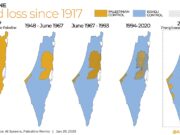


Over the last several years, UN votes regarding Israel have varied widely depending on the resolution. However, a broad majority of UN member states—often over 120 out of 193—frequently vote to condemn Israel, in the strongest language, and demand an end to the occupation of Palestine. From 2015 through 2024, the UN General Assembly adopted 173 resolutions against Israel and only 80 against all other member states combined.
Historically, the occupier state of Israel has been on a so-called charm offensive focusing on the continent of Africa, whose 54 nation-states represent the UN’s largest voting bloc. Last year, 45% of UN Security Council (UNSC) resolutions addressed crises in Africa.
Africa’s views of Israel are highly fragmented and are characterized by a complex mix of historical solidarity, economic pragmatism, and religious ties. While some countries on the continent actively deepen security and agricultural partnerships, others—most notably South Africa—view Israel’s policies in Gaza as severe human rights violations and have championed the Palestinian cause.
According to reporting from Al Jazeera, “African perspectives on Israel are deeply divided, reflecting a mix of strong diplomatic partnerships, religious ties, and vocal condemnations of the war in Gaza. While no African nation has officially cut all diplomatic ties (with Israel), continental opinions span from vehement opposition to pragmatic bilateral alliances.”
A June 4 Pew Research Center survey of global negative views of Israel has limited survey findings regarding the African continent. Africa, a continent with 54 nation states, is only represented in the survey by Nigeria as the one African country that was lumped in with others, including Australia, Italy, Poland, and the United Kingdom, in the category of very “unfavorable views” of Israel.
In another category in the Pew survey, “confidence in Netanyahu” included responses from Kenya and the Philippines. These, according to the Pew Center, are the only surveyed countries where more than half of the country’s public has “confidence in Netanyahu,” who is a global war criminal with an arrest warrant from the International Criminal Court (ICC), accusing him of war crimes and crimes against humanity for the atrocities committed against the Palestinians in Gaza.
The Pew survey notes, “views of Israel are among the most positive in some of the sub-Saharan African countries surveyed.”
The occupier state is still working to embed itself more deeply into the African continent under the guise of security.
To give more context, South African governance analyst Dr. Reneva Fourie explained to Al Jazeera that by embedding itself into regional security structures, Israel gains allies who are less likely to challenge its military occupation. She explained that these so-called counterterrorism partnerships are used as a public relations tool to normalize Israel’s international standing while obfuscating the violence it inflicts upon Palestinians.
“These partnerships normalize Israel as a counterterrorism ally while deflecting attention from the fact that it is the perpetrator of state terror against Palestinians,” she noted.
“By embedding itself in African security structures, Israel not only profits from instability but also gains partners less likely to challenge its brutal military occupation and its genocidal atrocities,” she told Al Jazeera.
But even as the world watches in real time, Israel’s continued massacre of Palestinians and now the Lebanese people, the regime’s right-wing government continues to attempt to make more inroads in Africa.
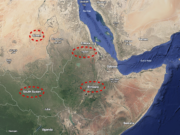
Israel also has its sights on Sudan and is involved in the current war in the African country, and according to published reports, it represents an external, outside influence fueling the current conflict in Sudan. A headline from an op-ed published on the Middle East Monitor website notes, “Sudan crisis not accidental: Rogue regimes UAE (United Arab Emirates) and Israel complicit in the genocide.”
What is currently unfolding “extends to reshaping the balance of power in the Horn of Africa and not surprisingly involves Israel and the United Arab Emirates (UAE),” the Nov. 4, 2025, article noted. “Haaretz noted in August 2025 that Israel was exploiting Sudan’s war to justify military expansion in the Red Sea under the banner of ‘protecting global shipping lanes from Houthi threats,’’’ continued the article, referencing the Israel-based publication.
It is also being reported that Israel has leveraged the Sudan crisis to deepen its political footprint in Ethiopia and Eritrea, “as part of its broader plan to contain Iranian influence extending from Tehran to Sana’a and Khartoum,” the Middle East Monitor article continued.
Countries in Africa should proceed with caution when dealing with Israel and be careful about engaging in relationships under the guise of counterterrorism and security, as the Israeli regime continues to try to expand its footprint and influence in the region.
Follow Jehron Muhammad @Africawatchfcn on X
