



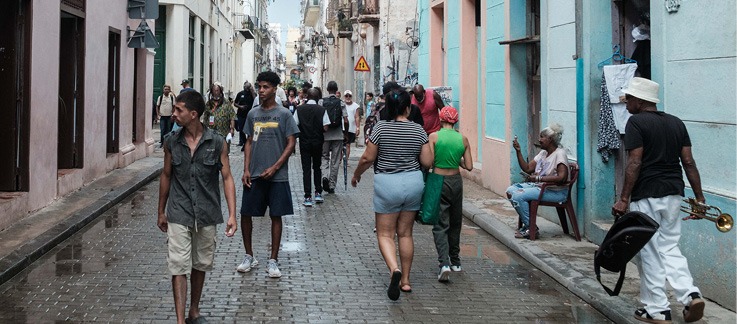

HAVANA—On a tiny island nation, 90 miles from Miami, where child mortality has more than doubled, where mothers die in childbirth for lack of basic supplies, and where the elderly go without electricity for days on end, a delegation of U.S. civil rights, faith, and human rights leaders have a stark message: The U.S. blockade on Cuba amounts to collective punishment, and it must end now.
The group was on the ground in Cuba as part of an Emergency Mutual Solidarity and Engagement Fact-Finding Delegation.
Organized by the Institute of the Black World 21st Century (IBW) and convened by Dr. Ron Daniels, the broad-based delegation, including journalists, business leaders, and activists, traveled to the island to bear witness to what Cuban officials call “intolerable acts” perpetuated by six decades of U.S. policy.
“The masses of Cuban people have suffered far too long from 67 years of selective, punitive blockades and sanctions imposed by the government of the United States,” Dr. Daniels told The Final Call.
“To add insult to injury, the current administration in Washington is inflicting collective punishment on the Cuban people by imposing a blockade on fuel urgently needed to provide electricity for the nation and sanctions on any nation seeking to assist Cuba to meet its essential needs. Collective punishment of a people is a violation of international law.”
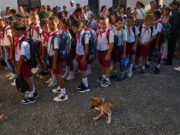
The human cost of the blockade is not abstract. It is measured in closed schools, in dark nights, in empty medicine cabinets, and in impossible choices.
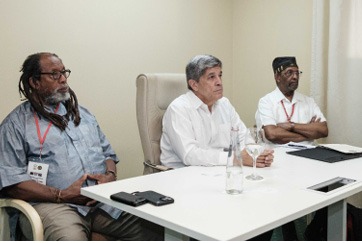
Yanela Gonzalez Gonzalez, a professor at Isri International University, spoke passionately about daily life under the siege. “There is genocide in Cuba, in a silent way among the people,” she said. “It’s very, very bad for the people, and especially for the Black women and our kids.”
She recalled a devastating loss: “Yesterday, my neighbor passed away because she didn’t have transportation to go to the hospital. When she previously tried to go to the hospital, she was told there wasn’t enough medicine to attend to her.”
Her plea was direct: “We need you to share our voices with the people in the United States. We need your solidarity. We need solar panels; we need medicine; we need people to respect the way that we decide to live.”
The delegation met with Carlos Fernández de Cossío, deputy minister at MINREX (Ministry of Foreign Affairs), who detailed the revolutionary gains now under threat.
He reminded the group that Cuba once guaranteed a liter of milk to every child and every pregnant woman, “regardless of who they are, who their parents are, if they’re professionals, if they’re farmers, if they’re delinquents, if they’re in jail, if they’re counterrevolutionary.”
That, he said, is social justice, along with free healthcare and free education for all. For decades, Cuba’s child mortality, maternal mortality, and life expectancy outpaced every country in the hemisphere except Canada.
But today, those gains are crumbling under U.S. economic warfare. Deputy Minister Fernández de Cossío asked plainly: “Is that a crime? Is that a criminal punishment imposed on a population that includes infants?”
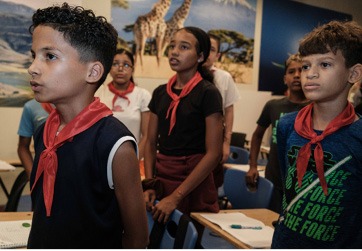
The official described a nation that often endures 16 to 42 hours without electricity in the 21st century, with food spoiling, children doing homework at 2:00 a.m. when power returns, and those with respiratory illnesses unable to run medical equipment. Meanwhile, he charged, the U.S. spends $30–50 million annually on propaganda blaming Cuba’s own government for suffering caused by the blockade.
Walking through Cuban neighborhoods, delegation members heard directly from residents.
Alejandro, a man with asthma, explained that because medical supplies are restricted, he can only obtain his inhaler on the black market. “Tell the Americans that we are suffering in Cuba because we can’t get basic care,” he said. “I need my inhaler but can’t find it. If I do, should I pay for it or get food for my family? These are choices people shouldn’t have to make.”
Dr. E. Faye Williams, peace activist, senior advisor to the World Council of Mayors, and former president of the National Congress of Black Women, said the Cubans she met were willing to share their struggles openly. But she stressed solidarity is not one-way.
“I certainly hope that the women we talked with here don’t feel that we have it so good in America,” Dr. Williams told The Final Call. “We, women, have our challenges in America, too. I hope they feel that they’re not alone, and that what we promised to do as we heard what their challenges are, [we will] do what we can to resolve, and also know that we have challenges.”
Dr. Haki Ammi, IBW board member, author, and educator, said the trip clarified the need for stronger organizing. “I’m dissecting the power dynamics, in terms of what Black people actually represent, and how we have to up our ante,” he said.
“The U.S. has oppressed this nation for decades. We have to expose the contradictions in the system, and expose that if the U.S. comes for Cuba, who else are they coming for?”
The delegation met with a range of Cuban officials, including at MINREX, the National Assembly, and municipal levels. They also visited the Afro-Cuban civil society and anti-racist organizations. Their conclusion: The solidarity movement must deepen and broaden.
Dr. Daniels announced that the group will return to the U.S. committed to systematic engagement through channels established by Pastors for Peace, which regularly sends aid to Cuba. They will also urge the Congressional Black Caucus, legacy civil and human rights organizations, and progressive faith groups to demand normalization of relations with Cuba.
“The Black world owes a debt to the people of Cuba,” Dr. Daniels said. “Hopefully, the African Union will have the audacity to follow CARICOM’s lead and defy the rogue regime in the U.S. by assembling an aid package and challenging the blockade.”
