









Thirty-six years ago, a college sophomore heard a voice on a VHS tape in a campus lounge, and her life changed direction forever. She had not come to listen. She was working nearby.
But the voice—the Honorable Minister Louis Farrakhan, speaking about Black separation with a clarity she had never encountered—stopped her cold. She went to the mosque that Sunday in Plainfield, N.J. She never looked back.
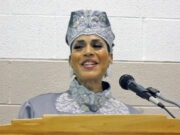
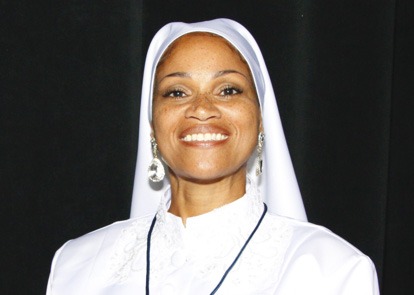
Today, Sister Dr. Monique Swift Muhammad is a member of the Nation of Islam as a proud M.G.T. and G.C.C. (Muslim Girls Training and General Civilization Class, the women of the N.O.I.). She is also the president of the Association of Black Psychologists (ABPsi), a clinician and a community builder.
She is a Muslim woman who prays before every session with clients, quotes and references Minister Farrakhan in her clinical work, and believes that Black psychological liberation and spiritual elevation are the same struggle.
“If I had not found the Nation of Islam,” she says plainly, “I probably would have quit by now.” She is not being dramatic. She means it.
Nation and Black first
Sister Dr. Monique Muhammad grew up asking questions no one around her was equipped to answer. When she arrived at Rutgers University and majored in Africana Studies, she found the intellectual framework. When she heard Minister Farrakhan, she found the spiritual one.
“Africana Studies was the backdrop,” she told The Final Call. “I didn’t understand who I was as a Black person—our plight, our history. Majoring in Africana Studies deepened that context significantly.”
From Rutgers, she moved to NYU for a master’s in counseling, shifting from the macro lens of social conditions to the intimate terrain of personal identity, which she said helped her understand herself and the range of experiences we have as Black people.
Her path eventually led her to ABPsi, where she found a professional home aligned with her deepest commitments. “Black first,” she said plainly. “That’s where I’ve been. And that’s what this organization is.”
When she went to the Sunday meeting at the Plainfield, New Jersey mosque, after seeing and hearing Minister Farrakhan on tape, legendary Student Minister Abdul Karim Muhammad was at the podium.
He was talking about building a Black army. Sister Dr. Monique—raised on Public Enemy, shaped by righteous militancy, and newly inspired by Africana Studies—thought she was signing up for one kind of fight. Allah (God) had something else in mind.
“What I thought would make me a killer for our people turned me into a healer,” she said.
When asked who sharpened her into the psychologist she is today, Sister Dr. Monique did not hesitate. “First and foremost, the Most Honorable Elijah Muhammad,” she said. “He helps us see who we are as human beings—spiritually, socially, personally. There’s nothing he hasn’t touched.” Minister Farrakhan comes next, she said.
She also said, Student Min. Dr. Ava Muhammad (may Allah be pleased), an attorney and scholar, showed her that spiritual conviction and professional excellence were not in conflict.
Professionally, she leans heavily on Dr. Wade Nobles, a founder of ABPsi and who she calls, one of the most influential thinkers in African-centered psychology, calling him a “prolific writer,” and stating that “his work grounds me.”
According to the organization’s website, the Association of Black Psychologists was founded in San Francisco in 1968 by several Black Psychologists from across the country who united to actively address the serious problems facing Black psychologists and the larger Black community.
“Guided by the principle of self-determination, these psychologists set about building an institution through which they could address the long-neglected needs of Black professionals,” notes abpsi.site-ym.com.
Her term as president of ABPsi is 2025-2027. Her presidency comes at a moment she describes as unprecedented. “It feels like a time we’ve never seen before,” she said. “I don’t think it’s an accident that I am where I am.”
She references Minister Farrakhan’s warning that it takes more emotional fortitude to function today than in years past. The pressures are immense, particularly for Black people.
Her overarching mission is clear: sovereignty. “All roads point to our sovereignty as an organization,” she said, referring to ABPsi. “We don’t have the luxury anymore to think of ourselves in the context of White America. We must think of ourselves as sovereign human beings.”
Sister Dr. Monique’s clinical framework for racial trauma carries the same precision as her community work. She does not use abstractions. She uses the example of the damage done by a bullet. “The bullet enters,” she explains.
“That is the initial wound—slavery, discrimination, being followed in a store, not getting the job. But a bullet ricochets. It pierces the spleen, the heart, the lungs. That is the internalization—the (feelings of) worthlessness, the self-doubt, the sense of being less than.”
And then there is the historical layer. “The genetic inheritance of trauma, passed from generation to generation. Epigenetics tells us this. You are born already carrying a wound you never personally received,” she said.
Three levels. One injury. Most psychology only treats the surface. “You cannot heal what you refuse to name,” she says. “And most of psychology has refused to name this,” she said.
The most misunderstood truth about Black suffering, she argues, is not the trauma itself. It is how deep it goes.
“The core of who we are is fractured,” she said. “We’re functioning—educated, working, buying homes—but not functioning knowing who we are.”
Sister Dr. Monique is direct about what clinical training got wrong. “They train you to be neutral,” she says. “Don’t bring yourself into the room. But there is no such thing as neutral. I am who I am.”
She brings her full self—her faith, her Muslim garment, her spiritual discernment—into every session. “But I don’t heal anybody. It is only by the Grace of Allah (God), coming through me (counseling and therapy), that healing happens.”
The Nation of Islam’s emphasis on discipline is something she carries directly into her clinical work. The Nation taught her to find beauty in hardship, to see the reward in struggle. That is not common language in mainstream therapy.
“The Nation taught me to subordinate myself to something bigger than me,” she says. “That is how I lead. That is how I heal. Not for recognition. Not for the prize. For the mission.”
Misunderstandings about Black healing
“We think healing is in accomplishments,” she said. “A Black president. Marching. Voting. Protesting. Legal victories. But that’s not what heals us.”
True healing, she insists, is spiritual. “Connecting with the spirit of who we truly are—that’s the missing piece. We’ve tried everything else. Spirit is what we keep skipping.”
The upcoming 57th Annual ABPsi Convention theme, scheduled for July 29 through August 1 at Morgan State University, an HBCU in Baltimore, reflects this conviction. This year’s theme, “The Illumination: Freeing the African Spirit,” was chosen by Sister Dr. Monique.
Founded September 2, 1968, after more than 200 Black psychologists staged a walkout from the American Psychological Association’s annual meeting in San Francisco, ABPsi has always been an act of organized refusal. It has never answered to the APA. It has never pretended that Black psychology is just mainstream psychology practiced on Black bodies.
Sister Dr. Monique is pushing ABPsi members to move from comfort to commitment—from relying on outside funding to building from within. She has chosen a presidential Adinkra symbol that captures her entire philosophy: Funtunfunefu Denkyemfunefu—two crocodiles conjoined at the stomach, fighting over food they already share.
“They fight because of ego,” she says. “But everything they consume feeds the same stomach. When we fight each other, we are only destroying ourselves,” she added.
“Our healing is in our spiritual elevation,” explains Sis. Dr. Monique. “Everything in the physical—all the marching, all the voting, all the lawsuits—none of it is enough without reconnecting with the spirit of who we truly are.”
Dr. Monique Swift Muhammad has built her life—and now her presidency—on that truth.
“We are the solution,” she says. “We always have been. We just need to remember.”
For more information, visit ABPsi.org.
