










The illegal and unprovoked war against Iran, initiated by the U.S. and Israel, is escalating into a dangerous new phase, spreading across the Middle East, with increasingly significant global economic consequences, including impacting the African continent.
“The Israel-U.S. war on Iran is engulfing the entire Middle East and could escalate to global war. The economic consequences are already severe and could become catastrophic,” noted Jeffrey D. Sachs, director of the Center for Sustainable Development at Columbia University.
And Sybil Fares, a specialist in Middle East policy and sustainable development, in their recent article published on CommonDreams.org, which also ran on the digital news platform theAfrican.co.za.
In their commentary, they argue that the aim of Israel and the U.S. is “a Greater Israel that absorbs all historic Palestine, combined with compliant Arab and Islamic governments stripped of genuine sovereignty, including on choices as to how and where they export their oil and gas.”
In Israeli Prime Minister Benjamin Netanyahu and U.S. President Donald Trump’s strategy, bombing and killing civilians throughout the entire region is becoming the norm.
This includes the total destruction of Gaza, expanding settlements, seizing land, and intensifying military operations in the occupied West Bank, invading, occupying, and displacing over one million Lebanese, and striking Iraq, Syria, and Yemen. Add to that, the bombing of Iran, including schools, houses of worship and hospitals.
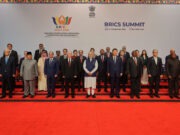
The commentary by Sachs and Fares offers BRICS (Brazil, Russia, India, China, and South Africa) and its expanded membership, representing nearly half of the world’s population and more than 40 percent of the world’s GDP (Gross Domestic Product), as a way out of the approaching global debacle.
“The BRICS have the credibility, the economic weight, and the absence of historical complicity in Middle East imperialism to bring the world to its senses. The BRICS should convene an emergency summit and present a unified framework incorporating the conditions for peace and security, which in turn would be pressed at the UN Security Council,” their article notes.
Shiri Fein-Grossman is CEO of the Israel-Africa Relations Institute and an expert on foreign policy, Africa’s global role, and regional normalization. In the latest edition of the Jerusalem Strategic Tribune, Fein-Grossman writes, “Africa occupies an increasingly pivotal position in the emerging global order.”
According to Fein-Grossman, in her article titled “The Iran War Is Recasting the Red Sea and the Horn of Africa as a Strategic Battleground,” she explained that Africa is home to vast reserves of essential minerals necessary for advanced manufacturing, defense technologies, and the global energy transition.
“Cobalt from the Democratic Republic of Congo, platinum from South Africa and lithium from southern Africa are critical for batteries, semiconductors and clean energy technologies,” are just some of the resources Fein-Grossman notes.
Additionally, the African continent’s maritime corridors are key. Africa connects the Atlantic, the Mediterranean and the Indian Ocean trade networks. And with the globe’s fastest-growing population, projected to reach 2.5 billion by 2050, and its expanding consumer markets, the continent is becoming an increasingly important arena for economic influence.
The war initiated by the U.S. and Israel has resulted in the Islamic Republic of Iran strategically regionalizing the conflict. “Iran is not treating the confrontation as a bilateral exchange with Israel or the U.S., but as a multi-theatre conflict in which different fronts—Lebanon, Iraq, the Persian Gulf, and maritime chokepoints—are integrated into a single strategic space.
This allows Tehran to stretch U.S. and Israeli resources, complicating their planning and creating constant uncertainty about where pressure will emerge next,” said Hamidreza Azizi, a visiting fellow at the German Institute for International and Security Affairs (SWP) in Berlin, during an interview published on the website of The Carnegie Middle East Center.
According to Azizi, Iran is producing a new strategic equation in which the threshold for attacking the country has been raised, including fallout from the Strait of Hormuz and U.S. interests in the Middle East. Another result is that Africa’s fuel vulnerability being exposed.
One-third of the global seaborne fertilizer trade passes through the Strait of Hormuz. According to CNBC, noted Oxford Economics, “Urea and ammonia prices (from which fertilizer is produced), since the war has surged by … 50% and 20% respectively. Sub-Saharan Africa, importing over 80% of its fertilizer, is acutely affected, threatening food security and increasing agricultural costs.”
Africa’s response thus far to the war in Iran has been generic calls for restraint and dialogue, with warnings about the disastrous consequences of this intensifying war, without naming the aggressors.
In an opinion piece published on Al Jazeera by Tafi Mhaka, a social and political commentator, titled “Iran today, Africa tomorrow,” Mhaka writes that “Africa must stand up to the many faces of imperial power, including through coordinated action at the African Union and the United Nations General Assembly.”
Mhaka invoked the circumstances that led to the founding of the Organization of African Unity (OAU) in Addis Ababa on May 25, 1963. One of its core principles was respect for sovereignty and territorial integrity.
“On that occasion, Ghana’s founding president Kwame Nkrumah warned fellow African leaders that ‘independence is only the prelude to a new and more involved struggle for the right to conduct our own economic and social affairs unhampered by crushing and humiliating neo-colonialist controls and interference,’” Mhaka wrote.
To correct and adjust its affairs, Africa needs a global engagement strategy that fosters African unity, builds strong relationships with partners, and protects a multilateral system.
Follow Jehron Muhammad @africawatchfcn on X
