











Almost a year after President Donald Trump signed two executive orders on energy and resource development, lands significant to Indigenous culture and lifestyle are under the threat of oil and gas exploration and extraction.
President Trump issued the “Unleashing American Energy” executive order, which affects federal lands and waters with possible trickle-down effects to Native American tribes that are adjacent to federal lands, and “Unleashing Alaska’s Extraordinary Resource Potential,” which targets resource development across Alaska, on January 20.
Nine months later, on Oct. 23, the U.S. Department of the Interior, which manages federal lands and natural resources, announced a slew of actions planned for Alaska, including reopening the 1.56 million acres of the “Coastal Plain of the Arctic National Wildlife Refuge for oil and gas leasing” and “completing right-of-way permits for the Ambler Road,” according to a press release.
The Bureau of Land Management, an agency within the Department of the Interior, considered the Arctic’s coastal plain “a frontier basin that holds strong potential for oil and gas development” and cited estimates from the U.S. Geological Survey saying the plain may contain between 4.25 and 11.8 billion barrels of recoverable oil.
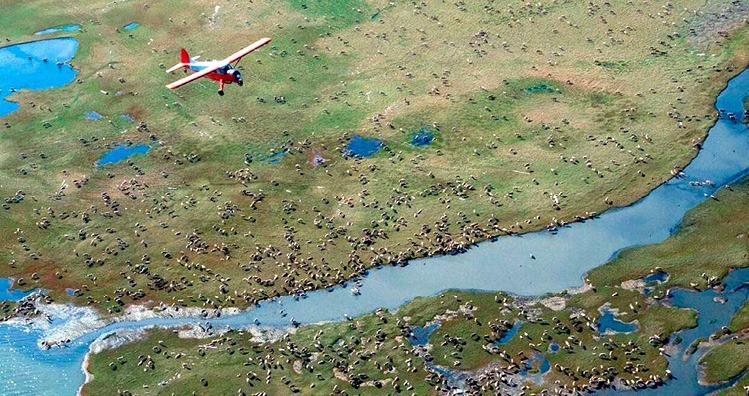
Many animals call the Arctic Refuge home, including polar bears, caribou and more than 200 species of migratory birds, according to the U.S. Fish and Wildlife Service.
The Arctic Refuge is also the ancestral homeland of the Gwich’in and Iñupiat peoples. Indigenous peoples have lived on the land for more than 20,000 years and still live off the land today, according to Protect The Arctic, a storytelling campaign fighting back against oil and gas development.
In their native tongue, the Gwich’in people call the Arctic Refuge’s coastal plain “Iizhik Gwats’an Gwandaii Goodlit,” translated as “the sacred place where life begins.” They rely on the caribou population for food, clothing and other goods and have been taking a stand against the U.S. government’s recent actions.
In a statement dated Oct. 23, the Gwich’in Steering Committee, an advocacy organization for the Gwich’in people, condemned the presidential administration’s actions and the announcement by Department of the Interior Secretary Doug Burgum to open the Arctic Refuge’s coastal plain to oil and gas development.
“Secretary Burgum claimed that the Department of the Interior is opening the Coastal Plain for the benefit of Northern communities, yet no one from this administration has reached out to the Gwich’in subsistence communities that rely on the Porcupine Caribou herd to listen to how this would affect our livelihood.
This is yet another disrespectful action from decision-makers that ignores the voice of the Gwich’in and violates our rights as Indigenous people,” the statement said.
It called the refuge “critical calving and nursery grounds of the Porcupine Caribou herd, which are essential to the nutritional, cultural, and spiritual needs of the Gwich’in Nation.”
“We have been fighting to protect the calving grounds of the Porcupine Caribou herd for decades. We know that any development in the Arctic Refuge would negatively affect their health and migration routes.
Our traditional Indigenous knowledge tells us that oil and gas drilling on the Coastal Plain would destroy the caribou calving grounds, devastating the animals and, in turn, the Gwich’in people,” the statement said.
Kristen Moreland, the steering committee’s executive director, described the Trump administration’s decision as a “direct attack” on the Gwich’in. Galen Gilbert, first chief of the Arctic Village Council, highlighted the potential of the decision to “cause irreparable damage to the Gwich’in way of life.”
An additional concern for Alaska Natives is the administration’s Ambler Road Project, which proposes a 211-mile industrial road that would allow access to Alaska’s minerals.
The Tanana Chiefs Conference, an organization based in Alaska that promotes tribal self-determination and unity, has established a campaign, “Stop the Ambler Road,” to raise awareness about the project’s negative impacts.
The road would cross 11 major river systems and thousands of smaller rivers, streams and wetlands and would affect critical fish spawning areas, the organization says.
It lists additional facts about the project, saying the road would “pierce the heart of the hunting and fishing lands that our people have depended on for thousands of years,” would “cause harmful impacts along 125 miles and 200,000 acres of public lands managed by the State in trust for its people” and would “be one of the biggest and most destructive in the State’s history.”
“Tanana Chiefs Conference (TCC) is deeply disappointed by this decision. The Ambler Road threatens to open a path for industrial mining through the heart of the Brooks Range and across lands that are vital to caribou migration, fish habitat, and the subsistence practices that sustain our people.
Once again, the federal government has prioritized outside interests over the voices of the Alaska Native Tribes who live in and depend on these lands,” the organization said in an Oct. 24 statement.
“This decision is a direct affront to the voices of Alaska Native people,” Brian Ridley, the organization’s chief and chairman, said in the statement. “It places corporate and extractive agendas over our rights, our lands, and our future. Despite this, we stand firm: we will not be silenced. We will continue to fight, to resist, and to protect our lands and waters for the generations who come after us.”
The organization’s Emerging Leader Youth Advisory Council also criticized the Ambler Road Project. “Our ancestors fought to preserve our homes, our lands, and our ways of being. Now it is our turn to continue that fight.
We refuse to stand by while industrial development pushes deeper into our homelands, ignoring our voices and the long-term consequences for our people and the environment that sustains us,” the group of young people said in an Oct. 23 statement.
“We are already rich—rich in our land, our waters, our animals, our culture, our language, and our way of life. These are the sources of our true wealth, and we will not trade them for short-term jobs that disconnect us from who we are.”
Separate from the threats against the Arctic National Wildlife Refuge and its coastal plain, the Department of the Interior also announced considerations for revoking a ban on oil and gas development near the Chaco Culture National Historical Park in northwestern New Mexico.
In a letter dated Oct. 30, the department stated it would consider eliminating the 10-mile buffer of protection from oil and gas drilling around the park.
Additionally, the federal government leased more than 8,000 acres of public land in New Mexico and Oklahoma for oil and gas development on Nov. 6.
In opposition to the sale, Navajo Nation activists with the group Protect Dinétah protested outside of the Bureau of Land Management (BLM) offices in Santa Fe, New Mexico, on Nov. 5.
“We cannot let the federal government steal more,” Cheyenne Antonio, a Navajo organizer, said at the protest, according to Source New Mexico, an independent news organization. “The BLM wants to wish you a happy Native American Heritage Month by selling your resources, by selling your water to oil and gas.”
In a Sept. 3 letter opposing the lease sale, community members said more than 3,800 acres of “ancestral Diné lands,” or Navajo lands, would be included in the auction and said the Bureau of Land Management’s actions “threaten land, air, water, sacred places, public health, and the global climate.”
The Chaco Culture National Historical Park is located within a canyon recognized as a World Heritage Site by the United Nations Educational, Scientific and Cultural Organization.
Leaders with the Pueblo peoples, who have ancestral roots in the canyon, held a press conference in Washington, D.C., on Sept. 17 demanding that Congress and the Trump administration protect the canyon.
Since the U.S. government shutdown, between Oct. 1 and Nov. 6, the Trump administration issued 628 new oil and gas drilling permits and 52 new oil and gas leases on federal lands, according to an oil and gas government shutdown tracker by the Center for Western Priorities. About 84% of the permits were issued in New Mexico.
“Our bloodlines, our heritage, our culture, our identity all come from Chaco Canyon. We [are] all stewards of our own people, the animals, our communities, and our culture, and this all started at Chaco Canyon,” Santo Domingo Pueblo Lt. Governor Raymond Aguilar said at the press conference. “Washington, D.C. is your nation’s capital, and Chaco Canyon is our nation’s capital.”
