

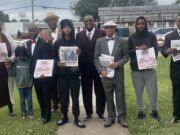






During the historic Million Man March on Washington D.C., October 16, 1995, participants pledged to “Strive to build businesses, build houses, build hospitals, build factories, and enter into international trade for the good of myself, my family and my people.”
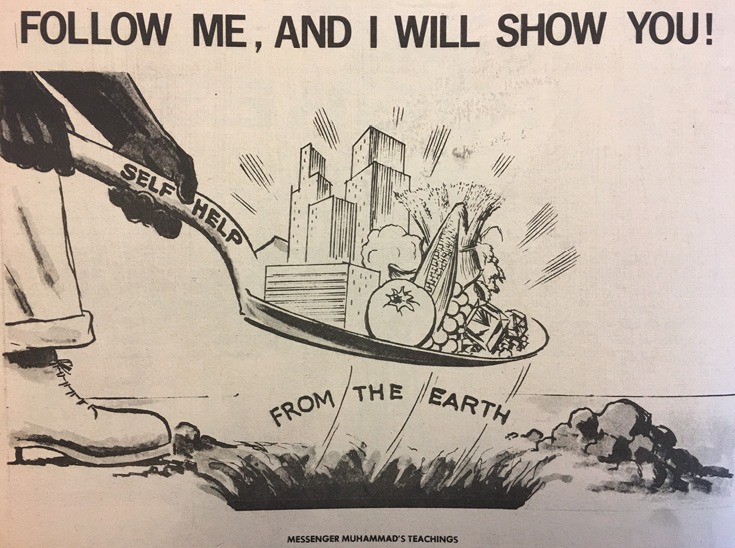
This was part of a pledge the men recited from the Honorable Minister Louis Farrakhan. Many of these goals take land and the acquisition of farmland is a means to inspire the revival of farming as an engine of national life.
In the three decades following the two million Black men presenting themselves to God in the spirit of atonement, reconciliation and responsibility, the pledge to become producers and owners, as presented by the Honorable Minister Louis Farrakhan, National Representative of the Most Honorable Elijah Muhammad and the Nation of Islam, still rings true.
In part 36 of Minister Farrakhan’s 2013, 58-week lecture series titled, “The Time and What Must be Done: Farming is the engine of our national life,” Minister Farrakhan said that many among Black America’s educated and professional classes often underestimate the importance and value of farming and agriculture.
“The gift of God to man is earth and also the knowledge of how to dress it and the fowl and the cattle that are on that land teaches us that the second profession after farming is animal husbandry,” he said, noting that land is the basis of freedom and independence.
“The point that we are making is that the first profession, as the basic support for all labor and all divisions of human labor, is the labor of tilling the ground, farming, feeding oneself and taking care of the gift of animals that the Creator has given for the benefit of man. So, farming and animal husbandry are the first professions and are the engine of every nation.”

At the Million Man March, Minister Farrakhan delivered the keynote message of redemption through self-improvement as a duty and love of the brotherhood and as a means to lift a people from death into life.
Brother Dr. Ridgely Abdul Mu’min Muhammad, manager of the 1,556-acre Nation of Islam’s Muhammad Farms in Georgia, told The Final Call that with a population of more than 10 million people in 1910, Black Americans.
Just 45 years up from chattel enslavement, owned 16 million acres of land in the United States. Within the confines of segregation, they were able to set up and run a number of towns and other self-sustaining communities.
“What the Honorable Minister Louis Farrakhan is doing today is using the example of the Honorable Elijah Muhammad to show us what we can do, if we decide to, if we have the will,”
Bro. Dr. Ridgely Muhammad said of the agribusiness and farming operations carried out by the Nation of Islam from its humble beginnings in the 1930s into the 1970s.
Eventually growing to operate thousands of acres of farmland both inside and outside of the U.S., as well as other enterprises that produced vegetables, clean meats, fish, and eggs.
“Now, when Minister Farrakhan called the Million Man March in October of 1995, he had already purchased the farm that I’m the manager of,” Bro. Dr. Ridgely Muhammad explained.
“He also saw that by the Black man getting back into farming on a large scale, this would give hope to the other Black farmers who were under attack and inspire others to get into farming, which has happened.
We got Black people all across the country, in particular the younger ones now, going back to the land that their forefathers owned, they’re coming back to the land to do for self,” he said.
Purchased with the pennies, nickels, dimes and dollars raised by the early members of the Nation of Islam, Bro. Dr. Ridgely described how the Most Honorable Elijah Muhammad acquired more than 15,000 acres of farmland in Michigan, Georgia and Alabama.
Commercial properties such as apartments, grocery stores, barber shops, restaurants, bakeries, laundry facilities, a newspaper plant, an interstate trucking fleet, fishing trawlers and cargo aircraft, and by 1974, the Nation of Islam also operated 47 schools across the United States and a national bank in Chicago.
“Independence, to you, is strange,” the Honorable Elijah Muhammad wrote on page 224 of His landmark book, “Message to the Blackman in America,” published in 1965. “You have given up hope of ever being independent, but this is what Allah (God) wants to do for you. Don’t you think it is time, after 400 years as servants to strangers?”
According to the 2022 Census of Agriculture by the United States Department of Agriculture (USDA), Black-operated farms accounted for 5.3 million acres of farmland in the United States, totaling 32,700 farms, reflecting an 8% decrease from 2017. Data also revealed that the 20th century marked the sharpest decline of Black landownership after the 1910 high point of 16 to 19 million acres.
Described by scholars as “the great land robbery,” dispossession, state-sponsored violence and intimidation, racism and discriminatory loan practices contributed to many Black Americans fleeing the South for the industrial North and West, transforming many Black families from rural landowners and producers to urban renters and consumers.
In an August 13, 2019, interview on the PBS News Hour, Vann Newkirk of The Atlantic magazine shared how Black Americans lost millions of acres of farmland in such a short period of time, becoming nearly landless today in comparison to what they owned in the early 20th century.
Critiquing what he described as a well-intended reparations movement regarding the redress of historical grievances through cash payments, Newkirk said the transfer of land would offer a more just outcome.
“I think that approach … has lost the focus on land and land ownership, and collective land ownership in some ways,” Newkirk said of the modern reparations movement in The News Hour interview.
“I think that’s a dimension that should be added back to this conversation, the original promise of reparations was a land grant, 40 acres and a mule.”
Regarding reparations in the form of allotting 400,000 acres of land to formerly enslaved Blacks in coastal South Carolina, Georgia and Florida during the closing days of the Civil War, General William Tecumseh Sherman’s Special Field Order 15 (a.k.a. 40 acres and a mule), was issued on January 16, 1865, as a means to solve the problem of Blacks no longer enslaved in the South.
And to punish the Confederacy for its rebellion. The order was later reversed after the assassination of President Abraham Lincoln and the subsequent presidency of Andrew Johnson.
“When we came out of slavery, we had the will,” Bro. Dr. Ridgely Muhammad said. “They gave 40 acres and a mule to a few for a year and then they took it back. But from 1865 to 1912, we bought over 16 million acres of land.
And in that period, Black people in Georgia alone had bought 1.3 million acres of land,” he said. He argued that both public and private interests undermined Black Americans’ willingness and ability to farm throughout the 20th century.
“So, they got us off the land, got us in the cities, and fed us with food stamps,” Bro. Dr. Ridgely Muhammad said, adding that one of the aims of the Nation of Islam’s current staple goods program is not only to grow our own food with the health of the people in mind.
But also to develop markets in the numerous food deserts plaguing too many urban communities in the United States and as a means to inspire others to continue doing the same.
—William P. Muhammad, Contributing Writer
