







In a last-minute bid to prevent the presidential administration from curtailing lower courts from implementing nationwide injunctions in the case of birthright citizenship, on July 10, U.S. District Judge Joseph Laplante temporarily blocked President Donald Trump’s executive order on the issue.
The judge ruled that a June 27 Supreme Court ruling does not apply in the case of “class action lawsuits,” thereby testing the limits of the high court’s ruling.
The court gave the Trump administration 7 days to appeal its decision. The administration was expected to appeal. A second federal judge in Maryland was expected to make a similar ruling as Judge Laplante, according to the Associated Press
U.S. District Judge Deborah Boardman said in an opinion on July 16, “that she would grant class action status on behalf of all children affected by the order and grant a preliminary injunction blocking it.
But she did not immediately rule, noting a previous decision of hers to block the order was on appeal to the Fourth U.S. Circuit Court and that court would have to return the case to her,” AP reported.
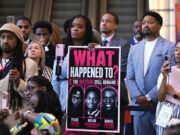
Legal professionals, pundits, immigration rights organizations, and families impacted by the executive order to deny birthright citizenship for children born to undocumented immigrants are connecting the June 27 Supreme Court decision.
Restricting federal courts in their ability to impose national injunctions, to an ongoing process that seeks to reinterpret long-held standings regarding the 14th Amendment to the U.S. Constitution.
Passed in the wake of the American Civil War, the amendment, ratified in 1868 to secure full citizenship for formerly enslaved Black people and their descendants, overturned the high court’s previously standing 1857 Dred Scott ruling that said Blacks could not be citizens of the United States.
According to the opinion of then-Chief Justice Roger Brooke Taney, Black people were “so far inferior, that they had no rights which the white man was bound to respect.”
Eleven years later, Section One of the 14th Amendment would eventually state that: “All persons born or naturalized in the United States, and subject to the jurisdiction thereof, are citizens of the United States and of the state wherein they reside.
No state shall make or enforce any law which shall abridge the privileges or immunities of citizens of the United States; nor shall any state deprive any person of life, liberty, or property, without due process of law; nor deny to any person within its jurisdiction the equal protection of the laws.”
Media Matters, an online media watchdog organization that provides news analysis and fact-checking, noted in an August 1, 2024, article, that several think tanks and groups “have spent years arguing against birthright citizenship—a cornerstone of U.S. immigration policy that is guaranteed by the 14th Amendment.”
Although the June 27 Supreme Court decision did not answer the citizenship question as it relates to the 14th Amendment, it did restrict the jurisdiction of a federal court’s authority to issue a national or universal injunction to block an executive order by the president.
A national or universal injunction is a court order that stops the federal government from enforcing a law, a regulation or a policy beyond lawsuits filed by plaintiffs and applies nationwide.
In addition to The Heritage Foundation, other groups calling for the end of birthright citizenship include the Claremont Institute and the Center for Immigration Studies.
These organizations currently argue that citizenship should not be granted to children born in the United States unless one parent is either a citizen or a lawful permanent resident of the United States, meaning they have a Green Card.
Regarding executive and legislative actions, Senate Bill S. 304 and House Bill H.R. 569 were introduced under the Birthright Citizenship Act of 2025, although the constitutionality of these bills has not yet been ruled upon by the Supreme Court.
According to Politico, the high court’s 6-3 vote along party lines granted President Trump’s request to narrow injunctions against his Executive Order No. 14160, signed on the first day of his second term, directing federal agencies to deny citizenship to children born to undocumented or temporary-status parents.
The case, “Donald J. Trump, President of The United States, et al. v. CASA, Inc., et al., on application for partial stay, (No. 24A884)” agreed to restrict the federal courts’ jurisdiction although, the Supreme Court left open the question of nationwide injunctions when states sue.
“The CASA ruling leaves room for judges to order relief akin to a nationwide injunction when a state sues the federal government,” the Politico article from June 27 said.
“But the justices provided little guidance, which indicates that different judges could reach different conclusions on whether and how states can get universal injunctions—until SCOTUS (Supreme Court of the United States) resolves that question too.”
The article continued, “Writing for the majority Justice Amy Coney Barrett wrote, ‘We decline to take up these arguments in the first instance,’” Politico quoted her as stating.
“The lower courts should determine whether a narrower injunction is appropriate; we therefore leave it to them to consider these and any related arguments.” This means, states would have different rulings.
During a news conference immediately following the court’s ruling, President Trump said he was pleased with what he called a big decision and a great win.
“This morning, the Supreme Court has delivered a monumental victory for the Constitution, the separation of powers, and the rule of law in striking down the excessive use of nationwide injunctions to interfere with the normal functioning of the executive branch,” he said.
Critics of the Supreme Court’s CASA decision, due to its relationship with the 14th Amendment, fear the potential for abuses that increased presidential powers may engender if unchecked by the judiciary.
In her 44-page dissenting opinion, joined by Justices Elena Kagan and Ketanji Brown Jackson, Justice Sonia Sotomayor wrote in part that:
“Children born in the United States and subject to its laws are United States citizens. That has been the legal rule since the founding, and it was the English rule well before then. This Court once attempted to repudiate it, holding in Dred Scott v. Sandford, 19 How. 393 (1857), that the children of enslaved Black Americans were not citizens.
To remedy that grievous error, Congress passed in 1866 and the States ratified in 1868 the Fourteenth Amendment’s Citizenship Clause, which enshrined birthright citizenship in the Constitution. There it has remained, accepted and respected by Congress, by the Executive, and by this Court. Until today,” Justice Sotomayor said.
Justice Brown Jackson warned of the possibility of an emerging lawless executive branch in her 22-page dissenting opinion on the ruling. “I agree with every word of Justice Sotomayor’s dissent. I write separately to emphasize a key conceptual point:
The Court’s decision to permit the Executive to violate the Constitution with respect to anyone who has not yet sued is an existential threat to the rule of law.
“It is important to recognize that the Executive’s bid to vanquish so-called ‘universal injunctions’ is, at bottom, a request for this Court’s permission to engage in unlawful behavior.
When the Government says ‘do not allow the lower courts to enjoin executive action universally as a remedy for unconstitutional conduct,’ what it is actually saying is that the Executive wants to continue doing something that a court has determined violates the Constitution—please allow this. That is some solicitation.
With its ruling today, the majority largely grants the Government’s wish. But, in my view, if this country is going to persist as a Nation of laws and not men, the Judiciary has no choice but to deny it.”
In a June 27 post to their website, the Reddy Neumann Brown PC, law firm said of the high court’s ruling on Executive Order 14160 that: “It allows the Order to take effect partially after July 27, 2025, and only against individuals not already protected by court orders or state-specific injunctions,” Atty.
Rahul Reddy said, noting that access to social security benefits will be granted for children born after July 27 if they are born in injunction-protected states.
“The Order targets only children born to specific categories of noncitizen parents,” he said. “If either parent is a citizen or lawful permanent resident, their child’s citizenship is unaffected.”
As of the court’s ruling, the president’s executive order does not apply to all states. “Twenty-two states (including Washington, Arizona, Oregon, Illinois, California, New York, New Jersey, Massachusetts, Maryland, Connecticut, Delaware, Hawaii, Maine, Michigan, Minnesota, Nevada, New Mexico, North Carolina, Rhode Island, Vermont, Wisconsin, and Colorado), plus the District of Columbia and San Francisco, have injunctions protecting them from enforcement,” Atty. Reddy said. “Other states are currently unprotected.”
Eric McDaniel is a professor in the Department of Government and co-director of the PRE-Lab at the University of Texas at Austin. He told The Final Call that the president’s executive order should be of concern for Black Americans.
“One of the things we do know about the way the immigration system is set up, it is always groups competing against each other. But this is problematic because if you can deny individuals citizenship, that means you can deny them rights,” he said.
“If they are opening the door for taking away citizenship for one group, that means they might have the ability to take away citizenship rights for another group,” he said.
