









Native and Indigenous nations in the United States are well-acquainted with broken promises from the federal government. Despite the trail of unfulfilled obligations, Native nations are looking to the future as they fight to protect ancestral lands, reclaim what was taken or stolen and exercise their rights to sovereignty and self-determination.
Michaela Madrid of the Lower Brule Lakota Sioux described tribal sovereignty as inherent. She is the program director for the Native Governance Center, a Native-led nonprofit that helps Native nations strengthen their governance and capacity to exercise sovereignty.
“Tribal nations are sovereign political entities that have the inherent rights to govern themselves, and this sovereignty comes before the United States. So, there’s nothing that the United States could really do to take away this sovereignty,” Ms. Madrid said to The Final Call.
But, she added, while there has been meaningful progress in tribal nations recognizing and exercising their sovereignty through self-governance, economic development and cultural revitalization, “that recognition on paper doesn’t always translate into the ability to exercise sovereignty in practice.”
Federal funding and unfulfilled obligations

Though Native nations possess inherent sovereignty predating the United States, their ability to exercise that sovereignty is often shaped by federal laws, policies and funding decisions.
Three reports by the U.S. Government Accountability Office (GAO) published in July and September covered issues related to Native American housing and homelessness, tribal water infrastructure and federaltribal shared decision-making agreements.
The housing report found that Native American communities face longstanding housing challenges, including poor housing conditions, overcrowding, and homelessness, and that federal housing programs do not always meet tribal needs.
The water report addressed how federal assistance for tribal drinking water and sanitation infrastructure is hindered by restrictions, fragmented processes and funding gaps. The GAO identified opportunities for federal agencies to streamline assistance and for Congress to consider changes to existing funding arrangements.
The third report on shared decision-making explored ways federal agencies and tribal governments can share responsibility for managing lands and waters that have cultural, historical and environmental significance to Indigenous communities. It examined existing agreements that allow tribes to participate in decisions concerning ancestral lands, including lands under federal jurisdiction.
All three reports highlight the need for a working relationship between sovereign Native nations and the U.S. government. Too often, that relationship has been undermined by funding cuts and broken treaties.
An October analysis by the Brookings Institution found that the Department of Government Efficiency eliminated more than $468 million in federal funding by canceling 1,597 grants and contracts affecting Native nations and organizations.
Brookings researchers argued that the continued massive underinvestment in Indigenous communities is a violation of the federal government’s trust and treaty obligations to tribes and hinders Indigenous efforts to protect the environment, according to a Nov. 12 article by The Associated Press.
“The actions that the Trump administration is taking are particularly significant, but it’s not totally out of trend with previous administrations,” the AP quotes Rob Maxim, who is Mashpee Wampanoag and a fellow at Brookings Metro. “And what we wanted to show was that actually this underinvestment is kind of the default for the U.S. rather than a blip.”
He further explained that funding for Indigenous communities is a federal obligation that promotes tribal sovereignty and the well- being of tribal citizens and communities.
Protecting ancestral lands
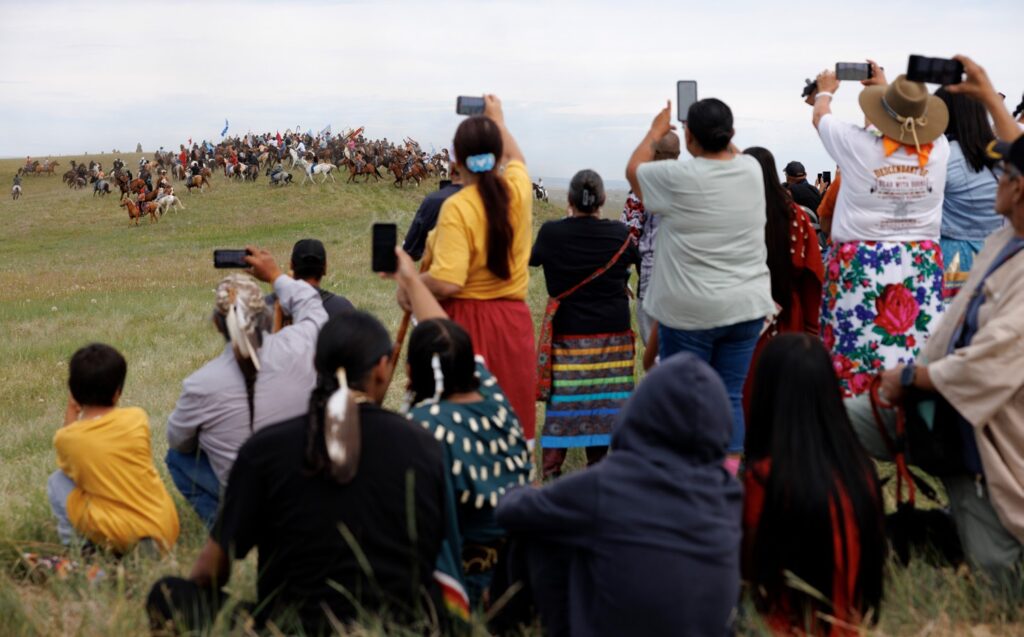
Federal funding, however, is only one area in which decisions made in Washington affect Native nations’ ability to exercise their sovereignty. Another is the management and protection of ancestral lands.
In July, President Donald Trump issued proclamations reducing the boundaries of two national monuments in southern Utah: Bears Ears and Grand Staircase-Escalante. The proclamations also dismantled the Bears Ears Commission and opened previously protected areas to potential mineral development.
Both monuments have a rich history for Native nations. Together, they contain ancestral dwellings, burial grounds, rock art, ceremonial sites, medicinal plants and other cultural and natural resources. Today, they are places of worship, traditional medicine gathering, cultural education and spiritual connection.
The Bears Ears National Monument was established by President Barack Obama in December 2016. The Grand Staircase-Escalante National Monument was established by President Bill Clinton in September 1996.
The original proclamation for Bears Ears reserved approximately 1.35 million acres of federal land as part of the monument and established the Bears Ears Commission, which provided five tribal nations a formal role in the federal management of their ancestral lands.
President Trump modified the boundaries to about 202,000 acres during his first term and also reduced the boundaries of Grand Staircase-Escalante. President Biden then restored both monuments and expanded Bears Ears to almost 1.36 million acres.
This year’s proclamations reduced the boundaries of Bears Ears to 121,096 acres, a reduction of approximately 91%, and the boundaries of Grand Staircase-Escalante to 181,000 acres, a reduction of approximately 90%. Together, nearly three million acres lost national monument protections.
Following the proclamations, prospectors began filing mining claims within the former boundaries of both monuments, with particular interest in Bears Ears.
Diné leaders Natasha K. Hale and Angelo Baca, who were instrumental in protecting Bears Ears, penned an opinion article for the nonprofit magazine High Country News demanding the full return of Bears Ears.
“What is at stake here goes well beyond one monument. If this proclamation is allowed to stand, it not only opens the door to unraveling protections for any national monument in the country, it also threatens centuries of tradition and land management by the tribal peoples who have cared for these lands since time immemorial,” they wrote.
“We reject the 2026 proclamation, plainly and categorically. We reject it for Bears Ears, and we reject it for Grand Staircase-Escalante National Monument … .”
“Native people will continue to speak up and hold the federal government accountable. We are watching, and we see what is being done to these lands,” they added. “This fight is no longer just words on a page:
Tribal nations and conservation partners have recently filed litigation challenging President Trump’s proclamations. We are defending Bears Ears and Grand Staircase- Escalante the same way we would defend any living, sacred place: by refusing to let it be taken without a fight.”
In September, tribal and conservation groups and outdoor apparel company Patagonia took legal action challenging Trump’s July proclamations. On Nov. 18, five tribal nations filed two federal lawsuits challenging the reductions of the respective monuments, “arguing that the administration is violating federal law and disregarding Tribal sovereignty,” according to Native News Online.
“Bears Ears’ canyons and mesas hold the dwellings, ceremonial sites, burial grounds and gathering places of our ancestors,” Anthony Sanchez, head councilman of the Pueblo of Zuni, which is involved in the Bears Ears lawsuit, said, according to Native News Online.
“These lands are an unbroken record of who we are and where we come from. It is our sovereign right as Tribal Nations to steward this land for generations to come.”
“These sacred lands hold our plant medicines, cultural resources, and histories that Tribal Nations are required to protect for the next generation,” Roland Maldonado, chairman of the Kaibab Band of Paiute Indians, which is involved in the Grand Staircase-Escalante lawsuit, said, as reported by Native News Online.
“Grand Staircase is inseparable from our culture, history, and identity, and we will continue to defend Tribal lands and protect the integral cultural resources within Grand Staircase-Escalante.”
The struggle to protect ancestral lands extends beyond southern Utah. Native nations are also fighting a new Senate bill, the Bipartisan American Affordability and Jobs Act of 2026, that they say could weaken longstanding federal protections for historic properties and sacred places.
The bill, introduced in the Senate in September, proposes changes to federal permitting processes and longstanding laws, including the National Environmental Policy Act.
The Clean Water Act and the National Historic Preservation Act. Native organizations warn that proposed changes to Section 106 of the historic preservation law would weaken protections for sacred places and limit opportunities for tribal consultation before development projects proceed.
Ms. Madrid described the bill as one of the biggest threats tribes are facing. She said on the surface, it seems to be about reforming infrastructure development and permitting, “but what it’s really doing is releasing and reducing some of the requirements to engage with Native nations” and consult with them on major development projects.
“It’s like a bait and switch, where it says that we’re just trying to protect affordability and jobs, but what we’re actually doing is going into these tribal historic preservation offices and making their jobs a lot harder,” she said.
The Senate approved the bill in a late-night vote on Nov. 19, sending it to the House of Representatives.
The National Association of Tribal Historic Preservation Officers, the National Congress of American Indians and the Association on American Indian Affairs released a joint statement on Nov. 17 calling on the Senate and the House of Representatives to reject the bill in its entirety after an amendment was made.
“The latest manager’s amendment does not resolve the serious concerns we have raised regarding the protection of Native sovereignty, sacred places, cultural heritage, and historic preservation. These are not minor issues that can be addressed through last-minute revisions.
They reflect fundamental problems with the legislation itself and its failure to recognize the rights, responsibilities, and inherent sovereignty of Native Nations,” they wrote.
They concluded the statement, “Native sovereignty, sacred places, and cultural heritage are not negotiable, and meaningful consultation cannot be replaced by amendments that fail to address the fundamental concerns of Native Nations.”
Reclaiming what was taken
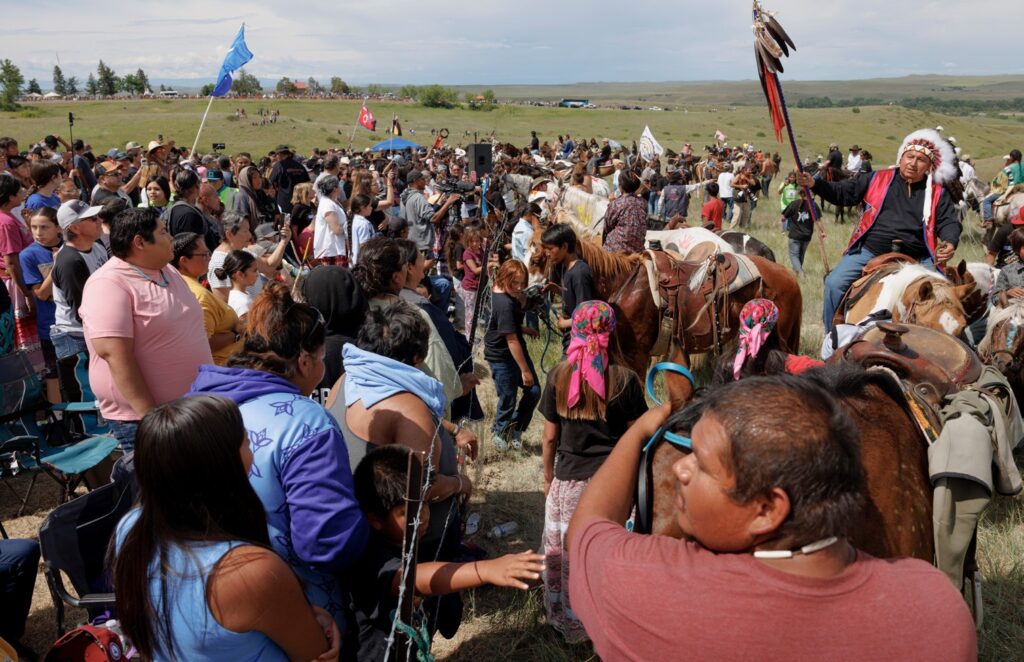
While the fight to protect ancestral lands under federal jurisdiction continues, Native nations are also making strides in reclaiming stewardship of lands taken from them.
In 2026 alone, tens of thousands of acres of ancestral lands have been returned to or reacquired by Indigenous nations across the U.S. Among the reclamation victories were 10,274 acres acquired by the Washoe Tribe of Nevada and California, approximately 3,400 acres acquired by the Mi’kmaq Nation in Maine and 11,297 acres returned to the Penobscot Nation in Maine.
Ms. Madrid described an Indigenous understanding of land rooted in relationship, responsibility and stewardship rather than ownership.
“We never really believed that we could own the land. To us, the land is really a relative, and it’s something that we need to take care of because we rely on the land so much for our existence,” she said. “We were in an active relationship with that land.
We knew how many berries to pick so that they would grow back even stronger next year while we could also sustain ourselves as well. And so to really have this deep love and reverence and respect for the land.”
The goal, she explained, is not to displace people but to restore Indigenous decision-making authority over ancestral lands.
Looking ahead, Ms. Madrid expressed optimism about the future of Native nations.
“We’ve got so many really amazing, intelligent, engaged, creative Natives that are out here doing this work every day. I know people who are burning the candles not just at both ends, but at four ends, trying to make sure that our sovereignty is upheld, and really warriors for our people in that way. And that’s just something that gives me so much hope,” she said.
“We have always been here. We’re not going anywhere,” she added. “While these governments have been in place a couple hundred years, we’ve been here since time immemorial. We’ve seen it up, we’ve seen it down, but we’re always going to be here, and at the end of the day, we’re always going to come out on top.”
Ms. Madrid concluded: “As Native people, sometimes we’re really painted as these static individuals who are in the past and have done things the same way, but our people were incredibly innovative and adaptive in our ways of doing things.
We’re always changing to meet the needs of the current day, and so I really think that practice has continued today and will be the reason that Native nations will continue to thrive for the rest of time.”
