











by Charles Abdul-Wali Muhammad
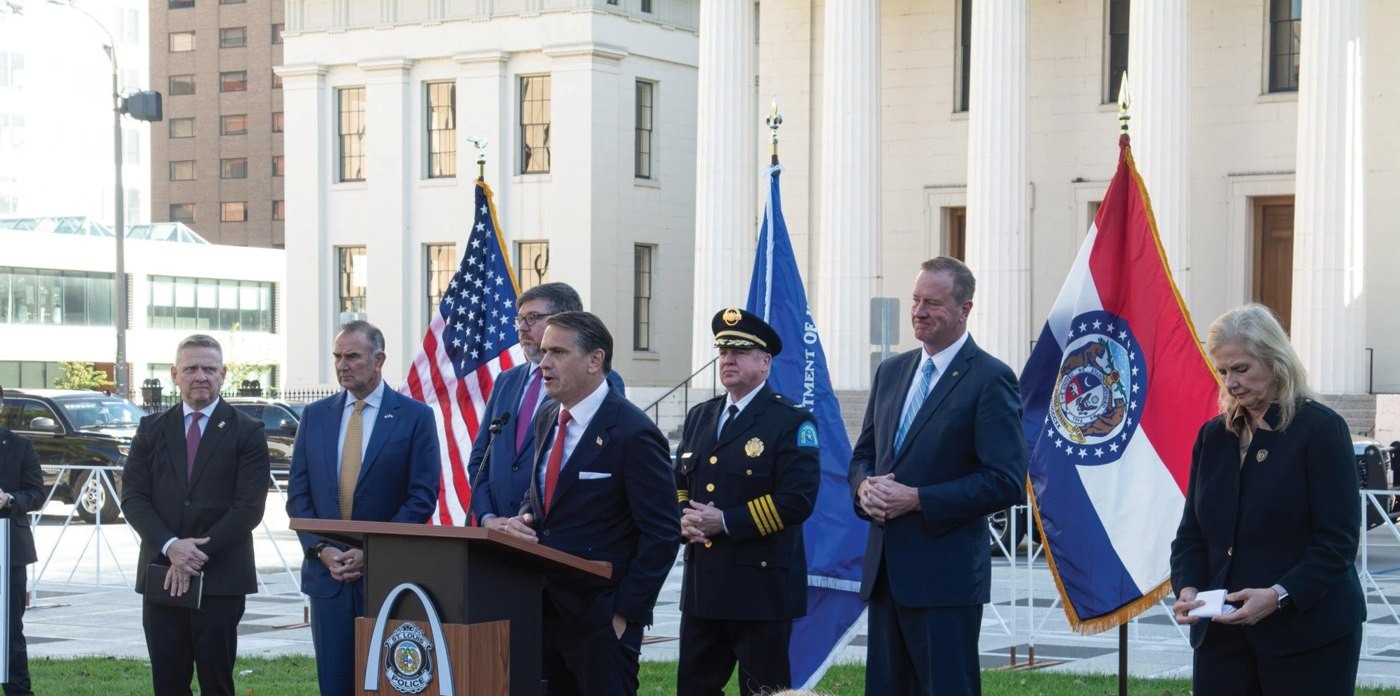
ST. LOUIS—Federal, state, and local leaders recently gathered in downtown St. Louis to announce that the city had been awarded $68 million through the U.S. Department of Justice’s Model Cities Initiative. Officials said that the funding will help the city hire more police officers, improve crime investigations, and provide new tools to fight violent crime.
However, despite what federal, state, and local political leaders are touting, some community members are skeptical.
St. Louis is one of only four cities in the country selected for the program. The money is expected to be provided over the next three years, with the first results possible in 2027. The U.S. Department of Justice selected the four cities through a competitive, two-phase application process. Factors included crime reduction plans, law enforcement partnerships, technology and innovation, the ability to deliver results, and community-wide strategies.
U.S. Attorney General Todd Blanche, representing the U.S. Department of Justice, opened the November 9 news conference in St. Louis by announcing the funding and explaining the federal government’s plans to help communities reduce violent crime. “The city of St. Louis, one of four cities, has been awarded $68 million,” he said.
The other selected cities included Jackson, Miss.; Jacksonville, Fla.; and East Baton Rouge Parish, La.
Attorney General Blanche explained that the program was created to support cities willing to work with federal officials to improve public safety. He said 47 cities applied, 21 reached the next round, and 11 became finalists before four cities were selected.
“The funding will help St. Louis build a center that allows police to track crime as it happens, offer hiring incentives, replace a radio tower, and improve police communications,” he said.
Missouri Governor Mike Kehoe welcomed the announcement and thanked the federal officials and Missouri leaders who helped secure the funding.
Gov. Kehoe spoke about the importance of making St. Louis safer for families, workers, and businesses. “Bringing back safer streets to our communities is paramount to economic investment,” he said. The governor also discussed Missouri’s ongoing efforts to bring law enforcement agencies together.
U.S. Senator Eric Schmitt (Mo.-R) also praised the announcement and said the people of St. Louis have lived with violent crime for too long and deserve to feel safe in their own neighborhoods. He also said the city must continue working to reduce violent crime and improve its public image and added that the public should hear about the progress being made, not just the crimes reported on television.
St. Louis Metropolitan Police Chief Robert Tracy said the money will help his department recruit officers, improve training, provide better equipment, and strengthen investigations. “Our priorities are clear. Recruit and support our officers, improve their training, give the investigators better tools,” Chief Tracy said. He thanked business leaders, faith leaders, and other community groups for their support. “Public safety requires all of us,” he said.
The police chief also promised that his department would set clear goals and share its progress with residents. Other officials at the news conference included ATF Director Robert Cekada, Associate Attorney General Stanley Woodward, Missouri Attorney General Catherine Hanaway, Rep. Ann Wagner (Mo.-R); President of St. Louis Board of Police Commissioners, Chris Saracino; President of Urban League Public Safety, James Clark, representatives from various faith-based community groups and other federal law enforcement officers.
Associate Attorney General Woodward said St. Louis must show that the funding is producing real results and that the Justice Department hopes to return in the coming years to review the program’s success. If the selected cities show strong results, federal officials may consider expanding the effort to more communities.
However, several community leaders expressed some serious concerns and doubts about the new federal initiative. Talibdin El-Amin, founder of the Argus Newspaper, is one of them. “I most certainly believe in ensuring not only that our law enforcement is adequately supported in their aim to keep streets safe, but there should be a parallel investment in mitigating the root causes that underlie crime (such as) mental health, community empowerment and initiatives such as apprentice and mentorship programs,” he told The Final Call.
In a joint interview with The Final Call, long-time St. Louis community activists Dr. Ajuma Muhammad and Anthony Shahid both expressed concerns about the initiative.
“We believe it’s a sham and a bowl of soup warmed over. Crime was said to have gone down and this was just a slick way of getting money. There is no one to go into the Black community and deal with us, especially the Black media. They are telling us what they are going to do, not asking us what to do,” said Mr. Shahid.
Dr. Ajuma Muhammad agreed, stating in part, “The majority of the Black community is against the tsunami of law enforcement coming in. They are just telling us what they are going to do without our input.”
According to Counciloncj.org, violent crime in St. Louis has trended downward in recent years, including homicides, aggravated assault, robbery, larceny, and motor vehicle theft.
Mr. Shahid also raised concerns about who will ultimately be targeted by the increased presence of law enforcement on the streets of St. Louis, “When they talk about crime, they are really referencing the Black community. They definitely keep the Black press out of the loop and we always get the information a day late. They say that crime is down, but then they come and implement this new program.”
Other issues include whether the necessary paperwork for the initiative was completed correctly. According to a KSDK News Channel 5 investigation, the grant form needed several signatures, including from the mayor, the prosecutor, the sheriff, the city council, the health director, and the probation chief. The only signature on the St. Louis application was from the state-appointed police board, which listed the signature as “Mayor.” The other signatures were allegedly from the governor, the FBI, ATF, DEA, and the Police Foundation.
St. Louis Mayor Cara Spencer’s office was reportedly at the first meeting on June 10 re-garding the grant for the initiative, along with City Prosecutor Gabe Gore and a representative from the governor’s office. The city needed additional clarification on some details, so they reportedly sent a four-page letter to the DOJ with questions including which agency holds ultimate authority for the operation, what would trigger a repayment clause of any grant money, and which agency specifically gets the surveillance data collected. The DOJ reportedly did not answer; however, it later produced a FAQ (frequently asked questions) pamphlet that said whoever files the paperwork holds the authority.
Also, according to KSDK, St. Louis City Prosecutor Gore said he would not sign the paperwork because it would give the DOJ too much prosecutorial authority and discretion. Aldermanic President Megan Greene said she was not in favor of the new initiative, as she did not see it as in the city’s best interest.
Student Minister Donald Muhammad of Mosque No. 28 in St. Louis also expressed reservations about the public safety initiative and questioned the true motive. “The idea of a state-appointed police board was a trick. This is a grab by President Trump to control these cities,” said Student Min. Donald Muhammad. “If the mayor, city prosecutor and the aldermanic president are against this, then how can it go through?” he questioned.
The announcement represents a major investment in St. Louis public safety. However, the program’s success will depend on how the money is spent and whether residents see lasting improvements.
For families and businesses across St. Louis, the main question is whether the new funding will lead to safer streets and stronger neighborhoods or will it lead to over policing of Black people and Black neighborhoods and instigate more fear and mistrust of law enforcement.
