











Yusef Makhandal Muhammad (Joseph Makhandal Champagne), Esq. | Guest Columnist
Thirty-one years after the Honorable Minister Louis Farrakhan called Black men to Washington, D.C., for the Million Man March, Haitians are embracing its message as a summons to rebuild our communities.
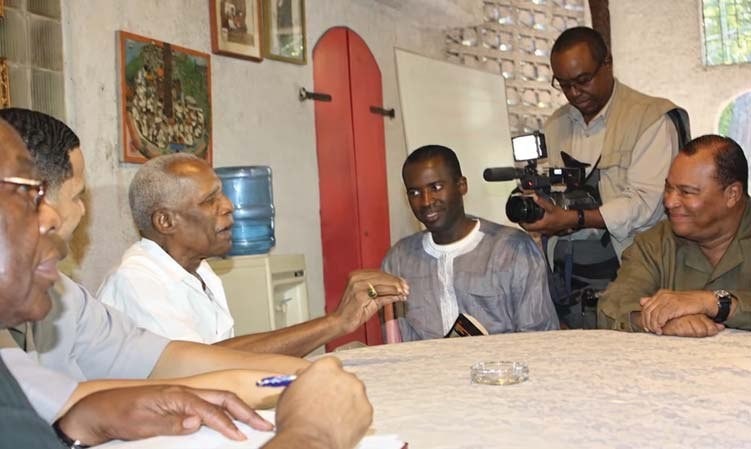
In Jacmel on October 16, Deputy National Coordinator for Southern Haiti Dieukifer Saint Juste delivered that message, supported by local coordinators Evens Samedi and Lauture Joseph, Joachin Sylvera and others. In the North, Deputy National Coordinator Jean Claude Simon spoke on the same theme.
Despite the stormy weather that day, Brother Dieukifer reported that participants were rain-soaked, yet they remained to commemorate this historic occasion. “The rain did not frighten us,” he said. They thoroughly enjoyed the celebration despite their discomfort. Their perseverance gave visible expression to the responsibility people gathered to affi rm and observe.
The gathering’s lasting measure will be what follows: neighbors checking on neighbors, adults guiding young people, families repairing relationships and people sharing resources to sustain community life. Atonement must leave evidence of how we live.
Haiti’s crisis of gang violence, displacement, hunger and institutional failure makes this message urgent. Personal responsibility does not excuse public offi cials, powerful economic interests or foreign actors from answering for their conduct.
Those who exercise power must account for the people entrusted to their care. Those who finance or profi t from violence must answer for the injury they cause.
We who lead organizations must practice the transparency, discipline and respect we ask of the country. We cannot preach unity while humiliating colleagues or spend collective resources without accounting for them.
The Honorable Minister Louis Farrakhan’s October 16, 1995, address outlined the eight steps of atonement toward union with God and one another. For Haiti, each carries a practical obligation, from my perspective.
1: Someone must point out the wrong: Speak honestly about violence, corruption, and injuries within households and organizations; 2: Acknowledgment of wrong: Titles cannot exempt anyone from correction; 3: Confess the fault first before God and those harmed: Instead of assigning every failure to somebody else; 4: Repentance (Through sincere remorse and changed behavior); 5: Atonement: Make amends, return what was taken, correct false accusations and honor neglected obligations; 6: Forgiveness (Work toward forgiveness, without demanding that injured people abandon protection or justice); 7: Reconciliation and Restoration (Do this with relationships through truthful agreements and conduct that earns trust; and 8: Perfect union with Allah (God) and with each other.
Reconciliation must never mean returning someone to abuse or granting impunity to continuing wrongdoing. For Haitians, a people gathering before God to reclaim their destiny has deep historical resonance.
Imam Dutty Boukman led the original Bois Caïman Ceremony in August 1791, near Cap-Français, uniting spiritual commitment with organizing against slavery. Imam Boukman was shipped from what became known as Jamaica to Haiti to eventually make history.
He and Cécile Fatiman are central to that memory, where they called thousands of enslaved Blacks gathered on a hill called Bois Caïman (or Bwa Kay Imam nan) to assert their right to live free or die trying.
Accounts diff er on dates and ceremonial details, but its enduring signifi cance lies in a collective commitment to freedom. The prayer associated with Boukman appeals to the God who sees the suffering of the enslaved.
I honor him as an imam in the sense of a spiritual leader guiding his people before God, while recognizing that histories commonly describe his leadership within the Vodou tradition.
Before Boukman, François Makhandal embodied resistance to the plantation order. Among many languages, Makhandal spoke Arabic and was revered by some as a“Black Messiah.”
Haitian memory carries his example as a prophetic assurance that the enslaved would become masters of the land where they labored. I understand the Haitian Revolution’s triumph as the fulfi llment of that hope.
Years of sacrifi ce culminated in victory at Vertières on November 18, 1803, and independence under Jean- Jacques Dessalines on January 1, 1804. Dessalines subsequently became emperor. Spiritual commitment demanded sustained organization and work.
On October 16, 1995, Black men assembled on the National Mall facing the United States Capitol Hill (another hill) in response to Minister Farrakhan’s call.
I understand that call as coming from God through His servant: accept responsibility for our destiny. We must also work to make our communities safe and decent places to live as Minister Farrakhan has instructed.
The historical circumstances diff ered, yet I see a spiritual parallel: people treated as powerless gathering before God, recovering their dignity and accepting freedom’s obligations. Liberation requires a new mind, changed institutions and freedom from destructive appetites and inherited habits of domination.
That connection became personal during Minister Farrakhan’s visit to Haiti, December 11–15, 2011, when I served as his interpreter. I recall Ati Max Beauvoir, then Caribbean tour, recalling Boukman’s association with Jamaica. Beauvoir identifi ed Minister Farrakhan as “The Modern Boukman.” I off er this as my testimony from that encounter.
His words expressed a continuity of spiritual service: awakening people to their worth, drawing them together across diff erences and calling them to responsibility. They help explain why the Million Man March speaks so powerfully to Haitians.
As a servant and a member of the Nation of Islam, I believe Allah (God) appeared in the Person of Master Fard Muhammad, whom we recognize as the Messiah of the Christians and Mahdi of the Muslims. Our teaching looks toward a divine order grounded in freedom, justice and equality: the Kingdom of God and of His Christ expressed through a righteous, peaceful people.
“Let this mind be in you, which was also in Christ Jesus,” states Philippians 2:5. Ephesians 4:22–24 calls us to put away the old self and receive a renewed mind. Our conduct must grow into the dignity we proclaim.
Our October 16, observance in Haiti also honored the life of Emperor Dessalines, assassinated on October 17, 1806. These adjacent dates invite us to examine the liberation we inherited and responsibilities we have neglected.
In both North and South, effort must be organized, resources accounted for and results reviewed.
Haitians’ freedom is bound to the freedom of Black people in America and worldwide. Haiti’s Revolution expanded humanity’s understanding of freedom. The Million Man March renewed a call to moral reconstruction that crosses borders.
I hear Boukman’s call to dignity renewed in Minister Farrakhan’s appeal. We honor Dessalines by protecting life, defending freedom and building our capacity to sustain ourselves. Thirty-one years after the Million Man March, our answer must be visible in the communities we build.
Yon nouvo Ayisyen pou yon nouvo Ayiti—a renewed Haitian people for a renewed Haiti. Konbit se fòs nou: Konbit (Cooperation) is our strength.
Brother Yusef Makhandal Muhammad (Joseph Makhandal Champagne, Esq.) is the Haitian Representative from the Nation of Islam. He is also an immigration attorney and the former mayor of South Toms River, N.J.
