








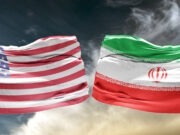
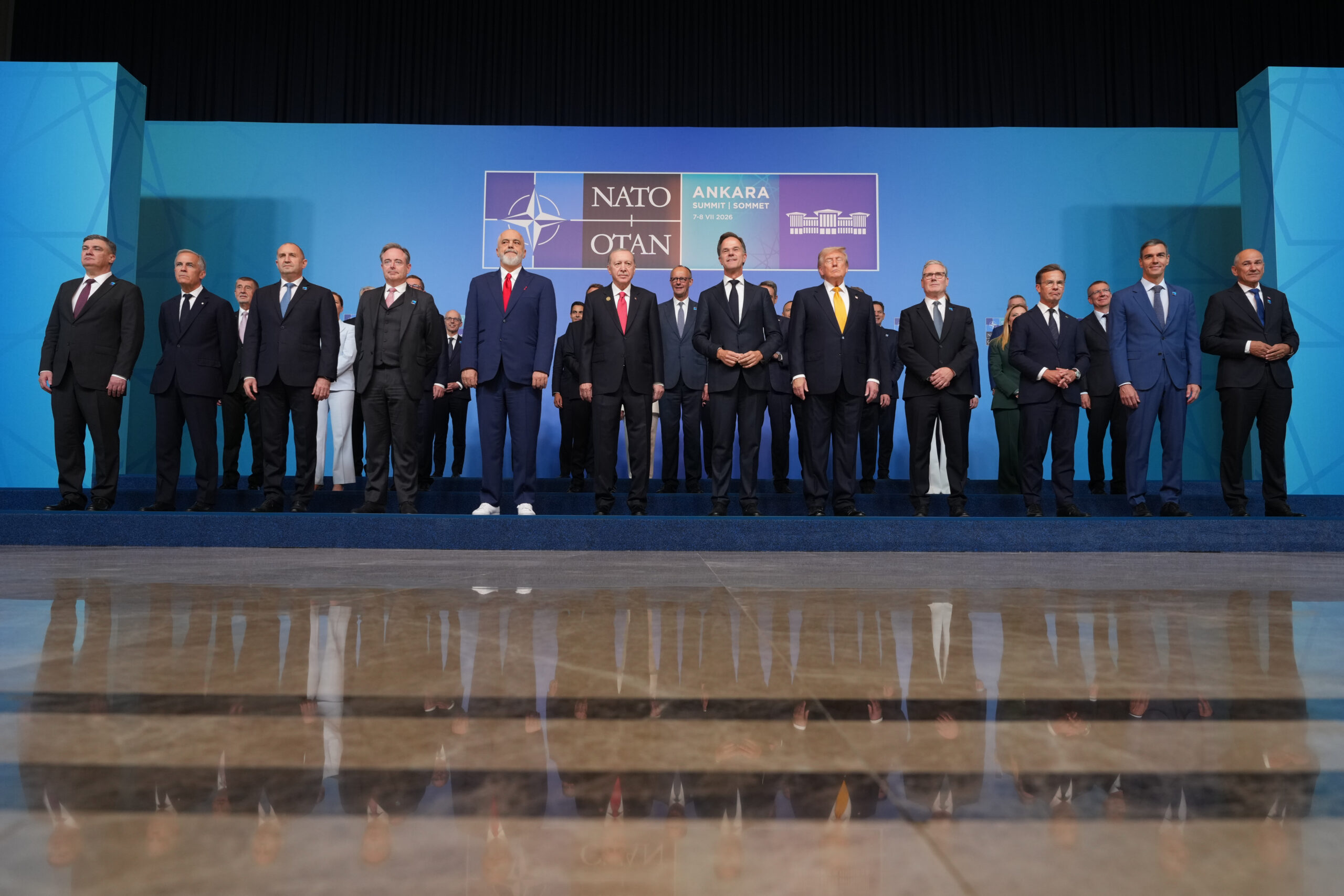

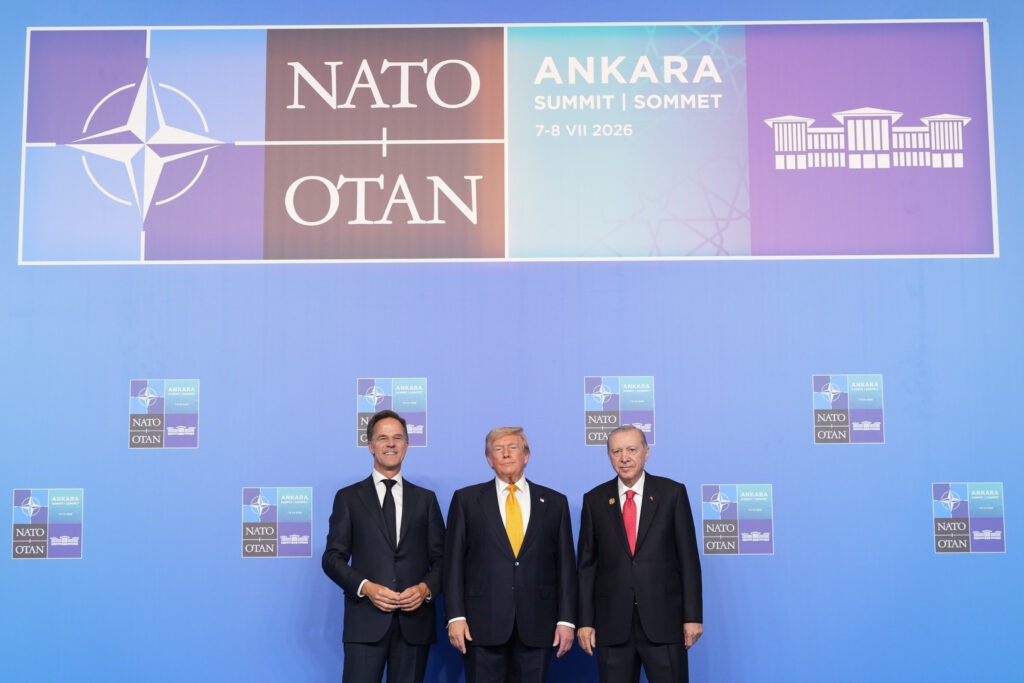
As President Donald Trump prepared to depart Ankara, Türkiye July 8—after both lambasting and praising his European allies at a NATO Summit there—renewed fighting broke out in the U.S.-Israel unprovoked war on Iran.
Now in its fourth month, the fighting once again shut down ship traffic through the Strait of Hormuz, which had recently reopened due to an agreement that both parties hoped would lead to long-term peace.
NATO is the North Atlantic Treaty Organization, a collective security and defense agreement among North American and European countries. Unlike most U.S. presidents, Mr. Trump has more harshly criticized and sent mixed relationship signals to his European allies that continued at the summit, held July 7-8.
He declared “there was a lot of love in that room, a lot of unity” as he emerged from a closed-door meeting with NATO leaders. The day before that meeting, he publicly berated European leaders for not joining his attacks on Iran that shut down the vital global shipping waterway for months.
Photos: AP Photo/Alex Brandon
President Trump also singled out Spain, calling it a “terrible partner” and announcing a cessation of trade with the country for refusing to allow U.S. aircraft to use its military bases, even after other member states eventually conceded to his demand.
“I was very disappointed with NATO,” the president said upon his arrival to the summit. “Frankly, if it (the summit) weren’t held in Türkiye where my friend happens to be a very strong leader, a very strong person, it’s possible that I wouldn’t have attended,” he said, referring to President Tayyip Erdogan of Türkiye.
President Trump continued his criticism of NATO members for not paying their fair share in defense spending and reiterated his desire to take control of Greenland.
Adding to the tension, Mr. Trump announced that the Memorandum of Understanding (MoU) worked out with Iran as a process toward peace was “over.” His remark came after Iranian drones struck several ships attempting to pass through the Strait.
Iran has stated that a decision on how the Strait will be controlled will be determined by coastal states Iran and Oman as described in the 14-point MoU. According to reporting by Al Jazeera, Iranian officials have argued that the memo allows Tehran to assert influence over how ships transit the Strait of Hormuz, therefore justifying attacks on vessels that do not comply.
The U.S. responded to the attacks with missiles striking numerous sites in Iran. PressTV.ir reported on July 10 that, “Iran’s top security official says any attack on the country’s infrastructure will be met with reciprocal action.”
Iran’s retaliatory attacks targeted U.S. bases in several countries in the region. Iran also warned that any attacks on its infrastructure would not be tolerated and that it does not view the U.S. as trustworthy negotiators.
“Iranian Parliament Speaker Mohammad Baqer Qalibaf says Tehran harbors no trust in the United States, emphasizing that only those who are prepared for war can engage in negotiation with Washington,” PressTV.ir reported. Mr. Qalibaf, is one of the top negotiator in talks with the U.S.
Addressing the tenuous Gulf situation prior to departing for Türkiye on July 6, Mr. Trump said, “We’re either going to make a deal or we’re going to finish the job. And it won’t be tough to finish the job. I’d rather make a deal, because I don’t want to affect 91 million people.”
In the opinion of analysts, to “finish the job” could mean U.S. boots on the ground, a situation political science professor Gerald Horne, Ph.D., says the only winner will be the military-industrial complex.
He pointed to President Trump’s leaning toward selling F-35 jets to Türkiye and his demand that NATO countries spend more on military equipment to defend themselves, as he signals a reduction in the U.S. troop presence in Europe.
“The U.S. military industrial complex is salivating at the idea of selling F-35 planes to Türkiye, just as the U.S. military industrial complex is the major beneficiary of Mr. Trump’s demand that member states spend more on their military,” Professor Horne of the University of Houston told The Final Call, adding that “most of the military material that they buy will be from the United States of America.”
He said Mr. Trump’s renewed interest in helping Ukraine defend itself against Russian attacks is “a profit-making venture once again” for the military industrial complex. The president signaled agreement to allow Ukraine to manufacture Patriot missiles to defend its airspace.
Dr. Horne described NATO as a weakened or a potentially dismantled entity, citing NATO’s “internal contradictions,” including America’s oversized financial contributions and contrary remarks about the Alliance. The U.S. has caused member states to move closer to each other against Mr. Trump’s remarks about taking Greenland and making Canada America’s 51st state.
“They don’t see [Trump] as being contradictory or inconsistent. They see him as representing something much deeper in the U.S. body politic and culture. Even if Mr. Trump decides to leave office, ‘Trumpism,’ as they see it, will be with us for some time to come. And I think that their perception is accurate.”
Asked to define “Trumpism,” Dr. Horne said, “neo-fascism, billionaires and trillionaires ruling with a substantial settler descendant working class and middle-class base, police terror, anti-Blackness.”
U.S. ally Israel has expressed alarm at President Trump’s suggestion to allow F-35 jets to be sold to Türkiye, arguing that it would “upset the power balance” in the region and that Mr. Erdogan has called for the “annihilation of Israel.”
President Trump banned Türkiye from the F-35 Joint Strike Fighter program during his first term in 2019 because the country had acquired a Russian S-400 air defense system.
Israel has vehemently opposed any ceasefire agreements between the U.S. and Iran and continues to violate the MoU, which calls for withdrawal from Lebanon, where the settler colonial state has attacked Hezbollah resistance fighters.
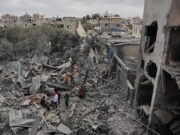
Withdrawal from Lebanon has been a red line for Iran in the peace process. A separate ceasefire agreement between Israel and Hamas resistance fighters in Gaza also has continuously been violated by Israel.
Hamas has agreed to dismantle its government apparatus as called for in the U.S.-brokered ceasefire agreement, according to recent reports. Hamas has refused to disarm, however.
“Hamas has been a governing body that operated within the context of a military occupation,” said attorney Terek Khalil, a spokesperson for American Muslims for Palestine (AMP). “It’s not a governing body that is independent, that is sovereign, that is exercising the sovereign rights of a state or a people that is not being suffocated by another state. That has not been the case in Gaza.”
Hamas ceded power in line with the agreement because “the people have suffered enough. This is a measure to alleviate the suffering so that Israel does not create a pretext for mass onslaught in Gaza again.”
Hamas was founded in 1987 after many decades of occupation, displacement, land theft, denial of basic rights guaranteed under international law, and denial of self-determination. All of that together, he said, fomented and created the impetus for the creation of Hamas.
The Honorable Minister Louis Farrakhan, National Representative of the Most Honorable Elijah Muhammad, has consistently warned Muslim leaders about America’s desire to cause division among Islamic nations as a divide-and-conquer strategy.
“We are Muslims and as Muslims we are commanded by Allah that when Muslims quarrel, make peace between the brethren. We have to make peace in this region, otherwise great war will spread in this region,” he reiterated in a message from Iran on Feb. 10, 2016.
“The beautiful cities that I have been blessed to see in the Middle East due to oil revenue, the enemy is envious at what Allah has blessed the Muslims to do with their cities and their countries. The enemy would love nothing more than to bomb them.”
