








PHILADELPHIA—The Philadelphia media market, stretching across the city, Southeastern Pennsylvania, and deep into the Black communities of South Jersey, has quietly become the epicenter of online gambling in America. What once lived in smoky back rooms and neon-lit casinos has now been placed directly into the pockets of the people, 24 hours a day.
For Black Philadelphians, who already face profound economic hurdles, the statewide gambling boom is not mere entertainment. It is the construction of a digital plantation economy in which corporations harvest the hopes, habits, and vulnerabilities of the people for profit.
In 2024 alone, internet gaming and sports wagering revenues in Pennsylvania surged past a staggering $6 billion. Penn State University’s 2024 Interactive Gaming Assessment confirms that one in five adults in the Commonwealth now gamble online.
As the industry grows, the fallout is accelerating faster than the systems meant to contain it. Today, nearly half of all calls to the 1-800-GAMBLER hotline involve online gambling.
According to Nielsen Ad Intel, the Philadelphia region has outpaced New York and Las Vegas as the number one online gambling advertising market in the United States. Between January and September 2024, gambling companies spent over $37 million saturating the region with ads.
These promotions flood billboards, bus shelters, social media feeds, and streaming platforms in Black neighborhoods already burdened with predatory marketing.
This modern digital crisis mirrors the stark warnings delivered decades ago by the Most Honorable Elijah Muhammad. In His seminal book, “Message to the Blackman in America,” in the chapter titled, “On Sport and Play,”
The Eternal Leader of the Nation of Islam offered a comprehensive critique of American entertainment, warning that gambling and systemic vices were engineered to exploit the poor and distract from spiritual awakening. He taught about the entrapment of “games of chance.”
“Great sums of money are spent in sport and play, in games of chance and gambling, in the operation of sporting houses. Millions are spent on horse racing and numbers rackets and are a disgraceful publicity of indecent sport,” the Most Honorable Elijah Muhammad wrote.
Community advocates in Philadelphia are also raising the alarm. Supported by funding from the Department of Behavioral Health, the Black Women’s Health Alliance is rolling out a comprehensive awareness and prevention campaign featuring billboards, social media outreach, and educational materials.
The initiative aims to address the severe financial toll problem gambling takes on families, highlighting the growing impact of casino access on isolated seniors and the rapid rise of sports betting among youth.
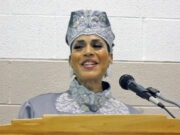
“We aren’t here to judge, but we want our community to pause and set firm guardrails before they play,” said Brenda Dunston, head of the Black Women’s Health Alliance, to The Final Call. “The industry invests heavily in keeping you at the games, so you have to know your limits … and never let gambling control your life or your ability to pay for essentials.”
Ms. Dunston also noted that the statistics are particularly alarming for so-called “minority” women. Recent data shows that 35% of minority ethnic females experience high levels of gambling harm, compared to just 12% of the overall female gambling population.
“Many are single parents desperately trying to provide for their families, and they view gambling as a potential way out,” Ms. Dunston explained. “Unfortunately, casinos capitalize on this vulnerability.”
The data reveals a highly dangerous pattern. Mixed-mode gamblers—those who play both online and in person—face the highest risk of addiction. Furthermore, 20% of online gamblers engage in illegal or unregulated sites, where losses are unrecoverable and protections do not exist.
An analysis of helpline logs shows a rising number of callers reporting drained bank accounts, maxed-out credit cards, the inability to pay utilities, and emotional breakdowns. When a working-class Black family loses $500, it is not just a setback; it is the rent, the groceries, and the school uniforms.
Local faith leaders recognize this targeted exploitation as a direct threat to the Black family. Bishop J. Louis Felton, president of the Black Clergy in Philadelphia and senior pastor at Mount Airy Church of God in Christ, stressed during a telephone interview with The Final Call that the industry preys on wishful thinking.
“Theologically, our doctrinal viewpoint is that we believe in going for a sure thing, and gambling simply isn’t it,” Bishop Felton said. “It might start out small and harmless—like a teddy bear—but it quickly grows into a chimpanzee, then a gorilla, and eventually Godzilla or King Kong.
Nobody starts gambling expecting to lose their home, family, marriage, or relationships. But it is so addictive that you can’t just quit when you want to.”
Bishop Felton warned against the community falling for the illusion of easy money. “They target us directly, and we cannot be gullible enough to let people make billions of dollars off our misery. That is exactly how the rich keep getting richer while the poor keep getting poorer.”
The Most Honorable Elijah Muhammad warned of the repercussions and fallout from gambling.
“Hundreds of millions of dollars change hands for the benefit of a few to the hurt of millions of poor people in the bread lines, and suffering from the lack of good education, with their last few pennies they help the already helped to try winning with these gambling ‘scientists’
Who have prepared a game of chance that the poor suckers have only one chance out of nine hundred to win. Therefore, the world of sports is causing tremendous evils,” He wrote in His monumental book, “Message to the Blackman in America,” in the chapter, “On Sport and Play.”
“Think over the destruction of homes and families, the disgrace, the shame, the filling up of jails—state and federal—with victims of sports and play, the loss of friendship, the loss of beautiful wives and husbands, the loss of sons and daughters to these penal institutions. From dope, knives and guns, this evil is practiced under Christianity,” the Most Honorable Elijah Muhammad continued.
Today, these “gambling scientists” use sophisticated algorithms and targeted ads to ensure users keep spinning. For Black men, the trap is laid with sports betting ads featuring hip-hop imagery. For Black women, the lure is casino-style mobile games. For Black youth, betting is normalized by influencers.
If left unchecked, the digital casino will continue to expand, draining billions from the very people already fighting for economic survival.
“We must confront this crisis with the urgency it demands. Protecting our wealth, our families, and our future requires us to recognize this digital casino for exactly what it is—a predatory economic trap designed to keep our communities impoverished.
True power and self-determination come from building up our own steadfast lifestyles through education, faith, and hard work, rather than enriching the very corporations that profit from our pain,” Bishop Shelton said.
