









‘Remember his (the Most Honorable Elijah Muhammad’s) words from the book “The Fall of America”; that God is going to use the Four Great Judgments of rain, hail, snow and earthquakes: ‘‘The four great judgments that Almighty Allah (God) is bringing upon America are rain, hail, snow and earthquakes. The forces of nature are great weapons as we see them in play upon America. … What can you do with a God like that?” This is taking place not only in America, but throughout the world!’ —The Honorable Minister Louis Farrakhan, “God Will Send Saviours,” February 27, 2011
Tornadoes in Illinois and Indiana leave residents grappling with damage; cleanup efforts underway
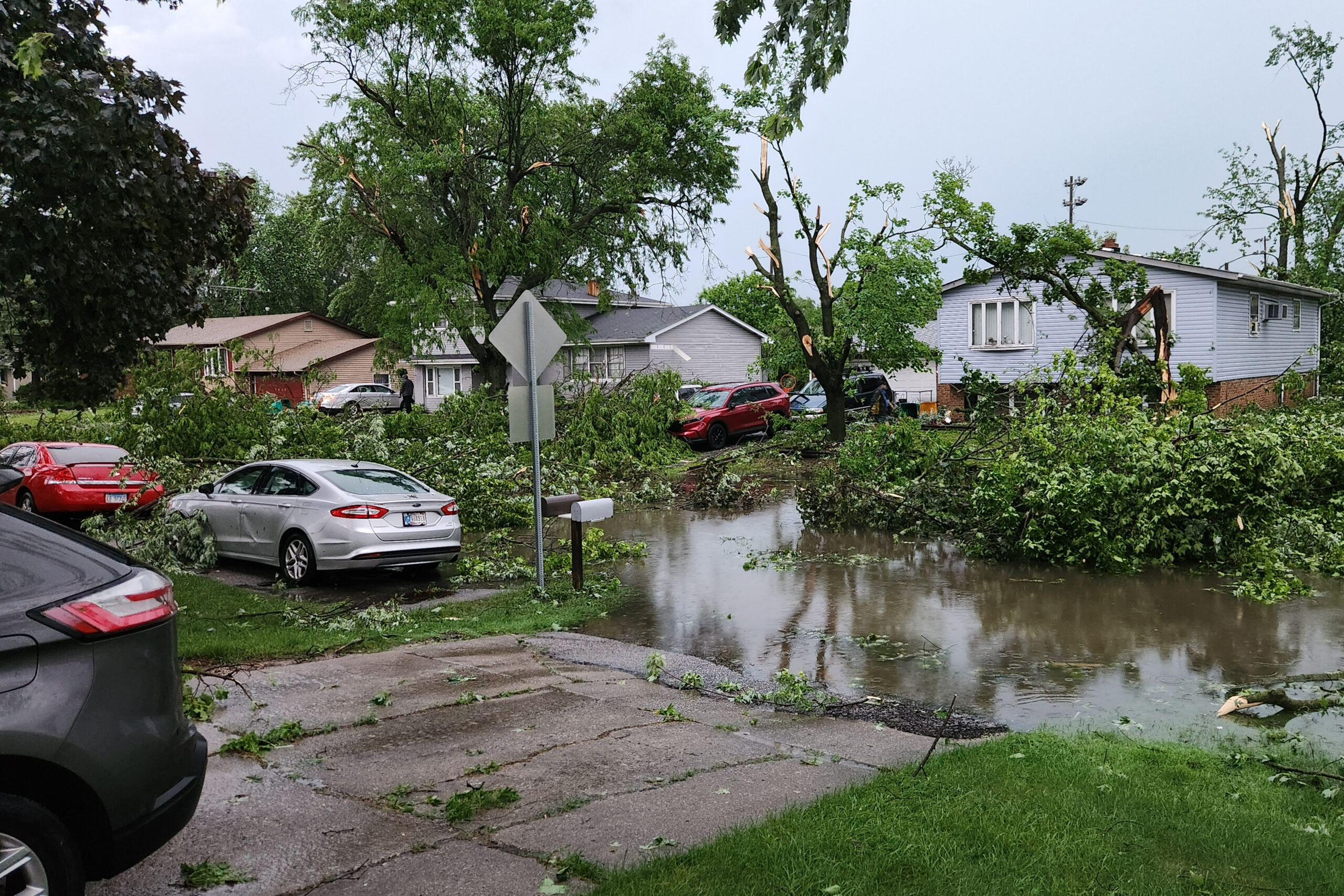
Residents in tornado-ravaged areas in Illinois and Indiana were grappling with the damage to their homes and neighborhoods on June 12, after the strong line of storms barreled through communities South of Chicago and left trails of destruction. Cleanup efforts were underway, and utility companies said power restoration efforts could extend into next week.

The June 11 storms ripped roofs off of buildings, flattened homes, brought down scores of trees and power lines and caused hundreds of thousands of power outages and major air traffic disruptions. Officials said there were no reports of deaths or life-threatening injuries, though there were several people treated for minor injuries.
Tornado damage was reported in several towns including Merrillville and Hebron in Indiana and Streator, Illinois. Authorities were surveying the damage June 12 and preparing to issue emergency declarations needed to get recovery funding.
Officials in Merrillville said more than 200 buildings were damaged, including some that were destroyed. Downed trees and power lines blocked streets, and part of a high school’s roof was ripped off. Cleanup crews were out working June 12.
There were nearly 180,000 power outages in Illinois on June 12 afternoon, down from more than 200,000 earlier in the day. Nearly 115,000 homes and businesses in Indiana were in the dark, down a few thousand from earlier June 12, according to poweroutage.us.
Aftershocks complicate Philippine recovery from quake that killed 45 and displaced thousands
GENERAL SANTOS, Philippines—Dozens of rescuers in hard hats scrambled out of a partially collapsed grocery in a southern Philippine city June 10 as it was rattled by an aftershock from a powerful earthquake that left at least 45 people dead and 17 others missing in the region.
The coastal city, a bustling commercial hub and the country’s tuna capital, was devastated by a 7.8-magnitude earthquake that hit June 8 and left a trail of destruction across southern Mindanao, the Philippines’ second-most populous region.
The earthquake has been followed by more than 2,100 aftershocks including a few that ranged up to 6.4 magnitude, which is strong enough to cause more casualties and damage, according to Teresito Bacolcol, who heads the Philippines Institute of Volcanology and Seismology.
More than 25,000 people remain displaced, many of them staying in 45 government-run emergency shelters and still too traumatized to return home, officials said.
The quake was one of the most powerful to hit the Philippines in a half century. It injured at least 630 people and damaged more than 3,100 houses, 29 roads, 11 bridges and more than 100 government buildings.
It also damaged the international airport in General Santos, forcing it to shut down indefinitely except for government and military flights transporting aid and disaster-response personnel, Civil Aviation Authority of the Philippines spokesperson Eric Apolonio said.
About 6,000 public school buildings in quake-hit provinces must be assessed before classes can resume. The quake struck on the first day of classes nationwide after a two-month summer break, and many who sustained injuries were young students who had gathered with excitement for morning flag-raising ceremonies.
Most of the deaths were caused by falling debris from collapsed buildings and landslides in General Santos and the nearby provinces of Sarangani, South Cotabato and Davao Occidental.
At least one person died after being swept out to sea following the quake, as waves up to 1.4 meters (4.6 feet) above tide level were measured in the southern Philippines. Smaller waves washed ashore in Indonesia and Palau and as far away as southern Japan before tsunami warnings were lifted.
The earthquake was set off by movement in the Cotabato Trench and was one of the strongest to hit the country since the same undersea depression triggered an 8.1-magnitude quake that whipped up tsunami waves on Aug. 17, 1976 and killed about 8,000 people.
The Philippines, one of the world’s most disaster-prone countries, is often hit by earthquakes and volcanic eruptions due to its location on the Pacific “Ring of Fire,” an arc of seismic faults around the ocean.
6.1 magnitude earthquake near Cuba shakes buildings in Havana and Florida
HAVANA—A 6.1 magnitude earthquake struck near western Cuba on June 8 afternoon, shaking buildings in Havana and Florida as far North as Orlando. No injuries or damage was reported.
The quake struck at a depth of 16 miles in waters just West of the capital, according to the U.S. Geological Survey.
Shaking was reported around southwestern Florida, the National Weather Service in Miami said in a tweet. A flood of social media posts indicated people felt shaking even north of Orlando.
Miami-Dade County officials said they were evacuating several buildings as a precaution, including the county’s main government office building, a 28-story high rise in downtown Miami.
Service for two elevated commuter trains that run through downtown was also suspended temporarily.
William Barnhart, a geophysicist with the U.S. Geological Survey, described June 8 earthquake as extremely rare. It’s the largest earthquake ever recorded in the Gulf of Mexico with modern instruments, which date to the 1950s. “It’s one of only five or six earthquakes of magnitude 5 or greater that we’re aware of in the entire Gulf,” he said.
No tsunami was created by this earthquake. Barnhart pointed out that the destructive ocean waves created by earthquakes and other underwater disturbances are more common in the Pacific Ocean, but they can occur in the Atlantic.
Tropical Storm Boris forms off Mexico’s southern Pacific coast and brings flooding threat
MIAMI—Tropical Storm Boris formed June 8 and was expected to bring heavy rain, flooding and possible mudslides to parts of southern Mexico’s Pacific Coast, the U.S. National Hurricane Center said.
Boris was located about 85 miles southeast of Acapulco and 50 miles southwest of Punta Maldonado, according to the Miami-based weather center. The storm had maximum sustained winds of 40 mph and was moving northeast at 2 mph.
Boris was expected to turn to the North, bringing rainfall of 4 to 10 inches to coastal areas of the states of Guerrero and Oaxaca through the night of June 8. The storm was forecast to make landfall along the coast of Guerrero by June 8 evening, the center said.
“This rainfall may produce life-threatening flooding and mudslides, especially in areas of steep terrain,” the center said.
The Atlantic hurricane season began June 1, but no cyclones have formed in that basin yet this year.
Compiled from Associated Press reports
