











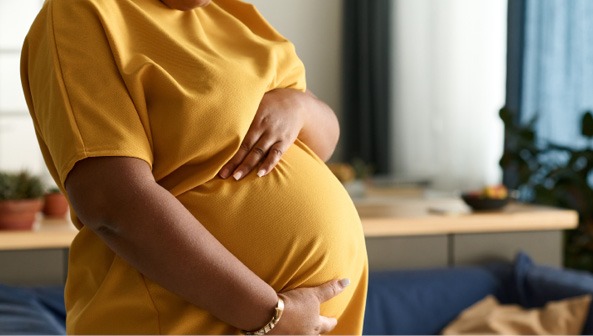

While racism in the medical field is nothing new, and for pregnant Black women, recent cases involving unnecessary and unwarranted C-sections are creating fear and further distrust.
As Black Maternal Health Week (BMHW), a campaign from Black Mamas Matter Alliance, is observed April 11–17, the challenges expectant mothers face must continue to be highlighted. Two cases have brought to light the concern that Black women are being coerced or forced to have C-sections.
“It’s a real judge in there?” That’s the question Cherise Doyley, a Black mother, asked a nurse while having contractions at University of Florida Health in Jacksonville, Fla., on Sept. 9, 2024, before attending a three-hour Zoom court hearing on a tablet, according to a recent investigation by ProPublica, published in March.
She was presented with a sea of White faces, including a judge, hospital attorneys, doctors and hospital staff, who would make the decision on how she would give birth: naturally or by a cesarean section.
The judge ruled that if an emergency arose, the hospital could operate and perform a C-section whether she wanted it or not. She had a C-section against her wishes.
In March 2023, a year and a half earlier, a judge court-ordered Brianna Bennett, another Black mother in labor at Tallahassee Memorial Hospital, to have a C-section. And in Virginia, more than 500 women.
Most of whom are Black, are suing Chesapeake Regional Medical Center and the hospital’s senior executives over claims that “for nearly a decade one doctor performed medically unjustified operations, including unnecessary C-sections and sterilizations without consent,” according to The New York Times.
These cases are just the most recent in the sordid history of medical racism in the United States. In recent years, birth justice advocates have used the term “obstetric racism” to describe the issues Black mothers face in hospital settings.
Continued on page 32
Obstetric racism and the history of modern gynecology
Dána-Ain Davis, an urban studies professor at Queens College, City University of New York, and director of the Center for the Study of Women and Society, coined the term “obstetric racism” in a 2018 journal article on “The Racial Politics of Pregnancy, Labor, and Birthing.”
She wrote that historically, Black women’s bodies have been valued as “medical superbodies,” worthy enough for labor and experimentation, but “the woman herself is not worthy of being treated humanely.”
She named several examples of “reproductive abuse suffered by Black girls and women,” including White slaveowners capitalizing on Black women’s reproduction to sustain the slave economy, the use of enslaved women in the development of gynecology, forced sterilizations and the denigration of Black women’s role as midwives in the formation of obstetric medicine.
Obstetrics was introduced in America in the 1700s, and it began to rise in the 1800s, largely among upper and middle-class White Americans, according to a timeline by the Black Midwifery Collective.
The Chicago-based organization combating obstetric racism, and Shafia Monroe Consulting. By the early to mid-1900s, White male physicians became the primary birth attendants, leading to the decline of midwives, and childbirth became a medicalized, hospital procedure.
The racist history of modern gynecology is well-documented. In the 1800s, James Marion Sims, considered to be the “father of gynecology” in the U.S., experimented on enslaved Black women without anesthesia, leading to the inaccurate concept that “Black people don’t experience pain” that still exists in the medical industry today.
“The doctors developed the OB-GYN surgeries on the bodies of enslaved Black women. They are used to using people and not respecting people, not honoring people’s humanity,” Dr. Leslie Farrington, a retired OB-GYN turned birth justice advocate, said to The Final Call.

Racial disparities in C-section rates
Each year, more than one million women in the United States have a cesarean delivery, amounting to about one out of three babies born by C-section.
A C-section is the surgical delivery of a baby through a cut or incision in the mother’s abdomen and uterus. Though exact numbers and statistics differ, experts say many C-sections are unnecessary.
The World Health Organization has found that C-section rates higher than 10% are not associated with reductions in maternal and newborn mortality rates. With the U.S. rate exceeding 30%, this raises concerns that many procedures may be avoidable.
“A good number of the C-sections are unnecessary. And we know this is true because it varies by hospital. You have some hospitals where the C-section rate is upwards of 45%, and then you have other hospitals where it’s closer to 25%,” Dr. Farrington said.
She listed several reasons for a C-section, including hospitals treating patients who live with the stress of racism and the hardships of life, possibly causing more complications during birth due to the person’s body;
Not enough doctors knowing how to do a vaginal breech delivery or simply, doctors not wanting to deal with prolonged labor. A baby is in breech when the fetus is positioned bottom first or feet first instead of head first.
“There’s a lot of people who are doing C-sections because they don’t want to wait. They don’t want to give that person more time. They don’t support the natural labor process by letting the woman walk around, and some of them, they give you so much medication to induce that they overdo it, and the baby goes into distress,” Dr. Farrington said.
“There’s many different reasons why a C-section might occur, and sometimes, if the doctor just waited longer, they would be able to have a normal delivery.”
Shafia Monroe, a midwife with over 40 years’ experience and a doula trainer for over 25 years, also argued that many doctors today do not know how to perform certain deliveries naturally. She did acknowledge to The Final Call that in some cases, C-sections can save lives, but she doesn’t agree with the court-ordered C-sections in Florida.
Black women are 25% more likely to have a C-section than White women, according to a National Bureau of Economic Research (NBER) report published in 2024 and revised in January of this year.
In the case of Ms. Doyley in Florida, the hospital wanted a C-section done, and the state filed an emergency petition with the desire to force her to undergo one, according to ProPublica.
Ms. Doyley was working as a professional doula and had founded Soul Sista Birth Services long before her 2024 experience. ProPublica reported that doctors were concerned about the risk of uterine rupture due to her having three prior C-sections.
But she said during the hearing that she understood that risk was less than 2%. ProPublica referenced a study finding that 0.15% to 2.3% of vaginal births after a C-section result in uterine rupture.
“Certainly, the more C-sections you had previously, the higher the risk of uterine rupture,” Marie Boone-Clark, founder and executive director of Birthing the Magic Collaborative, said to The Final Call. “That was the case with the young woman in Florida, but it should have been her decision. She’s a doula. She knew her body.”
The judge and the hospital refused to listen to Ms. Doyley’s arguments. She has been vocal about her experience on social media.
“What I obviously needed was to NOT be dragged into court for a NON-emergency C-section while I was actively in labor. When I got to the hospital, my contractions were already 2 to 3 minutes apart.
That means my body was already doing what it was designed to do,” she said in a Facebook post on March 30. She explained that labor runs primarily on the “feel-good” hormone, oxytocin, which is connected to love, bonding, safety, calm, intimacy and trust.
“That hormone is what helps contractions become effective and coordinated (longer, stronger, closer together). That hormone is what helps labor progress. Now …
What do y’all think happens when a laboring woman is threatened, terrified, crying, stressed, being coerced, and forced into a courtroom for THREE HOURS while contracting?” she questioned.
“Stress hormones go up. Cortisol goes up. Adrenaline goes up. And when those go up, oxytocin goes down. And when oxytocin drops? Labor can slow down. Labor can stall. Contractions can become less effective.”
“So no, you cannot terrorize a woman in labor, strip her of autonomy, force her through legal trauma, disrupt the hormonal process that birth depends on … and then turn around and say: ‘See? She needed the C-section,’” she added.
While delivering a presentation to a group of Black mothers in Ohio, Ms. Boone-Clark heard several testimonies on unwanted C-sections. She said some of the reasons for unwanted C-sections included the mothers not having anyone to watch their other children while hospitalized and longer unpaid days from work.
“It was surprising that in this setting of about 50 women, all new mamas within the last few years and then some who were expecting, how many of them felt they had been coerced into having C-sections,” she said.
C-sections and hospital profit
The NBER study acknowledges that doctors and hospitals can be paid more for C-sections than vaginal births in both private and public insurance.
“When you look at reimbursements to physicians for a vaginal delivery versus a C-section, the C-section is reimbursed at a higher rate,” Ms. Boone-Clark said.
Another study analyzing the relationship between hospital cesarean delivery and profit, published in 2021 on JAMA Network, found that women delivering at hospitals with higher profits per C-section were more likely to have a C-section.
“There’s not that much support for a natural process of birth in obstetrics as it is in midwifery. It’s something that started over 100 years ago when the doctors and hospitals started taking over the process of birth and took it away from the midwives.
That’s what started this change from relying on nature’s power in a woman’s body and moving it towards something that’s managed—a hospital medical condition. They basically turned birth into a for-profit business,” Dr. Farrington said.
She explained how hospitals make more money on C-sections done quickly than on having a patient in labor for a long period of time.
“The more babies you deliver more quickly, the more you get paid,” she said. “You’re going to try to get somebody to deliver vaginally faster, and if they don’t deliver in a certain time frame, you’re going to be more likely to do a C-section. It costs the hospital more if the doctors wait longer.”
Business Insider reported in an August 2025 article on the “Big Business of C-Sections” that C-sections are more profitable for hospitals than vaginal births, as insurers pay more, doctors are paid more per procedure and hospitals benefit from shorter procedures.
Not only do Black women disproportionately have C-sections but combined with evidence that doctors and hospitals are often paid more for surgical births, financial incentives may contribute to decision-making that leads to higher C-section rates, including and in particular among Black women.
Continued advocacy
Ms. Boone-Clark feels it’s important for Black mothers to understand both the risks associated with C-sections and the factors that may lead to needing one.
“It’s a surgery, so you’re going to have pain, you’re going to have limited mobility. Certainly, a longer healing period. But then you also have higher risks of infection. You have a higher risk of blood clots. You’ll have a risk of blood loss,” Ms. Boone-Clark said.
“Beneath the surface, the uterus, the abdominal wall, they still need time to repair. You may have numbness or lingering discomfort around the incision. And then on a more immediate basis and the impact between mama and baby, the biggest is her ability to breastfeed, especially in the early days.”
Conditions like preeclampsia can increase the likelihood of having a C-section. Preeclampsia is a life-threatening pregnancy complication that can lead to high blood pressure and organ damage. Black women are 60% more likely to develop preeclampsia than White women, according to the Preeclampsia Foundation.
Because stress can increase the risk of developing preeclampsia, Ms. Boone-Clark emphasized the importance of reducing stress for Black mothers. She also encouraged natural birth or hospital-based birth without interventions.
“If you have not prepared yourself to labor effectively and you’re tensing up, your labor pains are not going to be as productive, and you’re going to likely have to have a C-section,” she said.
What can Black mothers do to advocate for themselves? Ms. Boone-Clark and Dr. Farrington said it starts before the hospital. They suggested childbirth education, securing a doula and vetting the hospital and the doctor.
Dr. Farrington encouraged Black mothers to ask questions until they understand the answers, claim their mental and physical space, trust their body and tell their story.
“Really, we need more birth centers. We need more Black midwives. We need more people who are comfortable delivering at home,” she concluded.
April 21, 2026
