



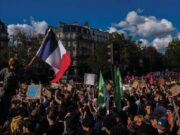
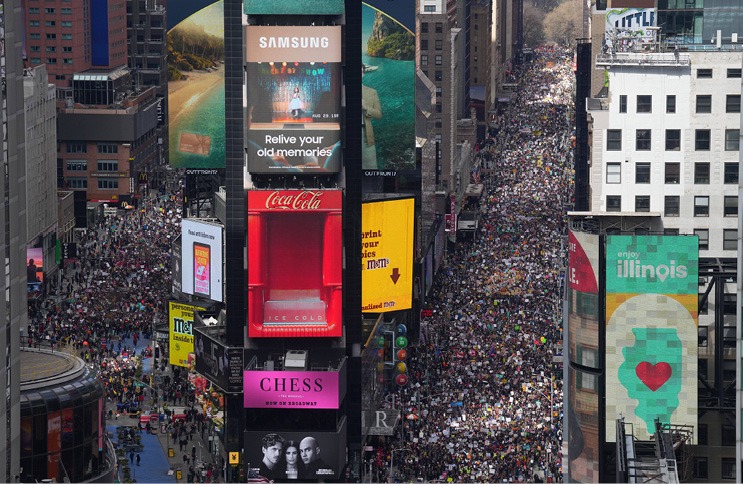

WASHINGTON, D.C.—Millions of Americans recently filled city streets, courthouse squares, and state capitols in what organizers say may be one of the largest coordinated protest mobilizations in recent U.S. history.
The demonstrations, organized under the banner “No Kings,” took place across all 50 states and cities in at least 16 countries, according to organizers, reflecting increased opposition to the Trump administration’s policies on Iran, the economy, and immigration enforcement. It was the third mass protest under that theme since President Trump was reelected.
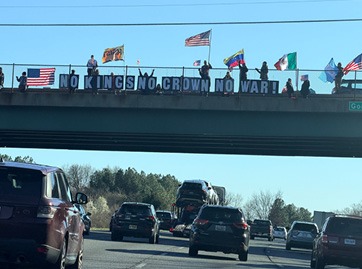
From the steps of the Minnesota State Capitol to small-town rallies in places like York, Pennsylvania, the message echoed through chants and placards: in a democracy, power belongs to the people.
The protests were organized by a coalition of grassroots networks, including Indivisible, the activist group 50501, labor organizations, and a range of local civic groups.
Organizers estimate that between seven and eight million people participated in more than 3,300 demonstrations nationwide. While those figures are difficult to independently verify, they suggest a mobilization on a scale rarely seen in recent American political life.
By comparison, the 2017 Women’s March drew an estimated three to five million participants nationwide and took place to protest Trump administration policies in his first term. The protests following the Minneapolis Police killing of George Floyd in 2020 were larger overall, involving an estimated 15 to 26 million Americans over several weeks.
The scale of the “No Kings” demonstrations reflects a moment of profound political frustration. Rising grocery prices, fuel costs, and fears about international conflict were often cited by participants as reasons for joining the protests.
On the movement’s website, organizers described their concerns bluntly, accusing the current presidential administration of undermining civil liberties, escalating international conflict, and worsening economic insecurity for working families.
A new wave of protesters
In Knoxville, Tennessee, protester Hannah Maples told local reporters she joined the rally because she felt the country was moving in a dangerous direction. “We’re fighting for what we think America should be,” she told local Knoxville station, WATE 6 On Your Side, “because America doesn’t feel very great right now.”
In York, Pennsylvania, another protester, Colbey Miskech, said immigration raids and concerns about government transparency pushed him to take part. “There’s a lot more change that needs to go on around here,” he told the York Daily Record. “Not just this local area but the United States in general.”
Local coverage across several states suggested that many participants were first-time protesters. Some journalists also observed that large numbers of demonstrators appeared to be middle-aged or older Americans—people who may not have previously seen themselves as part of protest movements.
A letter to the editor published in the South Florida Sun Sentinel described the crowd at a local rally as largely composed of people in their 50s and 60s and lamented the limited presence of younger participants.
If those observations hold true more broadly, they may signal an important shift. Unlike the youth-led, multiracial protests associated with the Black Lives Matter movement in 2020, many “No Kings” demonstrations appeared to draw significant participation from suburban and small-town communities. Rallies took place in locations as varied as Driggs, Idaho, and Kotzebue, Alaska, reflecting economic anxieties that cut across geographic and political divides.

Whose dissatisfaction?
Because comprehensive demographic data has not yet been compiled, the social composition of the protests remains difficult to measure. Observations about the crowds largely rely on local reporting and anecdotal accounts. Nevertheless, the demonstrations raise important questions about how different communities experience political unrest in the United States.
“I’m totally dissatisfied,” Elizabeth Harrison told The Final Call. She is a retired White, school administrator and was protesting in Philadelphia with her friends. “This is our first protest, but it won’t be our last. We are fed up with the man we voted for. He duped so many of us into thinking he was going to be better than President [Joe] Biden. I can’t believe I fell for his nonsense.”
“Everything costs more, Americans are getting killed by ICE, and now we are at war. This is not what he promised the voters. He’s a liar and a cheat. He’s not making America great again. He’s ruining America,” she added.
Political scientists and journalists covering the protests note that many visible participants appear to come from demographics that historically have not been the primary drivers of mass protest movements—particularly older suburban voters and politically independent Americans who may previously have remained outside activist politics.
However, that framing risks hiding who has long borne the brunt of these grievances. For many Black Americans, issues like economic inequality, voting rights, policing, and structural injustice have been at the heart of political activism for generations. Historians on civil rights point out that movements for racial justice often serve as early warning signals of broader democratic crises.
From that perspective, the frustrations now voiced in many town squares mirror concerns long voiced in Black communities, where fights for full democratic participation have shaped political life since the country’s founding. The question, then, is not just who is protesting today, but how these protests connect with the longer history of American dissent.
Media and the ‘protest paradigm’
The scale of the “No Kings” demonstrations has also revived an enduring debate over how the media covers mass protests. Communication scholars have long argued that mainstream news coverage often follows what sociologist Todd Gitlin called the “protest paradigm”—a pattern in which demonstrations are mainly depicted in terms of conflict, disruption.
Or political strategy rather than the real grievances that motivate participants. Researchers have documented similar patterns in media coverage of the Civil Rights Movement, anti-war protests during the Vietnam era, and more recent demonstrations around racial justice.
Some media critics say elements of that pattern may be visible again today. While many news organizations reported extensively on the “No Kings” rallies, debate has emerged over whether coverage fully reflected the scale and significance of the mobilization.
Timothy Karr of the media advocacy organization Free Press noted that the much smaller Tea Party protests of 2009 and 2010 received extensive national coverage despite drawing far fewer participants. Whether these comparisons are accurate is still debated, but they highlight the ongoing tension between large protest movements and the institutions that explain them to the public.
A moment of uncertainty
For organizers, the demonstrations are intended as a starting point rather than an endpoint.
Coalition leaders say the movement will shift toward voter registration efforts, community organizing, and electoral engagement ahead of the upcoming midterm elections. Their goal is to turn protest energy into lasting political participation.
Large protest movements have sometimes reshaped American politics—from the Civil Rights Movement of the 1950s and 1960s to the anti-war protests that many historians credit with accelerating the end of U.S. involvement in Vietnam. Other mass mobilizations have faded once the immediate crisis subsided.
The “No Kings” protests could be a turning point or just a temporary burst of frustration in a highly divided political climate. For now, they show a country confronting deep worries about economic security and the future of America.
