











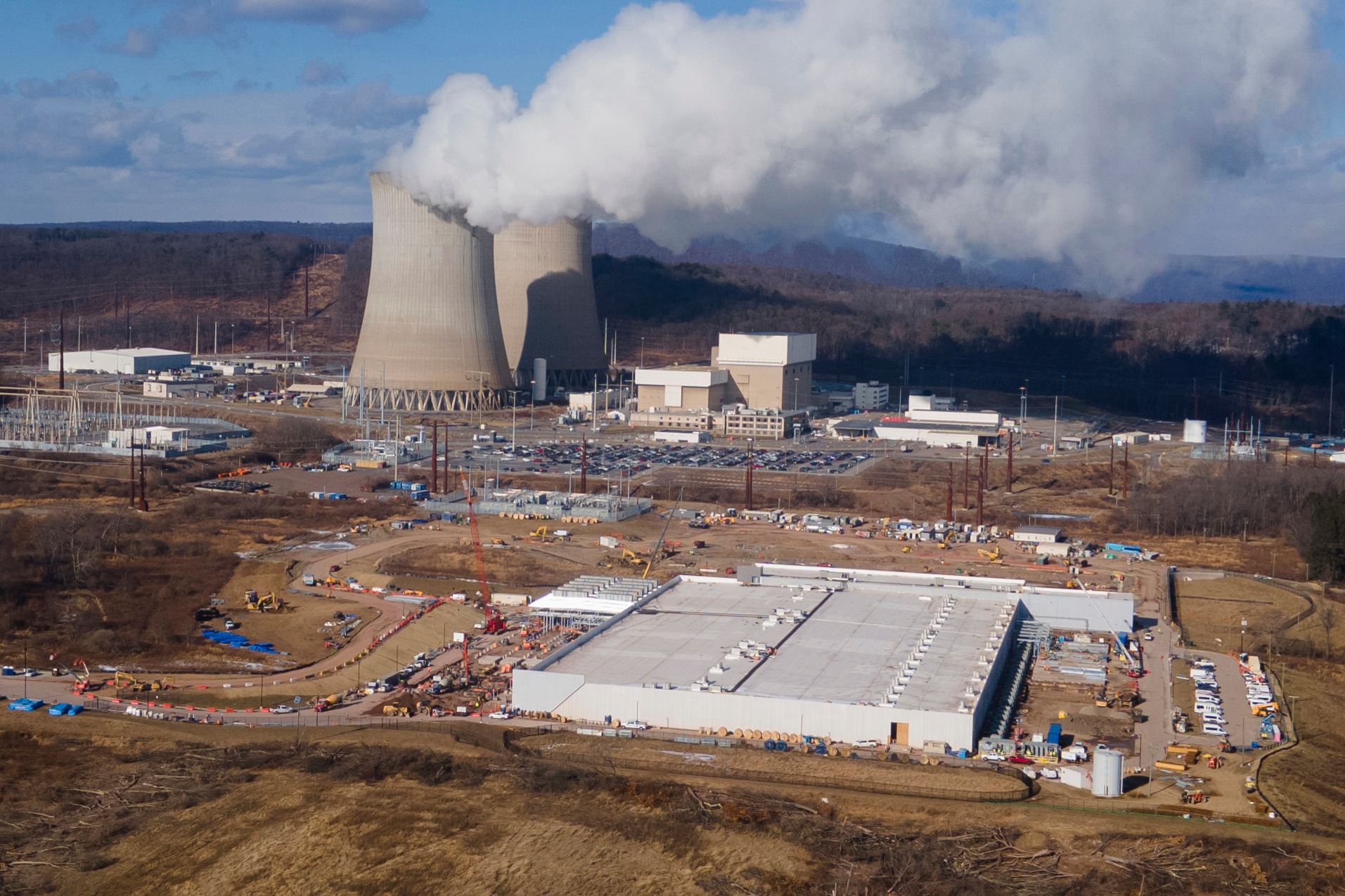

With rising environmental justice and health concerns, residents in various communities across the United States are challenging their local governing bodies on planned proposals and construction of data centers.
From known household names like Amazon, Meta, Microsoft, Google and, increasingly, OpenAI, to the lesser-known big tech companies like Equinix, Digital Reality and NTT Global Data Centers, data centers are popping up in both urban and rural areas, many times against residents’ wishes.
“We’re in the age of big data. We’re in the information age. So, anybody who’s in that space, the leading figures, you have Amazon, you have Meta, you have Microsoft. These are the companies that are part of our daily infrastructure.
They’re in the data center space,” Dr. Sacoby Wilson, founder and director of the Center for Engagement, Environmental Justice and Health INpowering Communities (CEEJH INC), said to The Final Call.
For him, the small data centers are not the problem; the hyperscale ones are. Due to their massive size and computing power, hyperscale data centers are more equipped to handle artificial intelligence (AI).
Hyperscale data centers contain at least 5,000 computer servers, occupy at least 10,000 square feet and require more than 100 megawatts of power, due to operation and cooling needs, according to a congressional report on data centers and their energy consumption, published in January.
That amount of power can support the electricity needs of 80,000 households, the report said. That same data center requiring more than 100 megawatts of power needs roughly the same amount of water as 2,600 households.
Dr. Wilson voiced concerns that data centers can impact electricity bills, particularly for individuals in low-income households who may already need assistance paying their bills. Byproducts from data centers also pollute the air and water, causing negative health outcomes.
In addition, as data centers grow, researchers are conducting more studies. A new study published on March 21, that has yet to be peer-reviewed, found that data centers are increasing temperatures across the globe, creating heat islands that can impact hundreds of millions of people in a single area.
Dr. Wilson mentioned how many Black and low-income communities in the U.S. are already burdened with “legacy hazards” such as gas, fire and coal power plants, petrochemical operations, landfills and major highways. Now, data centers are an emerging threat to those same communities.
In late March and early April, Tasmin Lockwood, a freelance journalist covering technology and climate, ranked the countries with the most data centers, the states that have the most data centers under construction as of March and states that will become data center hubs.
With more than 4,000 data centers, the U.S. hosts 43% of the world’s data centers and has more than eight times as many as the second highest country, Germany, which has 507, according to Ms. Lockwood’s work, published on visualcapitalist.com.
Texas and Virginia currently have more than 100 data center projects under construction. In Georgia, more than 300 data centers have been announced. There are only 12 states that do not have any data center projects under construction.
In the Great Lakes region alone, which contains 90% of the country’s fresh water supply, 368 data centers are currently operating, and 738 have either been announced or are under construction, according to Crain’s Cleveland Business, a local newspaper in Cleveland, Ohio.
Data presented by Ms. Lockwood says that about 11 states have introduced data center moratorium bills. One West Virginia educator, Paula Kaufman, published commentary suggesting that the state needs a data center moratorium to safeguard the future.
In Denver, local officials are proposing a temporary, possibly yearlong moratorium on new data centers, to put guardrails in place around energy use, water consumption and land use and zoning.
Lawmakers in New Jersey are advancing legislation that would protect ratepayers and are also pushing for clean energy requirements. To help inform local decision makers, the think tank, New Jersey Policy Perspective, published a report in March on the hidden costs of AI data centers.
Residents in Sedgwick County, Kansas, have been voicing their concerns at town hall meetings, as the county prepares for its data center moratorium to expire in June.
Residents in other communities have been less successful in having their concerns heard. In Louisiana, Meta is expanding its 2,000-plus-acre “Hyperion” data center campus, adding 1,400 additional acres.
Thousands in Charlotte, North Carolina, are saying no to a rezoning request to build a data center. In Sand Springs, Oklahoma, residents against a Google data center collected more than 1,600 signatures to recall the city councilors.
As a response to a 464-page report published in November by the Prince George’s County Data Center Task Force in Maryland, Dr. Wilson’s organization, CEEJH INC, partnered with the NAACP to create a “People’s Report.”
Dr. Wilson is a professor at the University of Maryland, College Park, and lives in Prince George’s County. “There was a moratorium put on data centers in the county, and out of that, there was a task force to develop a report about the viability of data centers in the county.
But I was part of a team that engaged an anti-data center coalition to develop a counter report to the county’s task force report, because the county’s task force report did not have any inclusion or didn’t talk about environmental justice, didn’t talk about civil rights, didn’t talk about air quality, didn’t really talk about water quality impacts or energy justice impacts,” Dr. Wilson said.
He pointed out that in cities across the country, local elected officials are arguing that data centers will aid in economic development, but he considered that a “false argument” for several reasons:
Hyperscale data centers can prevent other industries from coming into a community; data centers will provide short-term construction jobs but not long-term livable wage jobs for residents and the fact that AI is actually destroying jobs, not providing them.
Despite its size, Meta’s data center campus in Louisiana is said to be providing a mere 500 permanent jobs. Business Insider published an article last year on big tech’s failed promises to create jobs. It found that cities and states are giving massive tax breaks to attract data centers with very little job payoff, as most data centers employ fewer than 150 permanent workers.
“Why are you giving tax breaks to someone who’s potentially going to poison you? Why are you giving tax breaks to folks who potentially are destroying jobs? Why are you giving tax breaks to folks who are going to be using up your grid?
Why are you giving tax breaks for folks who are going to be contaminating your water? Why are you giving tax breaks to folks who are going to be contaminating your air?” Dr. Wilson questioned.
He advised residents in local communities to hold their elected officials and their planning and zoning commissions accountable. He recommends local communities enact a data center ordinance that would have restrictions on where data centers can go, how big they can be and what they can emit.
“If you’re going to incentivize with tax breaks and other types of benefits, incentivize the ones that are less pollution intensive, that have their own grid. They should get more,” Dr. Wilson said. “If you’re going to be forced to give folks tax breaks, okay, cool, but you give more breaks and benefits to the better stewards, the better actors, the better players.”
He acknowledged that while yes, technology will continue to evolve, its evolution must operate within a human rights framework. “Innovation is not bad by itself, but innovation that leads to inequities, innovation that leads to injustice, innovation that leads to health disparities.
Innovation that leads to harm to the environment and to people and the planet is a problem, particularly those who’ve been already left behind, who’ve been already dumped on, who already live in sacrifice zones,” he said. “We need to make sure we uplift those communities.”
“You want to minimize the harms and maximize the benefits,” he added. “We have to take that type of ethos and ethics when we’re doing development, whether it be industrial development or this new school innovation and data.”
