

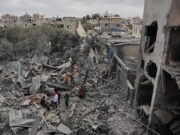
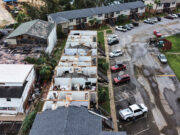






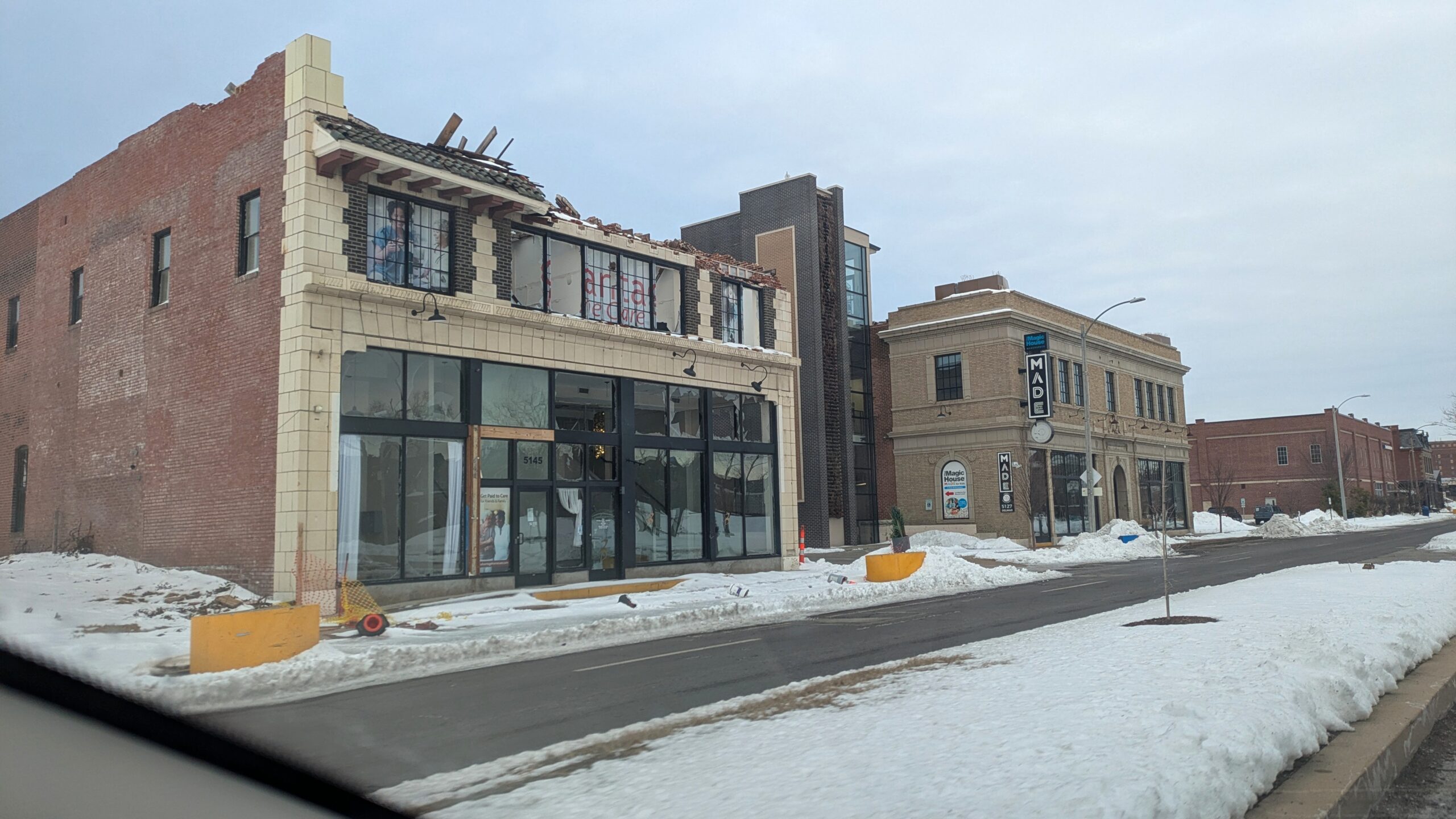

ST. LOUIS—Eight months after an EF-3 tornado tore through St. Louis with 165-mph winds, predominantly Black neighborhoods in North City remain trapped in bureaucratic barriers, insurance denials, and predatory developers.
While the storm made no distinction between rich and poor on May 16, 2025, the recovery effort tells a different story, one that echoes historical patterns of racial inequality.
The slow recovery in North St. Louis has become a case study in how natural disasters amplify existing inequalities. Predominantly White South neighborhoods received immediate infrastructure repairs and streamlined insurance payouts.

Main Street Photo: delmarmainstreetstl.com
While North City residents face overlapping jurisdictions, underfunded aid programs and institutional barriers that reflect decades of disinvestment in Black communities.
As extreme weather becomes more frequent, the question looms: Will America’s most vulnerable communities be left to rebuild alone, or be displaced entirely?
Yet amid the rubble, a spirit of resistance endures. “We are a people that has the fortitude and resilience to rebuild our communities,” declares Felice McClendon, executive director of Delmar Main Street, a local economic development group.
Unity in crisis, division in recovery
Mr. Shegog, a community servant working in North City’s recovery, sees the tornado’s aftermath as both a tragedy and an opportunity. “The progress and empowerment of our people lies heavily on unity,” he told The Final Call.
“Our survival relies on our ability to set aside differences. If we focus on the fact that we are humans suffering and want to help one another, that rallying call gets us from destination A to B.”
Mr. Shegog draws parallels to Black economic self-sufficiency movements of the early 20th century that were systematically destroyed. “When you look at Tulsa, East St. Louis, Atlanta, and Durham, these are examples of when we tried to be self-sufficient, it was intentionally wiped out,” he said, referencing the 1921 Tulsa Race Massacre and 1917 East St. Louis riots.
“That same spirit that helped create Black millionaires in the early 1920s ushered in over St. Louis on May 16, 2025. Now it’s up to us to rebuild together.”
But unity alone cannot overcome systemic obstacles. “There is a program headed by Julian Nicks to help residents with or without insurance, but they must apply,” Mr. Shegog said. “The Personal Property Assistance program has a February 14, 2026, deadline.
Only 1,700 property owners have applied, but approximately 4,900 eligible households have not. FEMA dollars may not be fully spent while residents still need support,” he added.
The Delmar divide
In St. Louis, Delmar Boulevard serves as a stark dividing line. This 9.1-mile corridor separates two Americas. According to several reports and studies, in South of Delmar, the median income is $50,000, 73% of residents are White, and home values exceed $300,000.
North of Delmar, where over 95% of residents are Black, median income is $18,000, and home values average $75,000. This disparity, rooted in decades of redlining dating back to the 1930s Federal Housing Administration’s “residential security maps,” was magnified after the May 16 tornado.
“It feels like yesterday, because it looks like yesterday, depending on what side of the street you are on,” Ms. McClendon said. “On the north side, just one block over from Delmar on Enright Avenue, you can still find people living in homes without windows. I’ve seen people in homes without roofs and in tents on their property, trying not to lose what they had.”
Many homes were passed down through generations and paid off, leaving families without mortgage-required insurance. “So, where is your insurance? It’s embedded in your mortgage, and if you don’t have a mortgage, you may be uninsured,” Ms. McClendon explained.
She traces North City’s vulnerability back further. “It goes way back to slavery, where people were divided from each other. What we see stems from Jim Crow laws and redlining. Even our life expectancy is determined by zip code. This is systemic.”
Predatory practices and political paralysis
Alderwoman Shameem Clark Hubbard of the 10th Ward has witnessed how bureaucracy becomes a weapon. “If the right people are not over the money, it’s a nightmare,” she told The Final Call. “They bog it down with bureaucracy and politics. What we are looking at is going to take decades to recover what has been already several decades of despair.”
Ald. Hubbard describes a familiar St. Louis tactic: “‘If all else fails, we’re going to turn it into race.’ The quickest way to obstruct progress is to make it North and South, Black and White. One side keeps going, and the other side gets stuck.”
She witnessed predatory developers swooping in immediately. “I was begging people not to sell. I met a man who cashed out within two weeks. Somebody offered him $30,000 for two houses, and he took it. I still talk to people to keep their land. God ain’t making no more land.”
The long road ahead
Yolonda “Yogi” Yancie, 10th Ward Committeewoman and storm victim, lives the reality daily. “Many news cameras have stopped coming where our stories still must be told,” she said. “Seniors and displaced families need immediate repair of roofs, windows, doors, and fences.
We desperately need recovery funds.” There was one bright spot: “Washington Montessori school reopened after the new year. The joy of seeing foot traffic and hearing school buses has brought normalcy back,” she said.
And for 89-year-old Shirley Everett, a resident of North St. Louis’ Penrose neighborhood who owns seven houses—bought one for each of her grandchildren—the work continues. She has lived in her home since 1964.

Photo: www.stlouis-mo.gov
She said the tornado damaged two of her homes and blew the roof off of hers. The rain severely damaged the inside. Fortunately, unlike many, Ms. Everett had insurance on all of her properties and two of them are being remodeled. Her home had to be completely gutted.
Mayor Cara Spencer acknowledged the challenge in December 2025. “Total damages exceeded $2 billion,” she said. “The city allocated $24 million for recovery. We’re working with the community to develop what that rebuild looks like. But the rebuild is going to be a yearlong process.”
The mayor noted federal response fell short. “It was clear FEMA was not going to run the response as it did in Joplin, Missouri. The federal apparatus is not the same. Those were responsibilities we had to take on.”
Despite $52 million in FEMA assistance, $30 million from the NFL Rams settlement, $100 million from Missouri, and $180 million for demolition, the math doesn’t add up. “We have about $450 million allocated for $2 billion in damages,” Mayor Spencer said. “That’s not enough.”
As North St. Louis enters its ninth month of recovery, the struggle continues. The tornado may have passed, but the storm of systemic inequality rages on, and the people of North City are determined to weather it, rebuild and reclaim what has always been theirs.
