





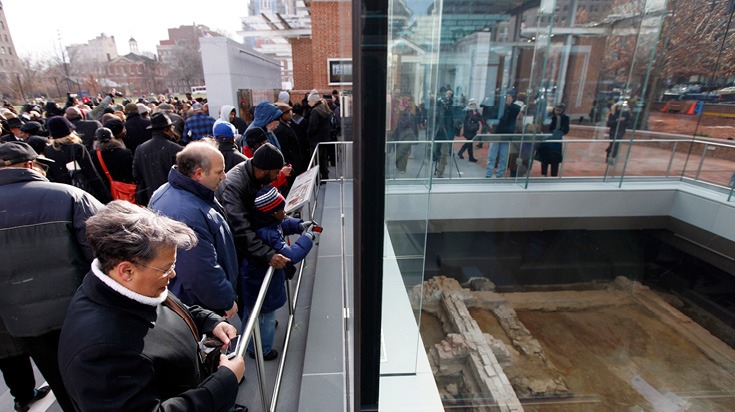

PHILADELPHIA—Philadelphia woke up to a startling void on Independence Mall. Not a shattered window. Not a stolen artifact. A stolen truth. Overnight, the President’s House slavery exhibit—one of the nation’s few public installations naming the enslaved Black Africans held by George Washington—was removed under a federal directive. No public notice. No hearings. No community input.
The National Park Service (NPS) workers dismantled the exhibit on Thursday, January 22, which honored nine enslaved individuals owned by Washington and explored the role of slavery in early U.S. history.
Panels titled “Life Under Slavery” and “The Dirty Business of Slavery” were taken down, leaving an empty space where history once stood. The removal has sparked outrage, lawsuits, and a reckoning with the nation’s ongoing struggle to confront its past.
The Interior Department, which oversees the NPS, justified the removal, stating to Reuters: “The President has directed federal agencies to review interpretive materials to ensure accuracy, honesty, and alignment with shared national values.”
Critics, however, see this as part of a broader agenda tied to Project 2025, a Heritage Foundation blueprint to reshape the nation’s institutions along right-wing lines.
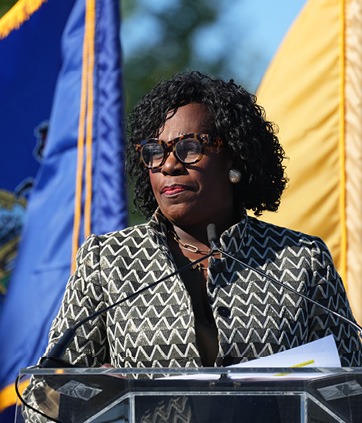
Philadelphia City Council Majority Leader Katherine Gilmore Richardson in a statement called the move “a troubling pattern of racist and bigoted actions that sow division, perpetuate hatred, and betray the very values our nation claims to uphold.”
The timing of the removal is particularly striking. As Philadelphia prepares to host America’s 250th Anniversary celebrations, the city is thrust into the global spotlight. The exhibit’s absence, many argue, undermines the integrity of the nation’s historical narrative at a moment when the world is watching.
Philadelphia Mayor Cherelle L. Parker’s administration has filed a federal lawsuit against the Interior Department and the NPS, seeking a preliminary injunction to restore the displays.
The city’s complaint argues that the removal was “arbitrary and capricious” and violated prior agreements requiring consultation with local stakeholders.
City Council President Kenyatta Johnson condemned the removal in a statement as “an effort to whitewash American history.”
He emphasized the exhibit’s importance in educating the public about the resilience of the enslaved and the complexities of the nation’s founding. “History cannot be erased simply because it is uncomfortable,” Mr. Johnson stated.
Attorney Michael Coard, a key figure in the exhibit’s creation, in a statement, called the removal “historical blasphemy” and urged both legal and grassroots action. “In the words of ancestor Frederick Douglass, ‘Agitate! Agitate! Agitate!’ And along with those profound words, I add these: ‘Litigate! Litigate! Litigate!’” he said

Photo: katherineforphilly.com
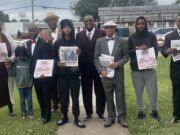
The removal has ignited a firestorm of criticism from community leaders, activists, and residents, including Supreme Dow, a prominent voice in Philadelphia’s Black community.
He criticized what he deemed as a tepid response by some local politicians to what is happening. “Being scared has never gotten us anywhere. It’s the ones who showed courage and bravery and stood in the face of bullies that made progress in this country.”
Stanley Crawford, another community leader, called for economic resistance. “If we, as an ethnic group, say to the powers that be, ‘You don’t want to acknowledge our existence? We will not spend $1 to help you during your celebrations,’ they will feel the effect of our power,” he said.
“Since Philadelphia is going be the focal point of this 250-year celebration … we should start organizing demonstrations for that whole period so we can show the world the hypocrisy … instead of celebrating with it that’s demonstrated against it,” Mr. Crawford added.
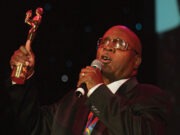
Nation of Islam Student Minister Rodney Muhammad, of Mosque No. 12 in Philadelphia, framed the removal as an “act of war” against Black history. “When Black America sees it properly, it’s a fight for the truth of our own existence.
Future generations will take the distorted picture of historical revisionist acts because then [the oppressors] are always able to define us and give us our sense of worth and value,” said Student Min. Rodney Muhammad.
The President’s House slavery exhibit was more than a collection of panels and plaques; it was a space for truth-telling, a place where the stories of the enslaved could be heard in the shadow of Independence Hall.
For 15 years, it stood as a testament to the resilience of those who endured unimaginable suffering and as a reminder of the nation’s unfinished work in confronting its past.
The removal of the exhibit is not just a local issue; it is a national one. It raises urgent questions about who gets to tell America’s story and whose voices are silenced in the process. As the nation approaches its 250th Anniversary, the fight to restore the exhibit is about more than preserving history—it’s about defending the truth.
For now, the space at Sixth and Market Streets remains empty, a stark symbol of what has been lost. But the voices of those who refuse to let history be erased are growing louder. The battle for the President’s House slavery exhibit is far from over.
